Where are you, little miss "I've disappeared for a month and a half leaving my fans with a feeling of huge empiness"?
(that'll learn her!)
Wednesday, May 17, 2006

Friday, May 12, 2006
Roger Waters in Athens... Should I go or not?

Decsisions decisions...
If I go, I miss two otherwise also mutually exclusive events. My choices are as follows:
1. Go to Roger Waters concert (practically all Sunday)
2. Go to Selinitsa with the caving seminars (totally all weekend)
3. Pick up K from the airport after not havng seen her for a full five weeks
There is no way to do a combo. Selinitsa is five hours drive from Athens.
K has urged me to go and not miss on the event. The tickets are priced at either ~50 or ~100 Euro.
Roger Waters, man. Doing all of DSotM live. I don't think I should miss that. Selinitsa will be there next year and the year after. Have a look at some Photos of Selinitsa by Satoshi Goto and Elias Kazais in Elias' album at the Selas photos site.
It is one of the more beautiful horizontal caves in Greece, frequently visited by beginner cavers and well worn cavers alike. The latter visit not least because of the cave diving opportunities and the recent link between two systems made by our friends at the SPELEO club.
Basically, I'm going to Waters and I am probably going to delay my flight to Sofia a few hours on Monday to allow me to sleep and stuff.
Friday, April 28, 2006
Prespa est magna divisa in partes tres
As part of easter holiday excursions, we visited the Greek side of Prespa. In easter period 2004 we had visited the northern side as well as Ochrid with K. Just the Albanian side left now for easter 2008!
Had a run in with another blood-sucking arthropod while up north. This time of the suck and go type, rather than the suck and stick around with your head in the host's body type. On the back of my neck. Been dousing the swelling with extracts of natural stuff as packaged and sold by Korres.
Going to the country again tonight. I am so behind on my trip reports that it really is not funny any more. The peppers have become edible, they have ripened and reddened and swelled, and I have done a whole bunch of travelling, but said nothing about it at all outsdie. This whole blogging stuff is a lot tougher than the writing I used to do in my diary as an angst-ridden hormone-driven adolescant public-schoolboy.
Oh well.
Still writing up the final chapter to Ravenna and keep getting stumped by the Goths. Don't want to write stuff which ain't right (as if anyone would notice, anyway) but finding it hard to remember things off the top of my head and finding it harder to be arsed to go look things up. I feel, though, that it must be written. I am so looking forward to knowing that somewhere, out there in cyberspace, some sola-scriptura "christian" of one of the American denominations will come across the description of the arian heresy I have prepared for my piece on the baptisteries in ravenna and will sit and think, and maybe, just maybe, a lightbulb will go off above their head which will lead to better things.
When Ravenna part II is published, the piece will be dedicated to that lightbulb chap or lassie.
Had a run in with another blood-sucking arthropod while up north. This time of the suck and go type, rather than the suck and stick around with your head in the host's body type. On the back of my neck. Been dousing the swelling with extracts of natural stuff as packaged and sold by Korres.
Going to the country again tonight. I am so behind on my trip reports that it really is not funny any more. The peppers have become edible, they have ripened and reddened and swelled, and I have done a whole bunch of travelling, but said nothing about it at all outsdie. This whole blogging stuff is a lot tougher than the writing I used to do in my diary as an angst-ridden hormone-driven adolescant public-schoolboy.
Oh well.
Still writing up the final chapter to Ravenna and keep getting stumped by the Goths. Don't want to write stuff which ain't right (as if anyone would notice, anyway) but finding it hard to remember things off the top of my head and finding it harder to be arsed to go look things up. I feel, though, that it must be written. I am so looking forward to knowing that somewhere, out there in cyberspace, some sola-scriptura "christian" of one of the American denominations will come across the description of the arian heresy I have prepared for my piece on the baptisteries in ravenna and will sit and think, and maybe, just maybe, a lightbulb will go off above their head which will lead to better things.
When Ravenna part II is published, the piece will be dedicated to that lightbulb chap or lassie.
Wednesday, April 19, 2006
V for vendetta
Yeah, so we went to watch it and it was a very well made film and thought provoking in all the right places.
The big and nagging question remains - in a similar situation, how would I react?
I figure I would probably sit there in my conservative (literal, not political) mindset, acting and arguing in favour of the status quo so as to cause as few ripples as possible while at the same time giving in to my aquarian revolutionary urges and keeping illicit stashes of contraband, much like both of the characters who help Evey during the film, because dammit, it is the right thing to do.
The right thing to do, of course, is like acorns: horses love them, but they are not palatable to most people.
I am so glad they never show us his face. That would have been a big mistake.
The big and nagging question remains - in a similar situation, how would I react?
I figure I would probably sit there in my conservative (literal, not political) mindset, acting and arguing in favour of the status quo so as to cause as few ripples as possible while at the same time giving in to my aquarian revolutionary urges and keeping illicit stashes of contraband, much like both of the characters who help Evey during the film, because dammit, it is the right thing to do.
The right thing to do, of course, is like acorns: horses love them, but they are not palatable to most people.
I am so glad they never show us his face. That would have been a big mistake.
Monday, April 17, 2006
Ixodes Ricinus, come on in, your time is up
The worst thing about pulling a blood sucking parasitic arthropod off your dick is not really being able to brag about it that much. I mean - come on, who wants to brag about having an eight-legged little fucker hanging by its proboscis off his cock?
Ah - the wonders of the internet and the anonymity it brings. So while I may not have the sang froid to sit and write to friends about this most enriching of experiences, the existence of a blog allows one to talk of such things with impunity.
Things I have learnt today, include:
The whole experience this morning, well, part of it, brought back one of my most vivid memories of my brief but colourful military service. While I was serving in a guard house in the middle of nowhere, somewhere where I am not allowed to talk about, one of things I would do to pass the time when not reading translations of ancient poetry, would be to sit and record the markings on the turtles which lived within the confines of the barracks. They say that no two turtles have the same markings, and having a teenage head stuffed to the brim with Victorian idiocy I set about to record what we had onsite, in an effort to see whether any pattern would emerge potentially proving them wrong.
None did.
I still have the drawings, done in biro on the back of spent Gitanes packets. I remember being very pleased with them at the time, although I have no idea what I would think of them now. I think I know where they are, though.
Anyway - to the point - as payback for the poor turtles who would sit for maybe an hour at a time and model for me, I would flip them over and take out the ticks stuck to their legs and neck, poor hapless bastards. I am not sure I did not imagine it, but more than once, I think I heard the turtles sigh appreciatively as I would pull a tick from their exposed skin. These of course were ugly huge red ticks - not at all like the small black one I had found this morning - but the gasp of satisfaction I remember hearing coming from the turtles stayed with me. I too almost gasped in the same manner this morning, such was my own feeling of relief at being free from the tick. There had been no real pain or discomfort attached to my experience. The whole thing was more psychological than physical, but still, at that moment I had connected once more with my reptilian friend from fourteen years ago.
Ah - the wonders of the internet and the anonymity it brings. So while I may not have the sang froid to sit and write to friends about this most enriching of experiences, the existence of a blog allows one to talk of such things with impunity.
Things I have learnt today, include:
- Girls will tend to get upset at the idea that there is a parasite stuck to your todger - avoid telling them if at all possible, especially when they are half asleep at half past seven in the morning.
- The little fuckers will come off if you pull them by hand - all this bollocks in the literature about using tweezers is crap, you cannot get a decent grip on the fuckers with tweezers.
- Ticks are arachnids, making them descendents of some of the very first land dwelling animals. Ever.
- Most ticks are sexually dimorphic - the male and female look different.
- Lyme disease is not very prevalent in Greece, although the main carrier, Ixodes Ricinus is.
- Top tip - don't go camping in a place where large mammals (cows) have been roaming around.
- It's like totally mind-blowing to feel that you have become part of one of these parasite life cycle diagrams showing many hosts and carriers and knowing that you were the human host in all this, man.
The whole experience this morning, well, part of it, brought back one of my most vivid memories of my brief but colourful military service. While I was serving in a guard house in the middle of nowhere, somewhere where I am not allowed to talk about, one of things I would do to pass the time when not reading translations of ancient poetry, would be to sit and record the markings on the turtles which lived within the confines of the barracks. They say that no two turtles have the same markings, and having a teenage head stuffed to the brim with Victorian idiocy I set about to record what we had onsite, in an effort to see whether any pattern would emerge potentially proving them wrong.
None did.
I still have the drawings, done in biro on the back of spent Gitanes packets. I remember being very pleased with them at the time, although I have no idea what I would think of them now. I think I know where they are, though.
Anyway - to the point - as payback for the poor turtles who would sit for maybe an hour at a time and model for me, I would flip them over and take out the ticks stuck to their legs and neck, poor hapless bastards. I am not sure I did not imagine it, but more than once, I think I heard the turtles sigh appreciatively as I would pull a tick from their exposed skin. These of course were ugly huge red ticks - not at all like the small black one I had found this morning - but the gasp of satisfaction I remember hearing coming from the turtles stayed with me. I too almost gasped in the same manner this morning, such was my own feeling of relief at being free from the tick. There had been no real pain or discomfort attached to my experience. The whole thing was more psychological than physical, but still, at that moment I had connected once more with my reptilian friend from fourteen years ago.
Thursday, April 06, 2006
Kastelorizo Total Solar Eclipse - Part I
Well, let me tell you about the eclipse...
We got to Kastelorizo on Monday morning, having traveled on the "Dodekanesos Pride" from Rhodes in all of two and a bit hours. I had slept for nearly the whole journey as we had woken up that morning in the school building of Afentou (very kindly donated by the municipality) before dawn. Bleary-eyed and unsure of our footing we descended to the bus stop for Rhodes, treated to a stunning display in the eastern sky of the heavily waning moon together with a very bright Venus. See you again in about 60 hours I thought to myself as the bus pulled up and we argued with the driver over where to put the ridiculous amount of crap we were carrying.
Crap. Defined in this context as: Tents, sleeping bags, clothes and food for seven overnights in a free camping environment, cameras, tripods, personal SRT kit, caving ropes and anchors, in short: crap. Oh, and a bicycle.
On board the "Pride" there was only so much time for people watching before sleep overtook each of us in turn. There was just enough time to notice that there were an extraordinary number of geeks on board with film (rather than digital) cameras around their necks which made me want to paraphrase Obi-Wan: "Dodekanesos Pride: You will never find a more wretched hive of nerds and geekery. We must be cautious." They were amateur astronomers fer chrissake! Real life accountants and engineers, probably.
And after sleeping, we arrived.
And there was Kastelorizo, Megiste, laid out around the harbour in the sun. We met up with the Mayor, he gave us the help we had asked for in our letter. Before we had had a chance to sit and order a frappe we were heading off to the first pot hole of the week - but this is a slightly different story for the caving pages, later.
So there we were, with George the guy who runs the Beautiful Megisti Restaurant and drives the island's only taxi, taking Kostas and myself up past the airport with a fishing boat captain called Kykkos and Tassos, the guard of the island's archaeological collection who was going to show us a hole where he had lost a goat about forty years previously.
The car left us half way between the airport and the rubbish dump. There on a curve in the road was a man sitting in a fenced area containing a tent, three telescopes and link to a diesel power generator for the telescopes' tracking drives. He was called Kostas and was looking a little worse for wear after only two nights in the wild. He was there with a group from Thessaloniki who had been to the 1999 eclipse in Bulgaria and were looking for a better shot at totality here. He explained to us that where he was he would get some seven or eight seconds more totality than those in town and started telling us stuff he had translated from the Espenak bible. I let him know we were not completely uninformed and we set off to look for our hole, but not before we had spotted a nice hill slightly to the SW of Kostas where we would get the same view as him, but slightly better - a view with a clear horizon on three sides.
Within the first hour of arriving, we had found an unexplored pothole and found the place from which we were going to observe the eclipse.
Things were looking good.
To be continued...
We got to Kastelorizo on Monday morning, having traveled on the "Dodekanesos Pride" from Rhodes in all of two and a bit hours. I had slept for nearly the whole journey as we had woken up that morning in the school building of Afentou (very kindly donated by the municipality) before dawn. Bleary-eyed and unsure of our footing we descended to the bus stop for Rhodes, treated to a stunning display in the eastern sky of the heavily waning moon together with a very bright Venus. See you again in about 60 hours I thought to myself as the bus pulled up and we argued with the driver over where to put the ridiculous amount of crap we were carrying.
Crap. Defined in this context as: Tents, sleeping bags, clothes and food for seven overnights in a free camping environment, cameras, tripods, personal SRT kit, caving ropes and anchors, in short: crap. Oh, and a bicycle.
On board the "Pride" there was only so much time for people watching before sleep overtook each of us in turn. There was just enough time to notice that there were an extraordinary number of geeks on board with film (rather than digital) cameras around their necks which made me want to paraphrase Obi-Wan: "Dodekanesos Pride: You will never find a more wretched hive of nerds and geekery. We must be cautious." They were amateur astronomers fer chrissake! Real life accountants and engineers, probably.
And after sleeping, we arrived.
And there was Kastelorizo, Megiste, laid out around the harbour in the sun. We met up with the Mayor, he gave us the help we had asked for in our letter. Before we had had a chance to sit and order a frappe we were heading off to the first pot hole of the week - but this is a slightly different story for the caving pages, later.
So there we were, with George the guy who runs the Beautiful Megisti Restaurant and drives the island's only taxi, taking Kostas and myself up past the airport with a fishing boat captain called Kykkos and Tassos, the guard of the island's archaeological collection who was going to show us a hole where he had lost a goat about forty years previously.
The car left us half way between the airport and the rubbish dump. There on a curve in the road was a man sitting in a fenced area containing a tent, three telescopes and link to a diesel power generator for the telescopes' tracking drives. He was called Kostas and was looking a little worse for wear after only two nights in the wild. He was there with a group from Thessaloniki who had been to the 1999 eclipse in Bulgaria and were looking for a better shot at totality here. He explained to us that where he was he would get some seven or eight seconds more totality than those in town and started telling us stuff he had translated from the Espenak bible. I let him know we were not completely uninformed and we set off to look for our hole, but not before we had spotted a nice hill slightly to the SW of Kostas where we would get the same view as him, but slightly better - a view with a clear horizon on three sides.
Within the first hour of arriving, we had found an unexplored pothole and found the place from which we were going to observe the eclipse.
Things were looking good.
To be continued...
Saturday, March 25, 2006
Showtime
The first members of the team have arrived on Kastelorizo already. There is already a huge number of people there, hotels are bursting, astronomical equipment fills every available space. Well, that's what I've been told so far.
We leave tonight for Rhodes / Rodos. We sleep on the boat, then we cruise around Rhodes town for a day and then we set off for the island, arriving on Monday morning.
Silence until well into the first week of April.
Time to get ready for the boat.
We leave tonight for Rhodes / Rodos. We sleep on the boat, then we cruise around Rhodes town for a day and then we set off for the island, arriving on Monday morning.
Silence until well into the first week of April.
Time to get ready for the boat.
Thursday, March 23, 2006
Weatherunderground.com giving clear skies
Weatherunderground.com is giving clear skies for the 29th. The excitement is becoming increasingly unbearable.
Monday, March 20, 2006
Peppers swelling

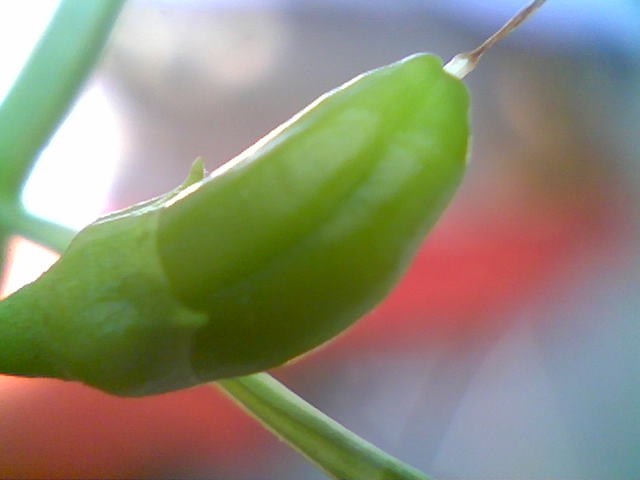 Last week before we go. Far too much to do yet. Every possible angle is uncovered. Too much chaos in my mind and no chance to untangle all the tangled threads. The good news is that we have some pollinated ovaries, which are now swelling into little peppers.
Yay!
Thursday, March 02, 2006
We have pollen!
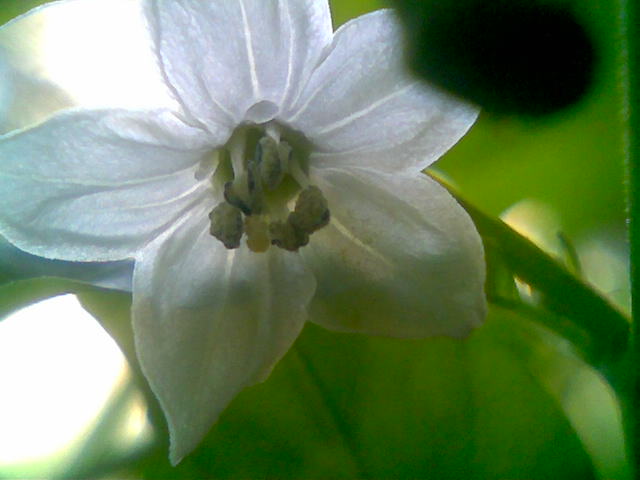
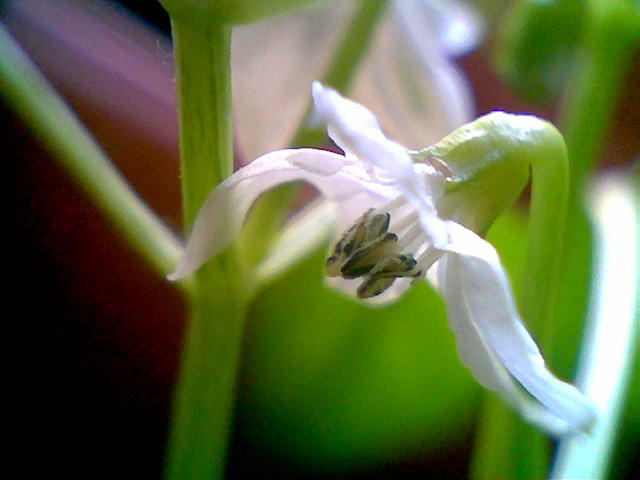
We have pollen - I did a bit of insect-work with a q-tip today... It's all getting very exciting in the pepper corner of the living room.
Monday, February 27, 2006
Friday, February 24, 2006
Easy-Rabbit Recipe
Or what I did with the rest of the rabbit after having made the Caneloni I haven't got round to showing off yet...
This is basically the easy chicken recipe, but now that chickens are slightly frowned on, and due to the fact that I had about 800 gramnmes of rabbit left over after making the caneloni, and about four portions of rice left over after saturday's cooking, we decided to make easy rabbit.
 Step one:
You put your rabbit in an oven-proof dish having salted and peppered it. Then you get the contents of a Knorr (or equivalent) Onion Soup sachet and cover the rabbit with this. Then you get a tin of pineapples in natural juice cut them up into sort of eighths of a circle and put them on top of the meat. Then you pour the rest of the contents of the tin into the oven proof dish and then you fill up the tin with water and pour that into the oven proof dish. Foo! this recipe writing stuff is tough work. OK on to Step 2:
 Step two:
So, put the thing in the oven at about 180-190 degrees centigrade, which is about between 355 and 375 in old money. Every 15-20 minutes I would turn and baste the meat and add more liquid to the Onion Soup Pineapple sauce if necessary.
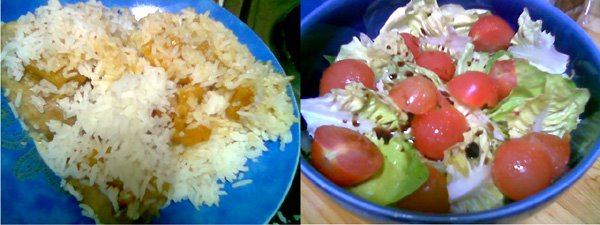
After about 45 minutes to an hour, you are ready. The final image shows Korinna putting in some rice so it can soak around in the juices and sauces before being served.
 Step three:
Serve (probably can be done more neatly than is shown in the picture). We usually have one of Korinnas salads with this meal.
So - there it is... easy rabbit.
I realise that use of the ready soup is a cop-out, but it is meant to be easy, after all.
This is basically the easy chicken recipe, but now that chickens are slightly frowned on, and due to the fact that I had about 800 gramnmes of rabbit left over after making the caneloni, and about four portions of rice left over after saturday's cooking, we decided to make easy rabbit.
 Step one:
 You put your rabbit in an oven-proof dish having salted and peppered it. Then you get the contents of a Knorr (or equivalent) Onion Soup sachet and cover the rabbit with this. Then you get a tin of pineapples in natural juice cut them up into sort of eighths of a circle and put them on top of the meat. Then you pour the rest of the contents of the tin into the oven proof dish and then you fill up the tin with water and pour that into the oven proof dish. Foo! this recipe writing stuff is tough work. OK on to Step 2:
 Step two:
 So, put the thing in the oven at about 180-190 degrees centigrade, which is about between 355 and 375 in old money. Every 15-20 minutes I would turn and baste the meat and add more liquid to the Onion Soup Pineapple sauce if necessary.
After about 45 minutes to an hour, you are ready. The final image shows Korinna putting in some rice so it can soak around in the juices and sauces before being served.
 Step three:
 Serve (probably can be done more neatly than is shown in the picture). We usually have one of Korinnas salads with this meal.
So - there it is... easy rabbit.
I realise that use of the ready soup is a cop-out, but it is meant to be easy, after all.
Chicky Thursday
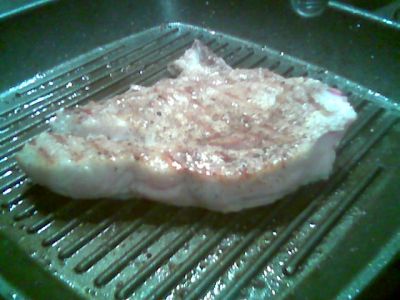 Yesterday was the last day in the calendar before Easter Sunday on which we can eat meat. So we ate meats. Oh yes. Meats from two different classes (Aves, Mammalia) and three different species (Chicken, Pig, Goat). My usually tough stomach has been complaining all day. We got about ten days to finish off all cheese and what have you before Lent starts in earnest. One year I will fast properly.
Thursday, February 23, 2006
Ravenna - Jan 2005, Part I
Here's one I prepared earlier, as they say... it follows on from the last Venice installment: Venice
Two nights and two days in fog choked Ravenna followed. Our ambitious plan was made easier by the fact that the mausoleum of Theodoric and the chapel of Aint Andrew were both closed for restoration work. That left only six (if I am not mistaken) UNESCO protected feats of the mosaicists art for us to go and gawp at. Fortunately, cameras are allowed here, although the fog cut the available light to a minimum and I had to use all my tricks to be able to shoot decent shots (not that I managed with 100% success, mind you).

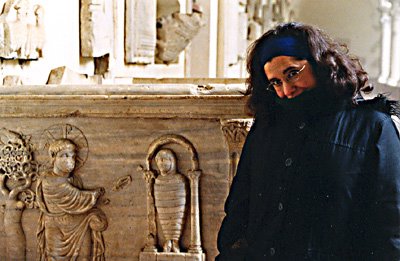
Corinna wrapped against the cold as effectively as Lazarus wrapped against death on this early Christian sacrophagus
After finding our way into town in the morning, and finding a place to park - something not as easy as it sounds - we headed off to the Saint Vitale and mausoleum of Galla Placida complex where we spent quite a while walking around and marvelling at the mosaics.
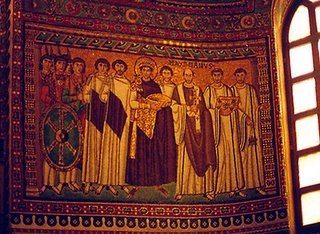

I suppose I could go off on the Justinian / Theodora tangent right now and that would lead us through the Belissarius / Procopius / Narses tangents and back to the goths and all that jazz, but I'd probably forget to write about how it is that I first came to want to come to Ravenna and whether or not you can tell that Saint Vitale is an architectural copy of Saints Sergius and Bacchus in Constantinople.
One thing I was not prepared for was the material used for the windows - a sort of yellow rock cut thin enough to be translucent and used for window material in San Vitale, the mausoleum and others of the old churches we visited.

We walked across the garden to the tomb of Galla Placida where the mosaic work was far more classically roman-looking than what we are used to miscalling Byzantine. Despite the figurative art having one foot firmly in the Greco-roman tradition, the geometric designs were incredibly forward looking and modern to our eyes.

Geometric patterns on the vault of the mausoleum of Galla Palcida.
Leaving the mausoleum / Vitale area we drove to the cathedral and museum. The chapel of Saint Andrew was closed, but we managed to see the exhibits in the museum, which included some good early mosaic work and of course the amazing ivory throne of Maximian, bishop of Ravenna. I remember friends ("Hi, James!") doing late Roman art courses getting all excited about this throne of some bishop in a place I hadn't heard of, called Ravenna. This was a long time before my "Byzantine" or late roman awakening. The throne was a masterpiece of ivory work of the period and it is good to look at. We have nothing in the eastern empire of this sort (meaning the flammable sort).
We walked around the city centre of Ravenna, which is beautiful enough and hides a number of later churches which no doubt are just as exciting to those who call the 17th or 18th centuries their own.
The baptisteries and St. Apollonaris are next and they require some introduction into the whole Arian / Orthodox thing and probably also the whole Goth business. This is a different chapter.
Two nights and two days in fog choked Ravenna followed. Our ambitious plan was made easier by the fact that the mausoleum of Theodoric and the chapel of Aint Andrew were both closed for restoration work. That left only six (if I am not mistaken) UNESCO protected feats of the mosaicists art for us to go and gawp at. Fortunately, cameras are allowed here, although the fog cut the available light to a minimum and I had to use all my tricks to be able to shoot decent shots (not that I managed with 100% success, mind you).
Corinna wrapped against the cold as effectively as Lazarus wrapped against death on this early Christian sacrophagus
After finding our way into town in the morning, and finding a place to park - something not as easy as it sounds - we headed off to the Saint Vitale and mausoleum of Galla Placida complex where we spent quite a while walking around and marvelling at the mosaics.

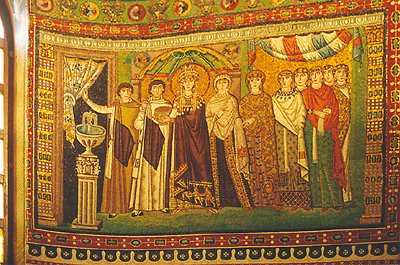
I suppose I could go off on the Justinian / Theodora tangent right now and that would lead us through the Belissarius / Procopius / Narses tangents and back to the goths and all that jazz, but I'd probably forget to write about how it is that I first came to want to come to Ravenna and whether or not you can tell that Saint Vitale is an architectural copy of Saints Sergius and Bacchus in Constantinople.
One thing I was not prepared for was the material used for the windows - a sort of yellow rock cut thin enough to be translucent and used for window material in San Vitale, the mausoleum and others of the old churches we visited.

We walked across the garden to the tomb of Galla Placida where the mosaic work was far more classically roman-looking than what we are used to miscalling Byzantine. Despite the figurative art having one foot firmly in the Greco-roman tradition, the geometric designs were incredibly forward looking and modern to our eyes.

Geometric patterns on the vault of the mausoleum of Galla Palcida.
Leaving the mausoleum / Vitale area we drove to the cathedral and museum. The chapel of Saint Andrew was closed, but we managed to see the exhibits in the museum, which included some good early mosaic work and of course the amazing ivory throne of Maximian, bishop of Ravenna. I remember friends ("Hi, James!") doing late Roman art courses getting all excited about this throne of some bishop in a place I hadn't heard of, called Ravenna. This was a long time before my "Byzantine" or late roman awakening. The throne was a masterpiece of ivory work of the period and it is good to look at. We have nothing in the eastern empire of this sort (meaning the flammable sort).
We walked around the city centre of Ravenna, which is beautiful enough and hides a number of later churches which no doubt are just as exciting to those who call the 17th or 18th centuries their own.
The baptisteries and St. Apollonaris are next and they require some introduction into the whole Arian / Orthodox thing and probably also the whole Goth business. This is a different chapter.
Wednesday, February 22, 2006
Total Solar eclipse in Kastelorizo II
Further to a previous post about viewing the total solar eclipse from Kastelorizo, I am happy to announce that I received just now my express mail box with 25 pairs of solar shades and a nice piece of aluminized mylar whatsit for making some coverings for my camera and telescope. It all came from these guys: Rainbow symphony.
Now, just have to sort out how we're going to go and how we're going to come back. And a whole lot of other stuff. More later this week.
Now, just have to sort out how we're going to go and how we're going to come back. And a whole lot of other stuff. More later this week.
Monday, January 09, 2006
Bird flu, mortality, immortality and related crap
Kastamonu, Samsun, Erzurum... if things were different, I might have been there now: the eye in the storm of a full blown family panic. As it is, I never made it to any of Kastamonu, Samsun, Erzurum.
I am concerned for Turkey and of course for when the jump will be made, but in a very detached sort of way.
I am not concerned about like whether I will get it. I will take my precautions, and if I am to outlive the pandemic, then I outlive the pandemic and tell the tale later. If I am to go in the pandemic in an unmarked mass grave with lime poured on top of me - well, yes, that sucks, but I'll be dead - so no sweat. We all die, you know. Whether we have managed to do all we want to do so that when we go we can feel we have justified our time here is something different completely. We are all dieing. Question is what are we doing about it - not about the fact that we are mortal, about the fact that once we are gone, we are gone. We can't write bullshit 15-syllable poems after death now, can we? We can't draw in chalk and charcoal after death.
We can't - but who is to say that so many of the other pleasures of life are lost? Who is to say that the sunset is lost, or that the crashing of the waves on the rocks is lost and who is to say that the joy to be gained from a nicely stratified and folded piece of limestone is lost? We are part of the natural world and we return to it. While we are alive, our bodies and our humanity prevent us from being one with the rocks, one with the trees, one with the surging sea and one with the stars as they wheel over the earth in their great circles.
"Why would I want to be one with the hermit crab chasing the tidal pools lest it dry in the heat of the sun?" I hear you cry... "Why would I want to be one with the arctic poppy as it twists itself continuously around chasing the never setting sun?"
I need to write more about nature and mans place both within and outside nature. I have no time now. I have a pandemic to panic about.
I am concerned for Turkey and of course for when the jump will be made, but in a very detached sort of way.
I am not concerned about like whether I will get it. I will take my precautions, and if I am to outlive the pandemic, then I outlive the pandemic and tell the tale later. If I am to go in the pandemic in an unmarked mass grave with lime poured on top of me - well, yes, that sucks, but I'll be dead - so no sweat. We all die, you know. Whether we have managed to do all we want to do so that when we go we can feel we have justified our time here is something different completely. We are all dieing. Question is what are we doing about it - not about the fact that we are mortal, about the fact that once we are gone, we are gone. We can't write bullshit 15-syllable poems after death now, can we? We can't draw in chalk and charcoal after death.
We can't - but who is to say that so many of the other pleasures of life are lost? Who is to say that the sunset is lost, or that the crashing of the waves on the rocks is lost and who is to say that the joy to be gained from a nicely stratified and folded piece of limestone is lost? We are part of the natural world and we return to it. While we are alive, our bodies and our humanity prevent us from being one with the rocks, one with the trees, one with the surging sea and one with the stars as they wheel over the earth in their great circles.
"Why would I want to be one with the hermit crab chasing the tidal pools lest it dry in the heat of the sun?" I hear you cry... "Why would I want to be one with the arctic poppy as it twists itself continuously around chasing the never setting sun?"
I need to write more about nature and mans place both within and outside nature. I have no time now. I have a pandemic to panic about.
Venice - Jan 2005 Part V
Next morning - the morning of the Befana we woke a little later than we had wanted and did not make it to the regatta - some other time perhaps. We did manage to pluck up the courage to go to the supermarket, where we got some amazing cheeses and hams for the homemade sandwiches we were intending to eat in the courtyard around the St. Maria of Murano.
We checked out of the Giardinetto and set off with our packed meals for Murano, passing the cemetery island on the way. We did not stop off to look around, although I dare say it will be as impressive and beautiful as our own Proto here in Athens.

An island populated by cypress trees - Venice's cenetery
We ate in the courtyard of the Santa Maria after our visit. Again no photos allowed of the mosaic work, such a disappointment - but definitely worth visiting if one is a fan. Full length theotokos - complete with cross-shadow (if I am not mistaken - it was a year ago). Hmmm I'm confused - why would there be a cross shadow in a church that never had iconoclastic bishops? Very confused. Either there was no cross shadow and I am imagining it, or I am remembering this correctly, in which case, Venice was more under the influence of Constantinople than not. Iconoclasm and the whole cross shadow business is a subject for another time, though. I can't remember where I have seen it most pronounced, but I know I have been there more than once - so probably in St. Sophia itself - or one of the Thessaloniki churches.

The church of Santa Maria in Murano in daylight
On our walk around and some way into the almost frenzy of shopping for glassware, we ran across this chappie in the photo below. He runs a third or fourth generation glass works and happened to be in the place on the Befana public holiday.
Corinna and I had both been to Venice before, at ages near enough the single figures. Both of us recalled very little of our previous visits apart from the very vivid memories of the glass works. This man put on a performance for us, heating and blowing and shaping and spinning the bottle for us - I was surprised to hear the sound the glass makes while red hot is pretty much the same sound it would make when cold when he beat it slightly with his tongs.

We thanked the man for the demonstration and headed back to the Lido to pick up the car. We crossed from the Lido to the ferry port in very dense fog and then crossed the bridge and set off for the other daughter of Constantinople on the Italian Adriatic - Ravenna - some two hours drive to the south.
The fog stayed dense all the way there. We got very lost, not having a decent map of Ravenna, but found the hotel Piccolo, booked through the internet. It was so-so, but cheap and the staff were friendly.
We checked out of the Giardinetto and set off with our packed meals for Murano, passing the cemetery island on the way. We did not stop off to look around, although I dare say it will be as impressive and beautiful as our own Proto here in Athens.
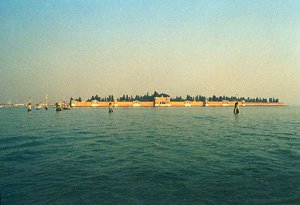
An island populated by cypress trees - Venice's cenetery
We ate in the courtyard of the Santa Maria after our visit. Again no photos allowed of the mosaic work, such a disappointment - but definitely worth visiting if one is a fan. Full length theotokos - complete with cross-shadow (if I am not mistaken - it was a year ago). Hmmm I'm confused - why would there be a cross shadow in a church that never had iconoclastic bishops? Very confused. Either there was no cross shadow and I am imagining it, or I am remembering this correctly, in which case, Venice was more under the influence of Constantinople than not. Iconoclasm and the whole cross shadow business is a subject for another time, though. I can't remember where I have seen it most pronounced, but I know I have been there more than once - so probably in St. Sophia itself - or one of the Thessaloniki churches.
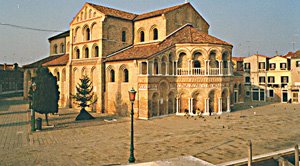
The church of Santa Maria in Murano in daylight
On our walk around and some way into the almost frenzy of shopping for glassware, we ran across this chappie in the photo below. He runs a third or fourth generation glass works and happened to be in the place on the Befana public holiday.
Corinna and I had both been to Venice before, at ages near enough the single figures. Both of us recalled very little of our previous visits apart from the very vivid memories of the glass works. This man put on a performance for us, heating and blowing and shaping and spinning the bottle for us - I was surprised to hear the sound the glass makes while red hot is pretty much the same sound it would make when cold when he beat it slightly with his tongs.

We thanked the man for the demonstration and headed back to the Lido to pick up the car. We crossed from the Lido to the ferry port in very dense fog and then crossed the bridge and set off for the other daughter of Constantinople on the Italian Adriatic - Ravenna - some two hours drive to the south.
The fog stayed dense all the way there. We got very lost, not having a decent map of Ravenna, but found the hotel Piccolo, booked through the internet. It was so-so, but cheap and the staff were friendly.
Venice - Jan 2005 Part IV
Well, one year on and so many other journeys to write about as well. The rest of this write up of Venice will be necessarily brief and based around the photographs. After Torcello, we returned to Burano, where every building really is painted a different colour.

Burano - happy colours, fishing town
This gives a very characteristic and happy look to the island. The vaporetto drops you off in front of a rather nice bronze nude and an open space with grass and trees which functions as a park.

In Venice, the canals share traffic signs with normal road systems everywhere…

The sun gets lower over the lagoon - January 5 2005
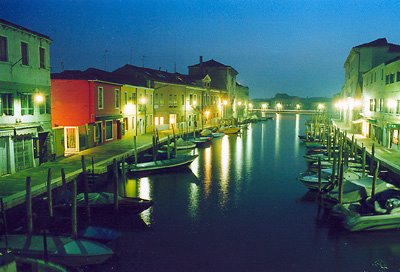
We walked around the town looking at the lace work and painted houses, stopping for some pastries along our walk. From Burano, we made our way to Murano with the sun hovering on the horizon dangerously close to setting. We walked along the banks of the canals of Murano looking in the windows of the shops and deciding to come in the next day on the vaporetto for a better look.

Corinna and I pose for a timer-shot in central Murano
One of the definite things to come back for was the church of Santa Maria - described as having one of the best full length Byzantine theotokos mosaics ever, and certainly nicely tarted up in full twelfth century brick and masonry extravagance.
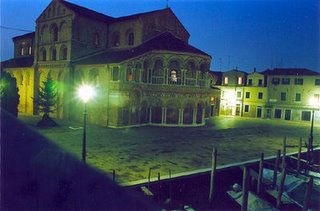
The church of Santa Maria in Murano, under night lighting
Resolving to be back the next day for a look inside, we set off for home, the long way round, taking the vaporetto towards the train station and then cruising the grand-canal back towards St. Zaccaria and off to the Lido again.
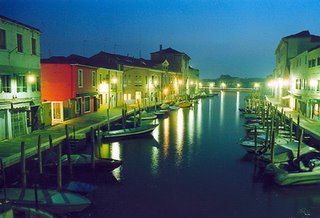

Burano - happy colours, fishing town
This gives a very characteristic and happy look to the island. The vaporetto drops you off in front of a rather nice bronze nude and an open space with grass and trees which functions as a park.

In Venice, the canals share traffic signs with normal road systems everywhere…
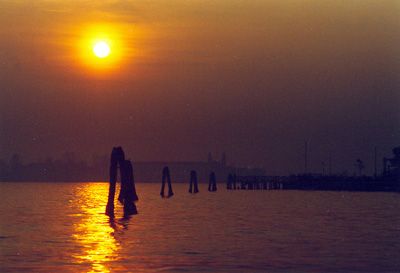
The sun gets lower over the lagoon - January 5 2005
We walked around the town looking at the lace work and painted houses, stopping for some pastries along our walk. From Burano, we made our way to Murano with the sun hovering on the horizon dangerously close to setting. We walked along the banks of the canals of Murano looking in the windows of the shops and deciding to come in the next day on the vaporetto for a better look.

Corinna and I pose for a timer-shot in central Murano
One of the definite things to come back for was the church of Santa Maria - described as having one of the best full length Byzantine theotokos mosaics ever, and certainly nicely tarted up in full twelfth century brick and masonry extravagance.
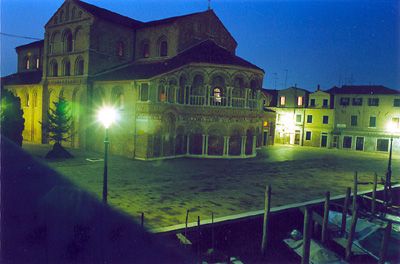
The church of Santa Maria in Murano, under night lighting
Resolving to be back the next day for a look inside, we set off for home, the long way round, taking the vaporetto towards the train station and then cruising the grand-canal back towards St. Zaccaria and off to the Lido again.
Sunday, January 08, 2006
Venice - Jan 2005 Part III
The plan was for the next day to go pick up some material for packed lunches from a supermarket and head to Torcello. We woke slightly later than planned and went to the nearest supermarket (the one on the same street as the Pizzeria). It had a huge selection of cold meats and cheeses, but something stopped us from trying out our ordering skills and we left with only bottled water. I had recently learned "a half" and was dying to ask for 250 grammes of cheese by asking for a mezzo mezzo. I had to wait for the next day to do this.
The boat to Torcello goes via some part of the lagoon accessible by road from the mainland and then via Burano. Stopping on Burano made us want to explore after Torcello, rather than go straight to Murano and then Venice. So we waited for the Burano to Torcello shuttle with the others and set off for the island which we could see in the misty half-distance. We could make out what we assumed must be the eponymous tower, from Burano, but not much else. I had read that there were essentially two old buildings on the island, one a round church and the older of the two, the other a basilica sort of building with stunning mosaics. There was also the famous "throne of Atilla" a marble throne which was said to have been sat upon by Atilla the Hun when he passed through the area, many centuries before Venice was inhabited. In fact, Torcello has the earliest signs of habitation in the lagoon. Today, the island has about five buildings in total - it seems to be just open land for walking and picnicking and in the half sun and mist we had while there, it was as atmospheric as the guide books describe. From the vaporetto stop, there is a fifteen minute walk to the overpriced museum, opposite which is the square with the two churches.

Corinna sits on "Attila's throne" in front of the two old churches
Round churches usually have a special and significant history, being as they are imitations of the Constantinian and later Justinian church of the holy sepulcher in Jerusalem. This one was rather bland on the inside. The basilica was far more exciting and was one of the big draws of the trip. Inside things to see include, apart from the bones of St. Hippolito (?),two sections of mosaic. The first, is a full standing theotokos in the main apse, the second, on the back wall of the church is a series of bands, of various ages, essentially showing the usual heaven and hell stuff. Obviously the work had been done by craftsmen from the east, or under their guidance.
One section which I found especially disturbing, mainly because I have not seen a parallel elsewhere, was the section with the proud in hell, where there were shown a number of kings and queens and bishops. What's wrong with this? Nothing, in itself. What disturbed me was the fact that the kings and queens were dressed as Byzantine emperors and their empresses, and the bishops were dressed as patriarchs. Whether or not this is standard practice - the depiction of those who were first on earth being amongst the last in hell - it is clear that the young Enrico Dandolo would have grown up having seen the images, at a time long after their creation when the kings and queens were iconographically no longer generic, but very much specific images of the eastern rulers. If the kings and queens of the east were in hell being tormented in the flames, it made the justification of the post-Zara movements of the fourth crusade much easier in the minds of those trying to justify them.

Before setting off back to the vaporetto, we were surprised to have walked past a Braille map of the lagoon. Neither of us had seen a map done in Braille before. The shallows and land and water all had different tactile hatching, with a key in the bottom right. You learn something new every day.
The boat to Torcello goes via some part of the lagoon accessible by road from the mainland and then via Burano. Stopping on Burano made us want to explore after Torcello, rather than go straight to Murano and then Venice. So we waited for the Burano to Torcello shuttle with the others and set off for the island which we could see in the misty half-distance. We could make out what we assumed must be the eponymous tower, from Burano, but not much else. I had read that there were essentially two old buildings on the island, one a round church and the older of the two, the other a basilica sort of building with stunning mosaics. There was also the famous "throne of Atilla" a marble throne which was said to have been sat upon by Atilla the Hun when he passed through the area, many centuries before Venice was inhabited. In fact, Torcello has the earliest signs of habitation in the lagoon. Today, the island has about five buildings in total - it seems to be just open land for walking and picnicking and in the half sun and mist we had while there, it was as atmospheric as the guide books describe. From the vaporetto stop, there is a fifteen minute walk to the overpriced museum, opposite which is the square with the two churches.

Corinna sits on "Attila's throne" in front of the two old churches
Round churches usually have a special and significant history, being as they are imitations of the Constantinian and later Justinian church of the holy sepulcher in Jerusalem. This one was rather bland on the inside. The basilica was far more exciting and was one of the big draws of the trip. Inside things to see include, apart from the bones of St. Hippolito (?),two sections of mosaic. The first, is a full standing theotokos in the main apse, the second, on the back wall of the church is a series of bands, of various ages, essentially showing the usual heaven and hell stuff. Obviously the work had been done by craftsmen from the east, or under their guidance.
One section which I found especially disturbing, mainly because I have not seen a parallel elsewhere, was the section with the proud in hell, where there were shown a number of kings and queens and bishops. What's wrong with this? Nothing, in itself. What disturbed me was the fact that the kings and queens were dressed as Byzantine emperors and their empresses, and the bishops were dressed as patriarchs. Whether or not this is standard practice - the depiction of those who were first on earth being amongst the last in hell - it is clear that the young Enrico Dandolo would have grown up having seen the images, at a time long after their creation when the kings and queens were iconographically no longer generic, but very much specific images of the eastern rulers. If the kings and queens of the east were in hell being tormented in the flames, it made the justification of the post-Zara movements of the fourth crusade much easier in the minds of those trying to justify them.

Before setting off back to the vaporetto, we were surprised to have walked past a Braille map of the lagoon. Neither of us had seen a map done in Braille before. The shallows and land and water all had different tactile hatching, with a key in the bottom right. You learn something new every day.
Sunday, December 11, 2005
More bread
Marky Mark's original recipe calls for 500g flour, one sachet of yeast, one coke-can of water or milk or mixture of the two and I add some oil as well. What I do is 400g of mixed maizeflour / wheatflour, 100g quaker oats and all the rest as per Marky's advice.
 On the left we have the dough rising after the first knead, then cooking and on the right the final loaves. I love home made bread. I love the yeasty smell and the whole house filling with bread smell as the cooking draws to a close. I love the taming of the fungus. It lives and dies so as to make more of the dough.
 We got the two loaves I made today here. Left picture is immediately after kneading, middle picture is after the dough has risen as far as it will go and the right hand side is the final cooked product. The top has the TE sign from Linear A/B inscribed - my initial but also a good shape for getting the crust to separate. The bottom loaf was not very well put together and opened up in the final rising stage - not a problem for the final product though. I have tried it and it's great!
 On the left we have the dough rising after the first knead, then cooking and on the right the final loaves. I love home made bread. I love the yeasty smell and the whole house filling with bread smell as the cooking draws to a close. I love the taming of the fungus. It lives and dies so as to make more of the dough.
 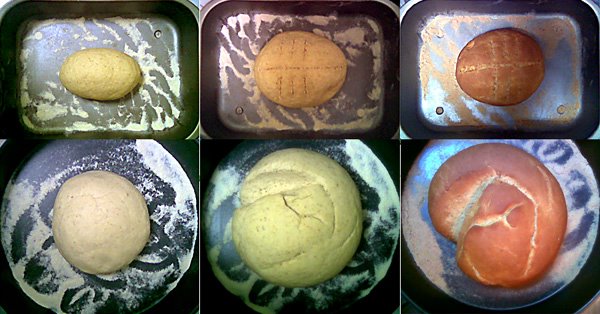 We got the two loaves I made today here. Left picture is immediately after kneading, middle picture is after the dough has risen as far as it will go and the right hand side is the final cooked product. The top has the TE sign from Linear A/B inscribed - my initial but also a good shape for getting the crust to separate. The bottom loaf was not very well put together and opened up in the final rising stage - not a problem for the final product though. I have tried it and it's great!
Subscribe to:
Posts (Atom)

