Finally putting up some moving pictures from Venice - there aren't many of these, but here is the first attempt. The footage was captured by my mobile phone, a battered and now-ailing Nokia 5410...
Showing posts with label venice. Show all posts
Showing posts with label venice. Show all posts
Tuesday, June 27, 2006

Monday, January 09, 2006
Venice - Jan 2005 Part V
Next morning - the morning of the Befana we woke a little later than we had wanted and did not make it to the regatta - some other time perhaps. We did manage to pluck up the courage to go to the supermarket, where we got some amazing cheeses and hams for the homemade sandwiches we were intending to eat in the courtyard around the St. Maria of Murano.
We checked out of the Giardinetto and set off with our packed meals for Murano, passing the cemetery island on the way. We did not stop off to look around, although I dare say it will be as impressive and beautiful as our own Proto here in Athens.

An island populated by cypress trees - Venice's cenetery
We ate in the courtyard of the Santa Maria after our visit. Again no photos allowed of the mosaic work, such a disappointment - but definitely worth visiting if one is a fan. Full length theotokos - complete with cross-shadow (if I am not mistaken - it was a year ago). Hmmm I'm confused - why would there be a cross shadow in a church that never had iconoclastic bishops? Very confused. Either there was no cross shadow and I am imagining it, or I am remembering this correctly, in which case, Venice was more under the influence of Constantinople than not. Iconoclasm and the whole cross shadow business is a subject for another time, though. I can't remember where I have seen it most pronounced, but I know I have been there more than once - so probably in St. Sophia itself - or one of the Thessaloniki churches.

The church of Santa Maria in Murano in daylight
On our walk around and some way into the almost frenzy of shopping for glassware, we ran across this chappie in the photo below. He runs a third or fourth generation glass works and happened to be in the place on the Befana public holiday.
Corinna and I had both been to Venice before, at ages near enough the single figures. Both of us recalled very little of our previous visits apart from the very vivid memories of the glass works. This man put on a performance for us, heating and blowing and shaping and spinning the bottle for us - I was surprised to hear the sound the glass makes while red hot is pretty much the same sound it would make when cold when he beat it slightly with his tongs.

We thanked the man for the demonstration and headed back to the Lido to pick up the car. We crossed from the Lido to the ferry port in very dense fog and then crossed the bridge and set off for the other daughter of Constantinople on the Italian Adriatic - Ravenna - some two hours drive to the south.
The fog stayed dense all the way there. We got very lost, not having a decent map of Ravenna, but found the hotel Piccolo, booked through the internet. It was so-so, but cheap and the staff were friendly.
We checked out of the Giardinetto and set off with our packed meals for Murano, passing the cemetery island on the way. We did not stop off to look around, although I dare say it will be as impressive and beautiful as our own Proto here in Athens.
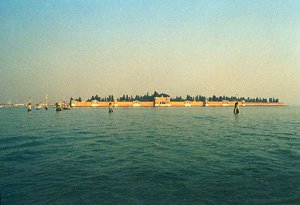
An island populated by cypress trees - Venice's cenetery
We ate in the courtyard of the Santa Maria after our visit. Again no photos allowed of the mosaic work, such a disappointment - but definitely worth visiting if one is a fan. Full length theotokos - complete with cross-shadow (if I am not mistaken - it was a year ago). Hmmm I'm confused - why would there be a cross shadow in a church that never had iconoclastic bishops? Very confused. Either there was no cross shadow and I am imagining it, or I am remembering this correctly, in which case, Venice was more under the influence of Constantinople than not. Iconoclasm and the whole cross shadow business is a subject for another time, though. I can't remember where I have seen it most pronounced, but I know I have been there more than once - so probably in St. Sophia itself - or one of the Thessaloniki churches.
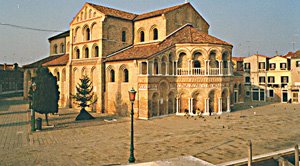
The church of Santa Maria in Murano in daylight
On our walk around and some way into the almost frenzy of shopping for glassware, we ran across this chappie in the photo below. He runs a third or fourth generation glass works and happened to be in the place on the Befana public holiday.
Corinna and I had both been to Venice before, at ages near enough the single figures. Both of us recalled very little of our previous visits apart from the very vivid memories of the glass works. This man put on a performance for us, heating and blowing and shaping and spinning the bottle for us - I was surprised to hear the sound the glass makes while red hot is pretty much the same sound it would make when cold when he beat it slightly with his tongs.

We thanked the man for the demonstration and headed back to the Lido to pick up the car. We crossed from the Lido to the ferry port in very dense fog and then crossed the bridge and set off for the other daughter of Constantinople on the Italian Adriatic - Ravenna - some two hours drive to the south.
The fog stayed dense all the way there. We got very lost, not having a decent map of Ravenna, but found the hotel Piccolo, booked through the internet. It was so-so, but cheap and the staff were friendly.
Venice - Jan 2005 Part IV
Well, one year on and so many other journeys to write about as well. The rest of this write up of Venice will be necessarily brief and based around the photographs. After Torcello, we returned to Burano, where every building really is painted a different colour.

Burano - happy colours, fishing town
This gives a very characteristic and happy look to the island. The vaporetto drops you off in front of a rather nice bronze nude and an open space with grass and trees which functions as a park.

In Venice, the canals share traffic signs with normal road systems everywhere…

The sun gets lower over the lagoon - January 5 2005
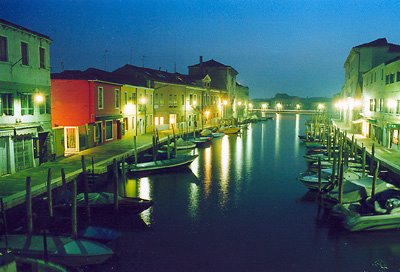
We walked around the town looking at the lace work and painted houses, stopping for some pastries along our walk. From Burano, we made our way to Murano with the sun hovering on the horizon dangerously close to setting. We walked along the banks of the canals of Murano looking in the windows of the shops and deciding to come in the next day on the vaporetto for a better look.

Corinna and I pose for a timer-shot in central Murano
One of the definite things to come back for was the church of Santa Maria - described as having one of the best full length Byzantine theotokos mosaics ever, and certainly nicely tarted up in full twelfth century brick and masonry extravagance.
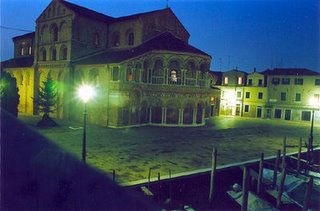
The church of Santa Maria in Murano, under night lighting
Resolving to be back the next day for a look inside, we set off for home, the long way round, taking the vaporetto towards the train station and then cruising the grand-canal back towards St. Zaccaria and off to the Lido again.
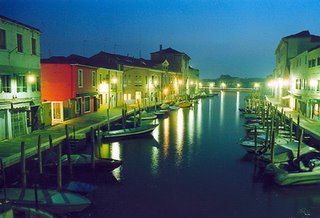

Burano - happy colours, fishing town
This gives a very characteristic and happy look to the island. The vaporetto drops you off in front of a rather nice bronze nude and an open space with grass and trees which functions as a park.

In Venice, the canals share traffic signs with normal road systems everywhere…
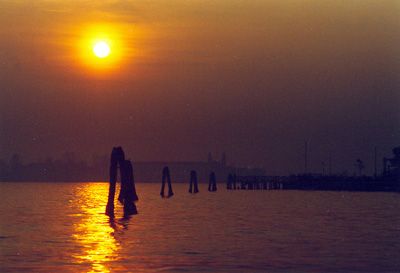
The sun gets lower over the lagoon - January 5 2005
We walked around the town looking at the lace work and painted houses, stopping for some pastries along our walk. From Burano, we made our way to Murano with the sun hovering on the horizon dangerously close to setting. We walked along the banks of the canals of Murano looking in the windows of the shops and deciding to come in the next day on the vaporetto for a better look.

Corinna and I pose for a timer-shot in central Murano
One of the definite things to come back for was the church of Santa Maria - described as having one of the best full length Byzantine theotokos mosaics ever, and certainly nicely tarted up in full twelfth century brick and masonry extravagance.
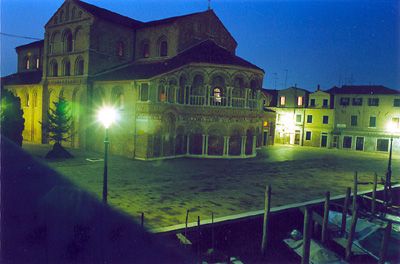
The church of Santa Maria in Murano, under night lighting
Resolving to be back the next day for a look inside, we set off for home, the long way round, taking the vaporetto towards the train station and then cruising the grand-canal back towards St. Zaccaria and off to the Lido again.
Sunday, January 08, 2006
Venice - Jan 2005 Part III
The plan was for the next day to go pick up some material for packed lunches from a supermarket and head to Torcello. We woke slightly later than planned and went to the nearest supermarket (the one on the same street as the Pizzeria). It had a huge selection of cold meats and cheeses, but something stopped us from trying out our ordering skills and we left with only bottled water. I had recently learned "a half" and was dying to ask for 250 grammes of cheese by asking for a mezzo mezzo. I had to wait for the next day to do this.
The boat to Torcello goes via some part of the lagoon accessible by road from the mainland and then via Burano. Stopping on Burano made us want to explore after Torcello, rather than go straight to Murano and then Venice. So we waited for the Burano to Torcello shuttle with the others and set off for the island which we could see in the misty half-distance. We could make out what we assumed must be the eponymous tower, from Burano, but not much else. I had read that there were essentially two old buildings on the island, one a round church and the older of the two, the other a basilica sort of building with stunning mosaics. There was also the famous "throne of Atilla" a marble throne which was said to have been sat upon by Atilla the Hun when he passed through the area, many centuries before Venice was inhabited. In fact, Torcello has the earliest signs of habitation in the lagoon. Today, the island has about five buildings in total - it seems to be just open land for walking and picnicking and in the half sun and mist we had while there, it was as atmospheric as the guide books describe. From the vaporetto stop, there is a fifteen minute walk to the overpriced museum, opposite which is the square with the two churches.

Corinna sits on "Attila's throne" in front of the two old churches
Round churches usually have a special and significant history, being as they are imitations of the Constantinian and later Justinian church of the holy sepulcher in Jerusalem. This one was rather bland on the inside. The basilica was far more exciting and was one of the big draws of the trip. Inside things to see include, apart from the bones of St. Hippolito (?),two sections of mosaic. The first, is a full standing theotokos in the main apse, the second, on the back wall of the church is a series of bands, of various ages, essentially showing the usual heaven and hell stuff. Obviously the work had been done by craftsmen from the east, or under their guidance.
One section which I found especially disturbing, mainly because I have not seen a parallel elsewhere, was the section with the proud in hell, where there were shown a number of kings and queens and bishops. What's wrong with this? Nothing, in itself. What disturbed me was the fact that the kings and queens were dressed as Byzantine emperors and their empresses, and the bishops were dressed as patriarchs. Whether or not this is standard practice - the depiction of those who were first on earth being amongst the last in hell - it is clear that the young Enrico Dandolo would have grown up having seen the images, at a time long after their creation when the kings and queens were iconographically no longer generic, but very much specific images of the eastern rulers. If the kings and queens of the east were in hell being tormented in the flames, it made the justification of the post-Zara movements of the fourth crusade much easier in the minds of those trying to justify them.

Before setting off back to the vaporetto, we were surprised to have walked past a Braille map of the lagoon. Neither of us had seen a map done in Braille before. The shallows and land and water all had different tactile hatching, with a key in the bottom right. You learn something new every day.
The boat to Torcello goes via some part of the lagoon accessible by road from the mainland and then via Burano. Stopping on Burano made us want to explore after Torcello, rather than go straight to Murano and then Venice. So we waited for the Burano to Torcello shuttle with the others and set off for the island which we could see in the misty half-distance. We could make out what we assumed must be the eponymous tower, from Burano, but not much else. I had read that there were essentially two old buildings on the island, one a round church and the older of the two, the other a basilica sort of building with stunning mosaics. There was also the famous "throne of Atilla" a marble throne which was said to have been sat upon by Atilla the Hun when he passed through the area, many centuries before Venice was inhabited. In fact, Torcello has the earliest signs of habitation in the lagoon. Today, the island has about five buildings in total - it seems to be just open land for walking and picnicking and in the half sun and mist we had while there, it was as atmospheric as the guide books describe. From the vaporetto stop, there is a fifteen minute walk to the overpriced museum, opposite which is the square with the two churches.

Corinna sits on "Attila's throne" in front of the two old churches
Round churches usually have a special and significant history, being as they are imitations of the Constantinian and later Justinian church of the holy sepulcher in Jerusalem. This one was rather bland on the inside. The basilica was far more exciting and was one of the big draws of the trip. Inside things to see include, apart from the bones of St. Hippolito (?),two sections of mosaic. The first, is a full standing theotokos in the main apse, the second, on the back wall of the church is a series of bands, of various ages, essentially showing the usual heaven and hell stuff. Obviously the work had been done by craftsmen from the east, or under their guidance.
One section which I found especially disturbing, mainly because I have not seen a parallel elsewhere, was the section with the proud in hell, where there were shown a number of kings and queens and bishops. What's wrong with this? Nothing, in itself. What disturbed me was the fact that the kings and queens were dressed as Byzantine emperors and their empresses, and the bishops were dressed as patriarchs. Whether or not this is standard practice - the depiction of those who were first on earth being amongst the last in hell - it is clear that the young Enrico Dandolo would have grown up having seen the images, at a time long after their creation when the kings and queens were iconographically no longer generic, but very much specific images of the eastern rulers. If the kings and queens of the east were in hell being tormented in the flames, it made the justification of the post-Zara movements of the fourth crusade much easier in the minds of those trying to justify them.

Before setting off back to the vaporetto, we were surprised to have walked past a Braille map of the lagoon. Neither of us had seen a map done in Braille before. The shallows and land and water all had different tactile hatching, with a key in the bottom right. You learn something new every day.
Wednesday, October 19, 2005
Venice Jan 2005 - Part II
We walked around the square to get our bearings and to allow the admittedly small queue for St. Mark's to become smaller. I was disappointed by the no-photography rule inside, especially given that this was one of the reasons I was here. I have photographs of mosaic work from Sicily, Greece and Turkey where no one forbids it. Now I had come on what was essentially a mosaic holiday and faced "no photography" signs. This was a bit down heartening. OK - if I cannot take pictures, St. Mark's still has one thing to offer me: atmosphere.
St. Mark's is meant to have been constructed on the same size and plans as the Church of the Holy Apostles in Constantinople. This was another of Justinian's exercises in supersizing Constantine's churches. While we can still see three of Justinian's churches in Istanbul today, the Church of the Holy Apostles fell into disrepair and was already in ruins at the time of the fall. It was taken apart and used as spolia by the Ottomans for their Fatih "Conqueror" mosque. There are very few churches of this size and floorplan still around, and now I was getting the opportunity to look inside a church with the floorplan of the Holy Apostles, and with mosaic decoration, which should also give an idea of what Justinian's church was like.
On entering, I was struck by the size and spaciousness, but that was all. What disappointed was the mosaic work. Compared to the works in Constantinople of the same time, or even of Palermo, what I saw in St. Marks left me with a feeling that I had been cheated. The hype was such that when I got there and craned my neck up, I felt unsated. It's not so much the workmanship on the figures themselves so much as the programme - there are great empty spaces of gold ground which would have been so much better filled with vines, tendrils, geometric shapes, and the like. I was not prepared for so much gold ground and unimpressed by it when I saw it. No doubt the Frankish knights of the fourth who came to ask for carriage to Alexandria in the very early thirteenth century were suitably impressed by this show of gold. I wouldn't have made a good Frankish knight.
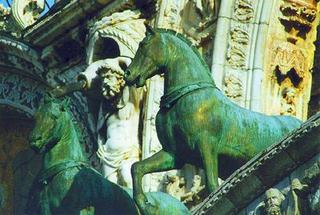
Speaking of which, we visited both the treasury and the Pala d'Oro, and then the space on the upper floor with the horses and an exhibition on the history of restoration work. The balcony gives an impressive view over the square and across to the Lido. The horses gave mixed emotions, as I wanted to believe that I was in the presence of a Pheidias original, but the exhibition texts talk of first or second century creations. We will never know. These horses in front of me are those same ones which Porphyrius the charioteer and Theodora's father raced around when they sat on the spina. No doubt some of the Nika rioters would have died with these horses as the last thing they saw, while being charged down by the horses of Belissarius' cavalry. Noise - the statues lived surrounded by noise in the mother of cities, and now they had the quiet of St. Mark's and the hushed voices of the passing tourists to keep them company.

I have highlighted a little original building-work peeping through here in the side of St. Marks.

Leaving the cathedral, we picked up our bags which we had been asked to leave just off the little square of the lions. We began a westwardly stroll without any destination in particular, intending to reach at some point the Rialto Bridge. We passed many art exhibitions which seemed ridiculously overpriced to us, especially the Turner whose works one does not pay for in London. I am not sure which way we went and how we eventually go to the Rialto Bridge, but we ate at a restaurant near the theater on the way, called al Teatro, which was decent enough, without being something overwhelmingly special. There were building works going on nearby which started up with their pneumatic whatsits soon after we started eating and the staff were very apologetic, despite it not being their fault at all.
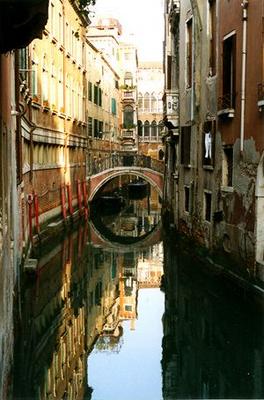 The Rialto Bridge area was very busy with tourists and locals alike. I was fascinated by the mareometer on the main vaporetto stop which barometer-like recorded the height of the sea throughout the day. I had read about the flooding and read the posters outside St. Zacharia showing flooded Venice, but since all the days we were there the water seemed to be quite low, nothing drove it home more than the mareometer, except perhaps the "moss-line" visible all over the town about half a yard above the sea level. This is a green line on every wall in the city above which the wall is normal, and below which grow mossy sorts of plants which give the impression of the sort of plants which need to be in water to survive.
 It was here at the Rialto area that I decided to talk to one of the gondoliers as we were still debating with Korinna whether or not to take one of the 60 Euro rides.
 I wanted to find out a bit about the Befana Regatta which ended at the Rialto - like what time it starts and where a good place to watch would be. The gondolier was a glum fellow and gave us the information I asked for grudgingly. I don't know whether this was because he realized we were not going to ask for a boat trip, or whether it was his nature to be a glum and grudging
 source of information about local customs to tourists. We did not take a gondola ride.
We walked about town after dusk and nightfall and stopped at a café which really did seem to be patronized by the locals. They had the Eraclea Antiqua brand hot chocolate, to which we are both very partial and we sat reading here until we decided to get on a boat back to the Lido. We did the Grand Canal by night this time, having walked up a little distance in the day and returned to the hotel.
We had supper in a pizzeria up the central perpendicular street which starts at the vaporetto stop. The pizzeria happened to be almost full of an American school group, but the pizza was good enough.
St. Mark's is meant to have been constructed on the same size and plans as the Church of the Holy Apostles in Constantinople. This was another of Justinian's exercises in supersizing Constantine's churches. While we can still see three of Justinian's churches in Istanbul today, the Church of the Holy Apostles fell into disrepair and was already in ruins at the time of the fall. It was taken apart and used as spolia by the Ottomans for their Fatih "Conqueror" mosque. There are very few churches of this size and floorplan still around, and now I was getting the opportunity to look inside a church with the floorplan of the Holy Apostles, and with mosaic decoration, which should also give an idea of what Justinian's church was like.
On entering, I was struck by the size and spaciousness, but that was all. What disappointed was the mosaic work. Compared to the works in Constantinople of the same time, or even of Palermo, what I saw in St. Marks left me with a feeling that I had been cheated. The hype was such that when I got there and craned my neck up, I felt unsated. It's not so much the workmanship on the figures themselves so much as the programme - there are great empty spaces of gold ground which would have been so much better filled with vines, tendrils, geometric shapes, and the like. I was not prepared for so much gold ground and unimpressed by it when I saw it. No doubt the Frankish knights of the fourth who came to ask for carriage to Alexandria in the very early thirteenth century were suitably impressed by this show of gold. I wouldn't have made a good Frankish knight.
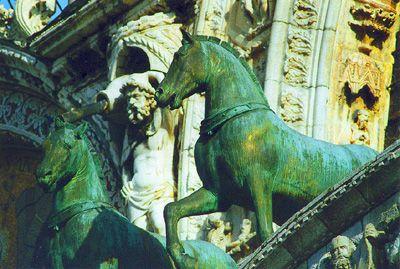
Speaking of which, we visited both the treasury and the Pala d'Oro, and then the space on the upper floor with the horses and an exhibition on the history of restoration work. The balcony gives an impressive view over the square and across to the Lido. The horses gave mixed emotions, as I wanted to believe that I was in the presence of a Pheidias original, but the exhibition texts talk of first or second century creations. We will never know. These horses in front of me are those same ones which Porphyrius the charioteer and Theodora's father raced around when they sat on the spina. No doubt some of the Nika rioters would have died with these horses as the last thing they saw, while being charged down by the horses of Belissarius' cavalry. Noise - the statues lived surrounded by noise in the mother of cities, and now they had the quiet of St. Mark's and the hushed voices of the passing tourists to keep them company.
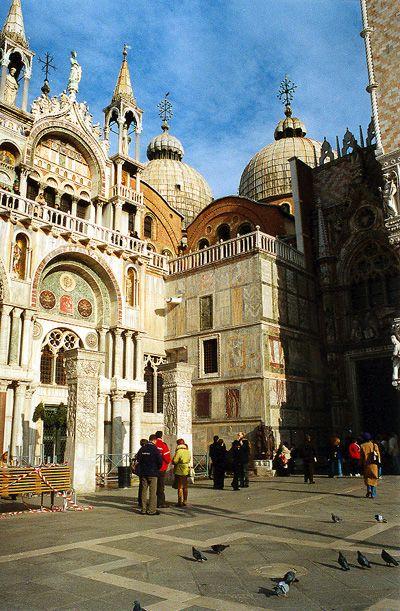
I have highlighted a little original building-work peeping through here in the side of St. Marks.

Leaving the cathedral, we picked up our bags which we had been asked to leave just off the little square of the lions. We began a westwardly stroll without any destination in particular, intending to reach at some point the Rialto Bridge. We passed many art exhibitions which seemed ridiculously overpriced to us, especially the Turner whose works one does not pay for in London. I am not sure which way we went and how we eventually go to the Rialto Bridge, but we ate at a restaurant near the theater on the way, called al Teatro, which was decent enough, without being something overwhelmingly special. There were building works going on nearby which started up with their pneumatic whatsits soon after we started eating and the staff were very apologetic, despite it not being their fault at all.
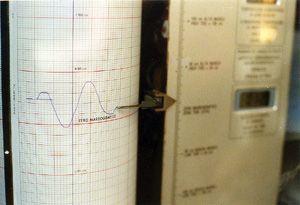
 The Rialto Bridge area was very busy with tourists and locals alike. I was fascinated by the mareometer on the main vaporetto stop which barometer-like recorded the height of the sea throughout the day. I had read about the flooding and read the posters outside St. Zacharia showing flooded Venice, but since all the days we were there the water seemed to be quite low, nothing drove it home more than the mareometer, except perhaps the "moss-line" visible all over the town about half a yard above the sea level. This is a green line on every wall in the city above which the wall is normal, and below which grow mossy sorts of plants which give the impression of the sort of plants which need to be in water to survive.
 It was here at the Rialto area that I decided to talk to one of the gondoliers as we were still debating with Korinna whether or not to take one of the 60 Euro rides.
 I wanted to find out a bit about the Befana Regatta which ended at the Rialto - like what time it starts and where a good place to watch would be. The gondolier was a glum fellow and gave us the information I asked for grudgingly. I don't know whether this was because he realized we were not going to ask for a boat trip, or whether it was his nature to be a glum and grudging
 source of information about local customs to tourists. We did not take a gondola ride.
We walked about town after dusk and nightfall and stopped at a café which really did seem to be patronized by the locals. They had the Eraclea Antiqua brand hot chocolate, to which we are both very partial and we sat reading here until we decided to get on a boat back to the Lido. We did the Grand Canal by night this time, having walked up a little distance in the day and returned to the hotel.
We had supper in a pizzeria up the central perpendicular street which starts at the vaporetto stop. The pizzeria happened to be almost full of an American school group, but the pizza was good enough.
Tuesday, October 18, 2005
Venice - Jan 2005 Part I
And so it was that following bookings made at hotels in the Lido and a little outside Ravenna, and with the Blue Guide to both Venice and Northern Italy firmly in hand we set off on the evening of 2 January for Patras in my ageing Fiat Cinquecento. The trip was a surprise. Korinna did not know where we were going, just that a passport would be useful. Since we had been before to Ochrid and I travel frequently to Turkey, there was no way she would guess until well past Corinth and almost right up to the boat that the destination would be across the sea to the ungrateful matricide daughter of the Eastern Roman Empire.
In the end the passports were not needed for the crossing, nor was my green card for the car requested by anyone. We had 31 hours in the boat and I spent the time reading up a little on the destination. Fortunately it is possible to sleep for much of the 31 hours without having to alter your normal patterns. The boat sets off at about midnight and arrives at about seven or eight in the morning.
The arrival time was planned to be at about seven local time, and I learned that this is arrival at the entrance to the lagoon, not actual disembarkation time, so we had an opportunity for breakfast in the ship's canteen as we entered the lagoon. By the time we were passing the Doge's palace and St. Zacharia stop, the twilight had become bright enough to see Venice passing gently before us. They say that Venice should be approached by sea to appreciate the city - I have no recollection of approaching it any other way, so I'll just say that the approach by sea is special enough for me not to want to arrive any other way if I have the opportunity to go again. They say the same about Istanbul as well. I will have to wait and see about this.


By the time we had moored, the sun was up and colouring the lagoon and the city in a golden glow which was increasingly beautiful as we disembarked and made our way to the ferry service for the Lido. We got a three day pass, plus a return trip to the Lido for the car and went back past St. Zacharia and St. Mark's with the sun shining onto them from the sea. The three day pass allowed great freedom of movement and a carefree attitude to direction taking - it did not matter to be on the wrong boat, because not only would we see something unexpected, but we would not need to pay to come back. It also came out quite economical as the cost was less than individual trips to the three outlying islands which we made.
On the Lido, we stayed at the hotel Giardinetto, which is very central on the Lido, twenty yards or so from the vaporetto stop for St. Mark's and decently priced. We did not have a view of the lagoon, but some rooms in the hotel do. We took the car to the Hotel Park, a few km to the south which has an agreement with the Giardinetto and left the car there for the next three days. Coming back on the bus - ferry pass is good for travel on the buses too - we set off straight for St. Mark's arriving at about ten am. Amazed at this uncharacteristic efficiency in actually getting from A to B I was pleased that we had a great number of hours of sunlight left for walking around.
The plan was to see as much of Venice on this first day as possible, see Torcello on the second day as a day trip, and to see anything else in Venice which took our fancy on the third day, after watching the Befana Regatta.
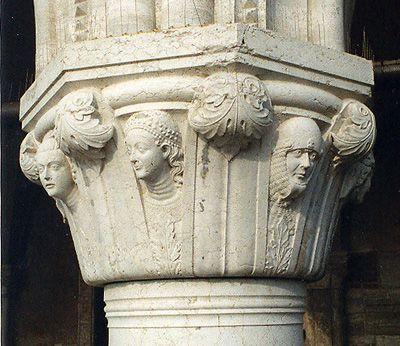
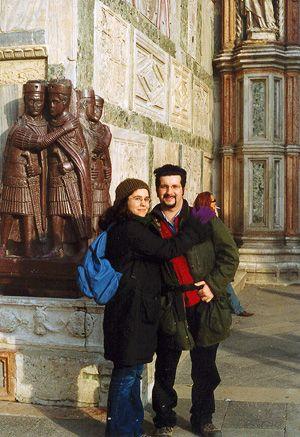
We walked past from the St. Zacharia stop to St. Mark's square, past the hordes trying to look at the bridge of sighs, which were a little bit of a turn-off. I very much enjoyed the sculptured capitals on the columns of the Ducal Palace. They were something unexpected, and I have no idea when they were carved. Within no time at all, we were face to face with the tetrarchs, staring out of their new perch in all their porphyrean glory. It was moving to finally stand next to and dare I say it, touch this sculpture which was in my Latin books at school and about which I have read so much since school, and there they were. We asked a passer-by to take the canonical shot of us embracing like tetrarchs in front of the tetrarchs, but the passer-by cropped it in a way which shows that the visual echo was more a duck's quack than a fully-fledged yodel.


To be continued...
In the end the passports were not needed for the crossing, nor was my green card for the car requested by anyone. We had 31 hours in the boat and I spent the time reading up a little on the destination. Fortunately it is possible to sleep for much of the 31 hours without having to alter your normal patterns. The boat sets off at about midnight and arrives at about seven or eight in the morning.
The arrival time was planned to be at about seven local time, and I learned that this is arrival at the entrance to the lagoon, not actual disembarkation time, so we had an opportunity for breakfast in the ship's canteen as we entered the lagoon. By the time we were passing the Doge's palace and St. Zacharia stop, the twilight had become bright enough to see Venice passing gently before us. They say that Venice should be approached by sea to appreciate the city - I have no recollection of approaching it any other way, so I'll just say that the approach by sea is special enough for me not to want to arrive any other way if I have the opportunity to go again. They say the same about Istanbul as well. I will have to wait and see about this.


By the time we had moored, the sun was up and colouring the lagoon and the city in a golden glow which was increasingly beautiful as we disembarked and made our way to the ferry service for the Lido. We got a three day pass, plus a return trip to the Lido for the car and went back past St. Zacharia and St. Mark's with the sun shining onto them from the sea. The three day pass allowed great freedom of movement and a carefree attitude to direction taking - it did not matter to be on the wrong boat, because not only would we see something unexpected, but we would not need to pay to come back. It also came out quite economical as the cost was less than individual trips to the three outlying islands which we made.
On the Lido, we stayed at the hotel Giardinetto, which is very central on the Lido, twenty yards or so from the vaporetto stop for St. Mark's and decently priced. We did not have a view of the lagoon, but some rooms in the hotel do. We took the car to the Hotel Park, a few km to the south which has an agreement with the Giardinetto and left the car there for the next three days. Coming back on the bus - ferry pass is good for travel on the buses too - we set off straight for St. Mark's arriving at about ten am. Amazed at this uncharacteristic efficiency in actually getting from A to B I was pleased that we had a great number of hours of sunlight left for walking around.
The plan was to see as much of Venice on this first day as possible, see Torcello on the second day as a day trip, and to see anything else in Venice which took our fancy on the third day, after watching the Befana Regatta.
We walked past from the St. Zacharia stop to St. Mark's square, past the hordes trying to look at the bridge of sighs, which were a little bit of a turn-off. I very much enjoyed the sculptured capitals on the columns of the Ducal Palace. They were something unexpected, and I have no idea when they were carved. Within no time at all, we were face to face with the tetrarchs, staring out of their new perch in all their porphyrean glory. It was moving to finally stand next to and dare I say it, touch this sculpture which was in my Latin books at school and about which I have read so much since school, and there they were. We asked a passer-by to take the canonical shot of us embracing like tetrarchs in front of the tetrarchs, but the passer-by cropped it in a way which shows that the visual echo was more a duck's quack than a fully-fledged yodel.

To be continued...
Monday, January 03, 2005
Going to Byzantine Italy
It all started about three weeks ago, when we realised K would have a full week off after the new year. Usually this is not the case - schools open in Greece the feast of St. John.
What to do with a week? We said it would be nice to go to Karpenissi for some mountainous fun and I started all the planning. It all looked a little expensive for me - high priced rooms and what have you - so I met K's suggestion to surprise her with a whole lot of excitement. I had already gone and looked at costs for going to Venice and it seemed to be about within the same budget scale as Karpenissi for a week (what does that tell you about post-Euro prices, huh?).
The idea was to plan this whole thing without her knowing. Not too tough, as it turns out. I made some clues, which Ill put in here: "space for clues" when I get back. The clues all point to the destination, and whatever I don't care what anyone has said to me about the obtuseness of them all, but she got the destination without any help and not too long after being given the clues. Qualia? Talia est mihi, I am happy to say.
I am currently on a cross-Adriatic ferry that bears absolutely no relationship to the ferries of my memories from childhood drives from the UK to Greece. The only thing in any way similar to the ferries of the past are the slot machines - and these are only superficially similar as the older ones were hand-cranked and not push button affairs.
The plan is to stay on the Lido for two nights, leaving after the conclusion of the Befanio Regatta for Ravenna, and to leave there on the Saturday for Patras again.
While in Venice the plan is to see St. Mark's, possibly the Accademia and Torcello. Anything else is left up to whatever fate has in store for our feet and legs. We may go up to Murano to look at the glassworks - childhood memories I think are enough, although a fresh look now may not be too bad.
I have not been in Venice since about 1987, maybe one or two years (but no more) later. I have not been on a ferry across the Adriatic since about the same time - although I did cross the straights to Brindisi in 2001.
Ravenna should be good - I have never visited and it has definitely been on my wish lost for a long time. K and I have been giving the old wish list a good going over these past 6 months...
One thing I'll say about the ferry before I close is that it ain't half hot in the rooms. Far too hot for a fatman in my condition.
I doubt I'll be able to post again before returning, but check back, just in case, why don't you?
What to do with a week? We said it would be nice to go to Karpenissi for some mountainous fun and I started all the planning. It all looked a little expensive for me - high priced rooms and what have you - so I met K's suggestion to surprise her with a whole lot of excitement. I had already gone and looked at costs for going to Venice and it seemed to be about within the same budget scale as Karpenissi for a week (what does that tell you about post-Euro prices, huh?).
The idea was to plan this whole thing without her knowing. Not too tough, as it turns out. I made some clues, which Ill put in here: "space for clues" when I get back. The clues all point to the destination, and whatever I don't care what anyone has said to me about the obtuseness of them all, but she got the destination without any help and not too long after being given the clues. Qualia? Talia est mihi, I am happy to say.
I am currently on a cross-Adriatic ferry that bears absolutely no relationship to the ferries of my memories from childhood drives from the UK to Greece. The only thing in any way similar to the ferries of the past are the slot machines - and these are only superficially similar as the older ones were hand-cranked and not push button affairs.
The plan is to stay on the Lido for two nights, leaving after the conclusion of the Befanio Regatta for Ravenna, and to leave there on the Saturday for Patras again.
While in Venice the plan is to see St. Mark's, possibly the Accademia and Torcello. Anything else is left up to whatever fate has in store for our feet and legs. We may go up to Murano to look at the glassworks - childhood memories I think are enough, although a fresh look now may not be too bad.
I have not been in Venice since about 1987, maybe one or two years (but no more) later. I have not been on a ferry across the Adriatic since about the same time - although I did cross the straights to Brindisi in 2001.
Ravenna should be good - I have never visited and it has definitely been on my wish lost for a long time. K and I have been giving the old wish list a good going over these past 6 months...
One thing I'll say about the ferry before I close is that it ain't half hot in the rooms. Far too hot for a fatman in my condition.
I doubt I'll be able to post again before returning, but check back, just in case, why don't you?
Subscribe to:
Posts (Atom)

