A baptistery is that part of the church (in early times a separate building in its own right) where baptism would take place. In the early days when those yet to be baptised vastly outnumbered those already baptised most baptisms were carried out on adults, and the baptisteries reflect this in that the font is big enough for a full size adult to be baptised in it.
The two baptisteries in Ravenna were built by the two rival sects practising in the empire at the time. The preferred form at this period is an octagon, and I have heard that this is to represent each day of the period from the entry into Jerusalem until Christ's resurrection. Anyway - what we have going on in the empire at the the time the churches of Ravenna were built is two competing sects of Christianity living side by side. We're not talking sects in terms of catholics and protestants thinking they have a different dogma, we are talking about a full blown disagreement in the nature of Christ. Let me just write those words out again, because they are important and to our post Chalcedonian mindset such a thing is not a matter for debate and / or discussion.
The nature of Christ.
There, I have written it again. We are all to some extent familiar with the concept of the creed. It's that bit of the service beginning with "I believe" or "credo" (or whatever) and it is essentially an affirmation of belief. In there we see all sorts of funky stuff, used to describe Christ. Like, he is the only son of the father, he is begotten not made, of one being with the father, etc. etc.
"Fair cop, guv", you might say, but I ask you why do we have this creed with all the rhetoric and reaffirmation of Christ's divinity? What need is it addressing? What's at stake? Yes - the trinity, father son and holy ghost - fine, but why labour the point when it comes to the son's divinity?
Once upon a time, in the second city of the newly officially Christian Roman Empire, there was a chap called Arius and Arius was bishop of this city, Alexandria. As bishop of the second most important city in the empire, he had some sway. Egypt and north Africa had always cast Christianity in a strange mould of their own and there the people clung on to strange (sometimes gnostic) ideas. These are the sorts of ideas which then come out of the sands seventeen centuries later to be turned into "National Geographic" cover stories.
Against this backdrop and only a generation after Origen, comes Arius with his separation of the nature of Christ the son from that of God the father. According to Arius, Christ was not "uncreated" and not wholly God in the way that God the Father was God. Arguing that the father was greater than the son and existed before him, the Alexandrine bishop managed to drive a wedge into the divine nature of Christ, which was to have repercussions many hundreds of years after the anathemas proclaimed on him. Think about the incongruity of the terms "one who never changes" and "baby Jesus"…
Before anyone could do anything to check the progress of this idea (which may have been potentially more palatable than the standard description of the trinity to the less philosophically inclined western areas of the empire), it had spread like wildfire, to the extent that arguments would erupt in the streets of Constantinople and, more significantly, to the extent that the religious figures sent to convert the non-citizen Goths who had recently begun to work as mercenaries in the armies of Rome were followers of Arian. Not only that, but the Arian theology buttoned itself onto the existing beliefs of the Goths who worshiped a father / son deity which had the father more divine than the son.
The council of Nicea gave christianity the Nicene creed with its use of the term "consubstantial" or "homoousios" which basically put an end to Arianism in the core parts of the empire. So these beliefs were anathematized and life went on in the empire with the Arian Goths on the periphery. Theodosios in the late fifth century had seen to it that all pagan worship ceased, and made all sorts of deals with the Goths to give them land for military service, despite their Arianism.
At some point, though, the goths were tired of sitting on the other side of the Danube and the time came for them to cross the river and make a bid for Rome. They managed to take much of Northern Italy. Rather than raze and rebuild, the Goths did something politically clever, in that they allowed the local population to continue their worship as they were wont to do, and introduced a parallel hierarchy of Arian clergy to tend to the Arian Gothic elite, which managed in this way to keep itself separate from their Trinitarian subjects.
Phew
So - Italy and especially Ravenna at this time (until Belissarius, essentially) was home to a coexistence of two very different "Christian" sects.
The reason for all this blah blah blah is that a) the art of the orthodox and heretical differs in the details in a way which is interesting to note and b) many formerly Arian buildings were taken over by Trinitarians after Belissarius re-conquered Italy for Rome. Belissarius we'll talk about some other time.
Against this backdrop, we can now move into the baptistries, and it is finally time for some of what might be the last glimmer of classically inspired sculpture before the renaissance came along. K and I particularly like the guy in this image as we both independently saw in him the patron saint of ironing. I am not sure who this funky low-relief guy is, but he stands below the dome of the baptistery of the orthodox.
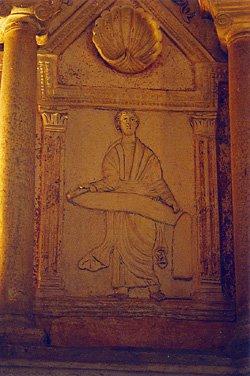
The first recorded extreme ironing aficionado
The baptistery of the Orthodox is of course more notable for the mosaic decoration adorning the vault depicting a belts-off-trousers-down Jesus in the water being baptised by JTB.
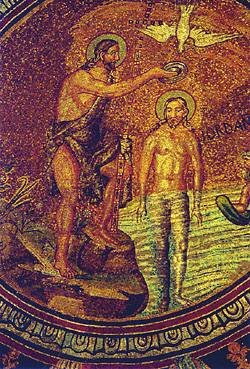 JTB and the skinnydipping JC groove on down in the Jordan wid da pijins(or something)
Christ is depicted as a fully grown bearded man. He is God, consubstantial, coeternal. Compare with later when we visited the slightly earlier baptistery of the Arians.
 JTB and the skinnydipping JC groove on down in the Jordan wid da pijins (or something)
Doesn't JC look a little dumpier, beardless and more boyish - like he is not quite as fully divine as the Father?
So after baptistery fun in these octagonal buildings displaying the last embers of truly classical art, we were ready for a visit to a good old fashioned basilica with three naves and some processional mosaics with repetitive undistinguishable saints parading towards the Christ figure. On the north side the saints process, walking from a depiction of Theodoric's palace towards the east. On the south wall, the lady saints are walking from the harbour towards the east. Have I not mentioned Theodoric? Did I throw him out at you without any explanation? His mausoleum had a brief mention in the previous Ravenna text.
Theodoric the goth, then. He was king of the Goths who had come to scare away those who had overrun Italy at the behest of Zeno, emperor of the Romans. The Goths had then set themselves up in the ruins of the empire in the west. Taking on Roman airs and titles, playing the system from the inside and letting the roman aristocracy carry on as before. The gothic kingdom was ruled from Ravenna from the Palace pictured in the mosaics of the basilica of Saint Apollinaris. From the palace helpfully labelled "PALATIVM" in the mosaic. From the palace which is less than forty yards down the road from the mosaic depicting it.
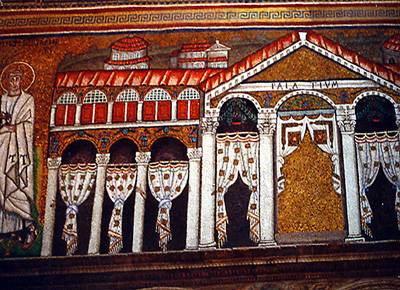 The Palace of Theodoric, setting off point for the procession of saints depicted in the basilica of Saint Apollinaris.
Theodoric's palace, in the mosaic, featured members of his family standing in the porches. Members of the royal family with haloes (normal for imperial portraits of the time) adorning the porches. And then along came Belissarius, strong -man of Justinian and restorer of orthodoxy to an Italy suffering under the heretical Goths.
And there, in the basilica of Saint Apollinaris, first to go were the Arian Saints. Up went the Orthodox saint names... and then away go the family of Theodoric. In their place, some very fashionable curtains were put up. You can see above the curtains where the haloes would have been, but more obvious, and highlighted in green in the next image, are the body parts painted outside the gaps and over the columns. They were never taken away - it is not known why and the hands of Theodoric's family are still there to be seen by whoever should visit the church.
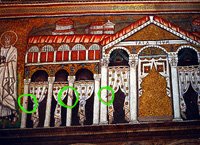
Same image as before with highlighted body parts
Not far from the palace and cathedral of Theodoric sits an unassuming building for which you really have to be on the look out or else very much into the back-street narrow-alley form of exploring new places. Inside is the tomb of Dante.
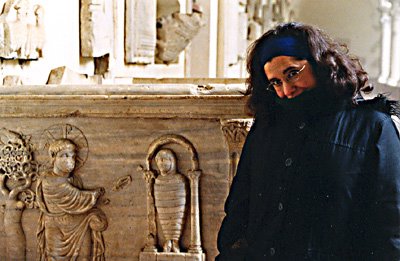
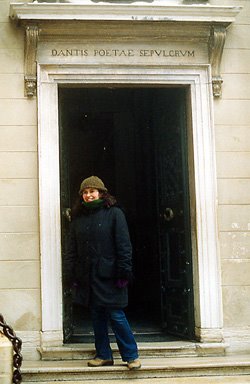 K emerges from the tomb of the poet
In Ravenna we discovered a very nice café type thing with good hot chocolate and also were lucky enough to catch the first day of the sales.
The next day we were off to Classe - the city named after what it did... Classe takes its name from Classis - fleet in Latin - for it is here that the imperial fleet would moor in the days when the empire was run from Ravenna.
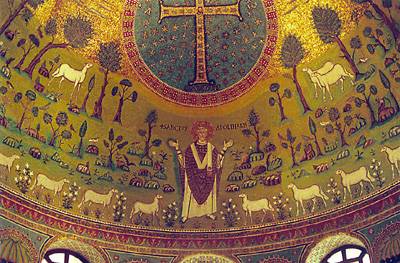 O lamb of God...
In Classe we found the last of Ravenna'a UNESCO inscribed buildings - the church of Saint Apollinaris in Classe. More mosaics, this time curiously pastoral, to bid us good bye as we set off doen the fog filled autostrade towards Ancona - a place known to me from childhood voyages as a harbour town with no intrinsic interest.
How wrong I had been! Ancona is a harbour town - yes, it's position and what have you make it a perfect place for setting off across the Adratic to a number of destinations.
The first surprise - seeing as we had arrived about an hour early, we had time to explore - was the triumphal arches on the waterfront. I did not remember them, of course, the last time I had been through there I didn’t know what a triumphal arch represented and what the roman empire was. My sole source of information had been "Carry On Cleo" with Kenneth Williams as a rather camp Caesar acting opposite Sid William's raunchy Mark Anthony, but I digress.
 Triumphal arches in Ancona with a view to the church on the top of the hill
The foreground arch in the picture as far as I can recall was set up by Napoleon. The one behind was set up by Trajan. The Ferry was delayed arriving - and therefore would be delayed in departing - by about five hours, so we had a good chance to walk about and get to know the city a little. We decided to walk up to the church on the hill overlooking the harbour and were rewarded with the exteriors of some baroque buildings on the way up and fine views from the top. Of course, all this was not really quite so exciting as the building at the top.
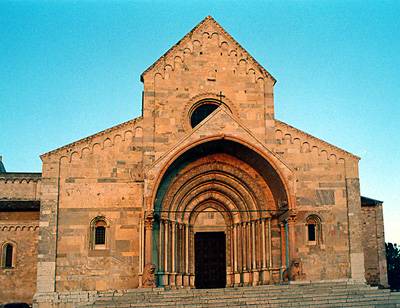 The old cathedral on top of the hill in Ancona
We were confronted by the rather gothic entrance with the arches all one inside the other, flanked by lions taken from somewhere I don't recall. The basilica itself was originally just a standard basilica, and took on its cruciform groundplan in about the 13th if I remember. The great thing about it is that in the basement you can see a bunch of Doric column bases from what used to be the old temple of Aphrodite which would stand above the harbour - sailors being sailors in all centuries no doubt had much to do with this choice of deity for the old temple.
The boat came, we boarded and set off again for Patras and later Athens.
The Venice / Ravenna trip was over, six days after commencing, the write up finished some five hundred and forty days after commencing. Hmm.
Now time to start writing up what came after Venice: Istanbul/Constantinople in June 2005 etc, Sikinos / Ios and Ikaria in August 2005, Meteora in September 2005, Paloumba for the epiphany of 2006, Paloumba for the first day of Lent of 2006, and Kastelorizo for the eclipse of 2006… all coming soon, oh yes.