Showing posts with label new acropolis museum. Show all posts

Thursday, December 27, 2012

Back to the Acropolis Museum, December 2012

So last week I went back to the museum... and it’s time for something positive, this being the season of goodwill and all.

I remember my three major complaints being the photography ban, the lack of printed and explanatory information and the lack of children oriented materials.
Image of sign outside New Acropolis Museum showing that photography is forbidden
No photography sign, outside the New Acropolis Museum
Image of the New Acropolis Museum entrance, with pottery left and right, the Archaic room ahead and the Caryatids above and a very prominent no photography sign
Main entrance hall of the New Acropolis Museum, with prominent no photography reminder
Well, having gone on Saturday 15 December (a normal, pay to enter day) with the girls, we had the museum essentially to ourselves – up in the Parthenon gallery we walked round the whole thing twice, only seeing other people towards the end of our tour. An experience both satisfying and slightly worrying at the same time.
My girls alone in the Hellenistic/Roman hall of the New Acropolis Museum - In the distance Praxiteles' huge head of Artemis
All the Hellenistic and Roman era to ourselves...
The major changes I noticed from the summer of 2009:

1. The Kritios Boy seems to have been raised on his pedestal to a much higher level. Can’t imagine why, but, there you have it. Blonde Boy also seems to have a new perch...

Archaic room, from behind the Blonde Boy and the Kritios Boy
Kritios boy, on a new perch (2012) - compare with the image below (2009)

Image of the back of the Blonde Boy's head and the back of the Kritios boy

2. There is now material for kids to read or have read to them, in big letters, bright colours and targeted at them. So – yes, the museum is currently better for kids than it was three years ago. Can it be better yet? I think so, but this is a good first step.

3. (I took about 50 photos and hardly anyone minded, shhh…)

4. In 2009, I had a very specific complaint about the lack of “how” – well, in the archaic sculpture room, there is now a very nice display of marble-working tools along with an example of how each one left its mark on the marble. There was a similar display about the various minerals used to colour the marble, where they came from and how they were prepared to be applied.
A display of tools of the marble worker in the new acropolis museum
Tools of marbleworking and the marks they make

So – the museum is getting better. I am more enthusiastic, and I can’t wait to go back. Oh, and as a coda: Ariadne, at 45 months old told me the next day that the sixth Caryatid should come back from London to be with her sisters. It’s not right that she’s far away from them. I had explained that the pedestal is empty because one of the girls has gone to London to another museum, in a totally non-judgmental and neutral way.


Sunday, August 22, 2010

Museum of Prehistoric Thera (Thira, whatever)

This museum was to have been the highlight of the trip. I had not been to Santorini since 1997 and the museum was still under construction then. The museum was to house the finds from the excavation of Akrotiri, the bronze-age Pompeii of the Aegean. The museum opened in 2000, so the chances of there having been a good museological approach employed were good. I had high hopes that I would come out of this museum knowing more about Akrotiri than I knew when going in. I consider myself a decently-read amateur so, it is not too much to expect that there would be something to learn from the combined wit and expertise of the Marinatoses and Dumases involved in the excavation and the museum itself.

Big disappointment.

The museum is little better than a store room with occasional explanatory texts. All the faults of the New Acropolis Museum are here (poor explanatory texts, lack of child-friendly texts, etc.), compounded by the exotic, unfamiliar and to a certain degree inaccessible nature of the material.

The exhibition is laid out chronologically with some further separation into categories with which I am not all that satisfied (to show for example, the cosmopolitan nature of the settlement, or the contacts with elsewhere).

I have nothing against contacts with elsewhere - my complaints stem from the bad labeling - put a map on the wall! What does it mean to the average visitor that these vases are from the Argolid, Corinthia or Aegina? Without a map, nothing; without an explanation of the travel routes and times necessary to get to Akrotiri, next to nothing. Again - we are shown lead weights in the trade section: how much did each one weigh? Was it a decimal system or something else? Are there parallels on Crete or on the mainland? In later weights? It's like being served a pistaccio nut and not being told that it needs to be shelled, then eaten!

Then again - what is Linear A? We are presented with a whole case of finds, inscribed with it and yet there is no attempt to help the visitor comprehend the significance of the script or the texts.

Frescoes - undoubtedly what most people go for what with the Minoan flounced skirts exposing breasts left right and center... I found the frescoes disappointing. Apart from the "African" and other fragments, there is nothing here that was not already on display in Athens before the earthquake of 1999. And yet, there have been so many discoveries, and so much is left in Athens (without good reason in my opinion). It is an injustice to keep the Ibexes, the fishermen and boxing boys in Athens when such a museum exists. It's not as if the labeling in Athens is much better. Even so - there is no text discussing the rituals depicted, the dress of the figures, the importance of crocus. The public do want to know. They come to the museum to learn and there is a real need (which is not being met) to explain things. Despite seeing many, I do not recall one explanation of what a rhyton is, or more significantly, how it was used in ritual. And all this from an exhibition designed and opened in the last ten years!

Museology #fail!

I did like the descriptive text about the frescoes and how they were painted, although diagrams or even photographs of pertinent parts of the frescoes showing such things as string impressions on the plaster or the way that true fresco differs from the dry fresco work (both were employed and presumably left different tell-tale signs). These are more missed opportunities to get people interested.

This museum was a great opportunity, sorely missed and it leaves you with a feeling of despair as you realize that we will always be two steps behind the museums of Europe (the real Europe, the one with industry, the one with proper state-sponsored education).

I have a bad feeling I'll be writing this about every new museum I will be visiting...

Ostrich-egg Rhyta showing contacts with the Levantine coast, but without any explanation of the form or function of a Rhyton...

Lion's-heda Rhyton again without any explanation of the form or function of a Rhyton... This piece used to be in Athens and is modelled on a metallic original (the angular eyebrows mimic the shape that a metal lion's head rhyton would take - there's one in the Mycenae room at the National Archaeological Museum in Athens). Of course, you won't learn any of this by reading the labels in the exhibition...

Saffron Gatherers... like the spinal tap song goes: "nobody knows what they were doing, but their legacy remains". It's not surprising that nobody knows, since there is no text written next to them to tell anyone.

Linear-A fragments. See text above for my complaints (or better still, don't - for that full "Greek museum ignorance experience").

Lead weights. See text above for my complaints (or better still, don't - for that full "Greek museum ignorance experience").


Oh, did someone mention a gold Ibex?

Saturday, August 08, 2009

New Acropolis Museum disappointing anticlimax

This article was edited in December 2012 to correct some image links
Please see my new post on the improvements made since Summer 2009


Don't get me wrong. The new museum is great. It's unique in terms of the architecture and the finds being exhibited inside. It houses the foremost collection of archaic and classical "golden age" sculpture in the world. There is no other such collection and there can be no other.

So, let me tell you about the museum, then, the museum that they have been building for more than four years; the museum that has been built and finished for the last two years (which were spent on the transfer of the exhibits from one building to the other). I emphasise the timescales involved, to pre-empt the whingers who will try to reason that all that is wrong with the museum is a result of the short timescales involved.

I have been critical of the management of the Museum Opening through this blog in the past. I had hoped to be able to come back with a gushingly positive review of the museum itself, to show to myself as well as to the world that Greece knows how to manage its cultural heritage. Unfortunately, this will not be possible. The museum is not so much a varnished turd, as a lilly gilded with shite (and then varnished). The material the museologists had to work with was amazing, the museum itself is rather disappointing in spite of this amazing material.

My complaints cluster around certain categories all of which are seen in the light of the media blitz telling us that this museum represents THE new way forward for all museums in Greece and that this is the face of the future.

Printed material
My first criticism is the lack of printed material for visitors. In every other archaeological site and museum in the country including the forgotten House of Tiles at Lerna which seems to receive no more than eight visitors annually, the visitors are given a glossy printed "guide" in their choice of English or Greek language, showing a floor plan of the site or museum and information about what is being seen. This is given out together with the entry ticket.

At the Acropolis Museum, which admittedly has just opened (but which has been in a state of being about to open for the best part of two years), the visitor is given his barcoded ticket (a nice touch, although it has been implemented in less advanced countries such as Turkey for years) and that's it. No leaflet, nothing. From there on, the visitor is left at the mercy of the occasional signage pointing him to the next floor. The result of this, I saw quite clearly in the group of English-speaking tourists wondering whether there was anything more to see on the floor above the gift shop and cafeteria. I interrupted them and helpfully offered that they may want to go upstairs, given that the museum was built essentially for the plastercasts on show there.

Sure, there may be a printed leaflet on the way, but why isn't it here yet? Was there not enough time? Was the floor plan not known?

Photography ban
This, at the time of my visit had me more annoyed than anything else. I have been away from friends such as the moscophoros or the sandal-binder for about four years, and now I can see them again, I am not allowed to photograph them. This unjustified ban is as unjustifiable as the illegal summerhouses being built in the burnt forests of Attika.

I am curious from where the authorities of the new acropolis Museum think they are given the right to impose a blanket ban on photography in the museum. Certainly not through Law 3028/2002 on the protection of antiquities (and in general of the cultural heritage of the country).
Sandal-binder Moschophoros

Apparently, the ban was put in place (according to the guard I asked) because some people were taking "improper" pictures together with the statues. This very unique ban on photography is put in place because people are interacting with art? I am shocked! I am shocked, given the copious amounts of information you give the visitor about the exhibition, and given the respect for the art he is watching that this information will have built in the visitor, I am shocked that some chose to photograph themselves standing next to or even pointing at the penis of a statue. How could someone do this after all the interesting information the museum has provided? And even so: how elitist and snobby does one have to be to proscribe how exactly the visitor is to react to art, that some reactions are acceptable and some unacceptable?

Is the museum in the present century? Does it acknowledge the universal nature of the items on show inside? How can it argue that this universally recognised art should be accessible to all people of the world and then proscribe to these same people the way to enjoy it? Is the status of the Venus de Milo or the Lacoon or indeed of the originals of the plastercasts of the Parthenon marbles any different because photography is allowed?


Ban this sick filth!
(Photos have been downloaded in low res, clicking on the image will take you to the original source)

I will not dwell on the photography ban as I consider it wholly temporary. I am just sad that I could not share all the wondrous things I saw, the new faces of old friends.

Poor explanatory materials
Two problems here, both of which stem from the narrow-mindedness inherent in the system. The labels and explanations are written by archaeologists for archaeologists. The labels on each individual item are very cursory and the general texts do nothing to help the casual visitor who has heard of neither Kekrops nor Erechteus nor indeed Hercules (unless in relation to Xena, warrior princess).

The individual labels rarely go beyond a name and a catalogue number, as if this is enough for 95% of the visitors to the museum who hardly realise that possibly all of the archaic sculpture they are looking at is on display because of the same Persians depicted in the hit film "300" (this is Spaaaarta!). To put it journalistically, while the "what" and possibly the "when" are covered (albeit in a very superficial way), the "where", "why" and "how" are left very much missing.

Why is there no text describing for example, what the gigantomachy is? Or indeed what the amazonomachy and kentaromachy scenes are representing: the Greeks and the 'other'? What is the procession showing on the Parthenon frieze, how many horsemen are there and is it a coincidence that there are 192 of them? In the room full of the Archaic Kouros / Kore / Horsemen: Why was this sculpture erected, where exactly, by who, for what purpose, how was it made, where did the raw materials come from, how much would it have cost (how precious was it) and most significantly, how come this sculpture has come down to us: why was it buried in pits? Perserschutt is a wonderfully fun word, after all (Perserschutt on wikipedia). Why is the Kritias Boy so called, but more interestingly, how is the weight balanced on his feet? What does that do to his buttocks? It is infuriating that for the first time visitors to the museum can walk around a three dimensional sculpture that was created to be seen in the round and there is no help offered to them to guide them in their appreciation. It is easy to appreciate the hair on both the Kritias Boy and the Blonde Boy when you know what to look for, but unfortunately most visitors do not. And why are there no analyses of the composition of the kentauromachy metopes contrasting those showing elegant use of space to those without? Finally - for the first time the friezes and metopes of the Parthenon are displayed in glorious 360 degrees, with their back surfaces exposed to the museum goers. This is the case with the balustrades of the temple of Athene Nike also. This is a joy to behold if, like me you are interested in the makers' marks and the pragmatic side of decorating a temple - ie how to fix the decoration to the temple itself. But again, it is mentioned nowhere that it is possible to see this and that the visitor may learn from this innovative way of displaying the exhibits.

It is snobby and elitist to throw art at the people without providing explanations and insight for those interested in learning how to appreciate it more.
I'm not saying there should be touch screens and multimedia mumbo-jumbo (although that would show a more 20th century approach to museum displays), just more information and the right sort of information. At the moment it is almost totally lacking in printed form and totally lacking in the form of walkman style audio tours. Even the jumbled Roman and late antique town under the pilotis of the museum are left completely unexplained, despite the marvels of modern engineering employed to protect them.


Lack of child-friendly ideas
Children do not exist, at least for the curators of the new acropolis museum and their handlers at the Ministry of Culture.

Very few of the exhibited items are accessible to children, those that are, are accessible by accident rather than by design. Even so, there is no printed information for children of the sort that one finds in museums in Rome which provoke the kids into interacting with their past.

All it takes is a sign with big font text asking kids some questions to get them thinking: Questions could range from the totally neutral: Why do you think the statue of the Kore has got one hand extended? To the (unacceptably) sentimentalist-political: What do you think the five Karyatids are thinking about the empty space next to them?


Both of these last two faults may be explained by the fact that there was no time. I realise that the three to four years or so between the closing of the old museum and the opening of the new one are a very short space of time (almost unimaginably short, approaching quantum-short) for the hiring of archaeologists with museological postgraduate qualifications to prepare texts for the visitors. Such people do exist, and I am sure they would have loved such a challenge. Time was not the problem. The problem is that the Ministry does not care, at all levels. From the guard in the Mycenaean room at the National Archaeological Museum who wouldn't know, if asked, where the Sesklo finds are (just through the door on the left) to all other levels of the hierarchy, apathy is king. The lustre of the exhibits is expected to carry the lacklustre effort made to dress them, but this, unfortunately, will no longer do.

So, we come to the final question: what is the role of a museum, in the 21st century? If the role of a museum is to teach or to communicate to the visitor about the exhibits, then the New Acropolis Museum fails. Other than presenting the exhibits, this museum does very little else. Granted, the architecture is amazing especially in the use of natural light.

However, the New Acropolis Museum does not explain nor does it help the visitor to understand the conditions which existed while the exhibits were being made, or why this is important to today's society.
I have been taught that one does not respect that which one does not know well. No wonder that in a society which seeks to impose admiration of the past without also seeking to promote understanding of that same past, we continue to show disrespect to ourselves and our heritages.

Given the state of the Ministry of Culture and its status as dumping ground for otherwise useless political has-beens (not forgetting the rotund fraudsters), it is no surprise that the Greek state has failed to make the most of the new museum. The problem is intimately linked to the leadership of the Ministry, because the problem is one of vision. There is no forward-thinking vision because those entrusted with the protection of Greece's heritage sit safe in their own blinkered world view: they cannot see beyond the walls of the offices surrounding the soft chairs to which their comfortable arses irrevocably adhere thanks to anachronistic civil service staffing laws.

The irony of naming the archaeo-web portal of the ministry "Odysseus" is not lost on many. It would have been fitting had the people of the ministry shared the hero's inquisitive nature and had allowed themselves to "get to know the cities and minds of many men" like he is said to have done.

We cannot assume that because we have the unique resource on our doorstep, that we know what to do with it and how to manage it. This last sentence alone is likely to rile the feathers of many within the musty, cocooned and introverted ranks of Greek academia.

So - final verdict: go to the museum, but learn about the exhibits before you set out.

Wednesday, June 10, 2009

New acropolis museum - opening soon... or is it?

I am writing to complain about the sheer volume of information that is being poured on us Athenian Culture-Vultures about the opening of the new Acropolis Museum.

As of 3 June a mere 17 days away from the opening, no press release has been released by the Greek Ministry of Culture. Did I write Ministry of Culture, I meant to write the ministry for has-been ministers moved over here to keep a low profile while fat-man general secretary "bounce" Zachopoulos skims the cream off the milk.

So - where were we? Ah, yes. Nothing. Zip. Zilch. Nada.

Don't believe me? Look at the photo - screen grab from the press-release page of the MiniCult on 3 June. Mr. Samaras, the man who loved Greece enough to resign as Foreign Minister when the borders were opened in the early nineties seems less enamoured of Greece now. He has the perfect opportunity to bring the world's attention to this country and to our showcase super-duper-wow museum. Paging Mr. Samaras!

So, I wish I could write more about the opening. Truth is, I know nothing about it. There is no information on the site of the MiniCult and no information on the site of the museum itself other than the opening date of 20 June.

If I were a journalist in foreign parts I would not know anything about the opening of this museum. That is a shame, Mr. Samaras. And it's all yours.

Monday, July 03, 2006

New Acropolis Museum - first day of exhibition

So we went to the opening with K, George and an increasingly pregnant Poppy of the exhibition of finds from the area where the New Acropolis Museum is being built.


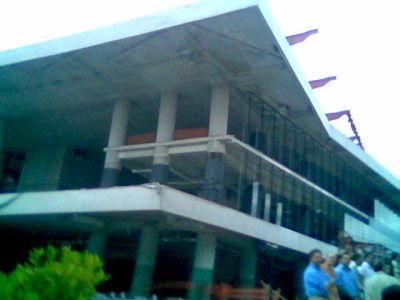
The new Museum, being built next to the Weiler building under the Acropolis.


George, Poppy and K

Far too many people in too small a space and politicians and the teams of cameramen following them gave the whole trip to the museum a different feel altogether. The exhibition houses some of the findings from the site of the new museum being built just a few tens of yards away, displayed in cases made out the building materials being used on the new museum. The site cuts through a good slice of old Athens from classical through to late roman and early byzantine. The site will be visible through the floor of the acropolis museum making it a huge almost open-air museum. Poppy had worked for some months before leaving for the UK on the site and had been informed of the opening by an archaeologist friend who was involved in the excavations of ten years.

On arrival and after all the faff of waiting for the Minicult to arrive, we went in and sat through speeches by inaudible archaeololigsts and the booming Minicult himself who mostly talked bollocks using rhetoric worthy of midday soap operas rather than someone with the syllable "cult" in his title.


After the obligatory chamber music and mad crush for the drinks table, and after some of the most impolite and unbecoming scrambles for the unimaginitive but tasty enough canapés K and I managed to enter the exhibition. George and Poppy had left for elsewhere.

Poppy's friend was showing someone famous around. Well, famous enough to be shown around by one of the excavators, but not famous enough to be someone I recognise. The plus side to all this fame and what have you is that K and I and half a dozen others managed to piggy back on Tatiana's tour of the finds and at the same time benefit from both her enthusiasm for and knowledge of the site.


The exhibition is separated into thematic sections.


The first section is worship. In this section we have some good marbles statues of deities which are very rare indeed outsdie the east - there are not many excavated sites in Greece which are contemporary with some of the sections of this site, so although we got the oriental gods here and there, what was found in this esentially rescue dig was unique in Greece. The first "cool" find is a statue of "Isis Panthea" an Isis figure from the second or third century AD.

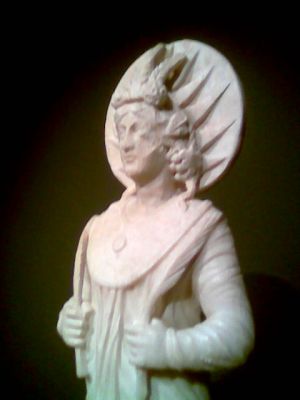
Isis Panthea

Why Panthea? - well, she’s got the sun disk of Sol Invictus, the corn sheaths of Demeter, the aegis of Athena, the grape clusters of Dionysos around her ears, a snake running around her body, reminiscent of Asclepios, and she is standing on a funky crocodile. All the gods and goddesses together… Next up comes a Zeus Heliopolites – Zeus from Heliopolis (today’s Baalbek), with a whole bunch of other deities on his tunic.


Zeus Heliopolites, appearing after coming all the way from Baalbek, Ladies and Gentlemen

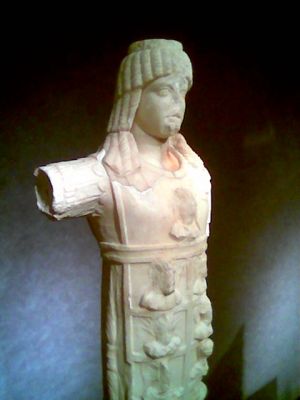
We also saw a nice representation of the Artemis Astarte with the many breasts.

Artemis of the many breasts...


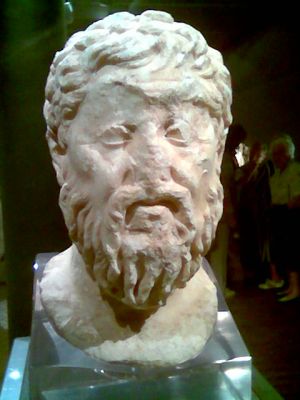
There was a good bust of Plato from a Herm, and a whole bunch of home implements and pottery, commercial stuff and tradesmans' craftsmens' stuff in the economic activity section.

Plato

One thing I liked a lot was how they give the concept of stromatography a real good showing with this conceptual well with many pots discarded in it over time after it had silted up.

Nice representation of the stromatography in one of the silted up wells


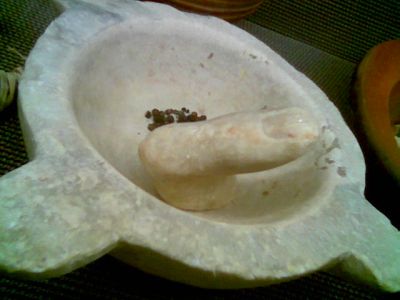
I also liked this thumb shaped mortar for the pestle – very nice and apparently not uncommon, sitting amongst the spice containers and cooking vessels in the cooking section of the exhibition.

Can't find something witty to say - but I'm working on it...

In all the exhibition is really quite worth it, very nicely put together museuologically and interesting for the wealth of second and third century AD items on show all in the same place.


Like I said before, the experience of seeing it under the wing of one of the excavators made the whole thing that much more fun.