This article was edited in December 2012 to correct some image links
Please see my
new post on the improvements made since Summer 2009

Don't get me wrong. The new museum is great. It's unique in terms of the architecture and the finds being exhibited inside. It houses the foremost collection of archaic and classical "golden age" sculpture in the world. There is no other such collection and there can be no other.
So, let me tell you about the museum, then, the museum that they have been building for more than four years; the museum that has been built and finished for the last two years (which were spent on the transfer of the exhibits from one building to the other). I emphasise the timescales involved, to pre-empt the whingers who will try to reason that all that is wrong with the museum is a result of the short timescales involved.
I have been
critical of the management of the Museum Opening through this blog in the past. I had hoped to be able to come back with a gushingly positive review of the museum itself, to show to myself as well as to the world that Greece knows how to manage its cultural heritage. Unfortunately, this will not be possible. The museum is not so much a varnished turd, as a lilly gilded with shite (and then varnished). The material the museologists had to work with was amazing, the museum itself is rather disappointing in spite of this amazing material.
My complaints cluster around certain categories all of which are seen in the light of the media blitz telling us that this museum represents THE new way forward for all museums in Greece and that this is the face of the future.
Printed material
My first criticism is the lack of printed material for visitors. In every other archaeological site and museum in the country including the forgotten House of Tiles at Lerna which seems to receive no more than eight visitors annually, the visitors are given a glossy printed "guide" in their choice of English or Greek language, showing a floor plan of the site or museum and information about what is being seen. This is given out together with the entry ticket.
At the Acropolis Museum, which admittedly has just opened (but which has been in a state of being
about to open for the best part of two years), the visitor is given his barcoded ticket (a nice touch, although it has been implemented in less advanced countries such as Turkey for years) and that's it. No leaflet, nothing. From there on, the visitor is left at the mercy of the occasional signage pointing him to the next floor. The result of this, I saw quite clearly in the group of English-speaking tourists wondering whether there was anything more to see on the floor above the gift shop and cafeteria. I interrupted them and helpfully offered that they may want to go upstairs, given that the museum was built essentially for the plastercasts on show there.
Sure, there may be a printed leaflet on the way, but why isn't it here yet? Was there not enough time? Was the floor plan not known?
Photography ban
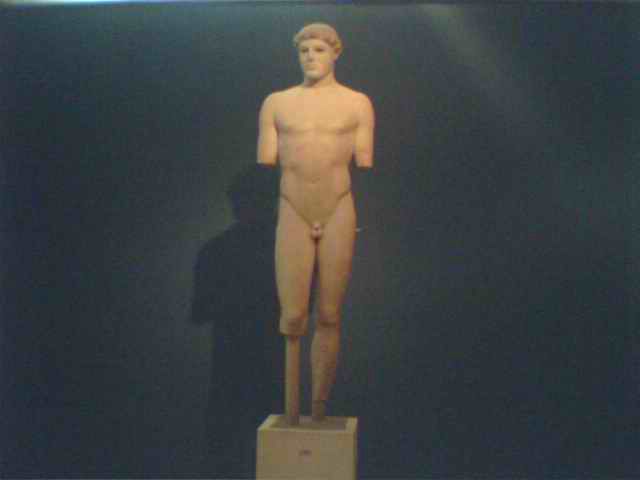
This, at the time of my visit had me more annoyed than anything else. I have been away from friends such as the moscophoros or the sandal-binder for about four years, and now I can see them again, I am not allowed to photograph them. This unjustified ban is as unjustifiable as the illegal summerhouses being built in the burnt forests of Attika.
I am curious from where the authorities of the new acropolis Museum think they are given the right to impose a blanket ban on photography in the museum. Certainly not through Law 3028/2002 on the protection of antiquities (and in general of the cultural heritage of the country).


Apparently, the ban was put in place (according to the guard I asked) because some people were taking "improper" pictures together with the statues. This very unique ban on photography is put in place because people are interacting with art? I am shocked! I am shocked, given the copious amounts of information you give the visitor about the exhibition, and given the respect for the art he is watching that this information will have built in the visitor, I am shocked that some chose to photograph themselves standing next to or even pointing at the penis of a statue. How could someone do this after all the interesting information the museum has provided? And even so: how elitist and snobby does one have to be to proscribe how exactly the visitor is to react to art, that some reactions are acceptable and some unacceptable?
Is the museum in the present century? Does it acknowledge the universal nature of the items on show inside? How can it argue that this universally recognised art should be accessible to all people of the world and then proscribe to these same people the way to enjoy it? Is the status of the Venus de Milo or the Lacoon or indeed of the originals of the plastercasts of the Parthenon marbles any different because photography
is allowed?


Ban this sick filth!
(Photos have been downloaded in low res, clicking on the image will take you to the original source)
I will not dwell on the photography ban as I consider it wholly temporary. I am just sad that I could not share all the wondrous things I saw, the new faces of old friends.
Poor explanatory materials
Two problems here, both of which stem from the narrow-mindedness inherent in the system. The labels and explanations are written by archaeologists for archaeologists. The labels on each individual item are very cursory and the general texts do nothing to help the casual visitor who has heard of neither Kekrops nor Erechteus nor indeed Hercules (unless in relation to Xena, warrior princess).
The individual labels rarely go beyond a name and a catalogue number, as if this is enough for 95% of the visitors to the museum who hardly realise that possibly all of the archaic sculpture they are looking at is on display because of the same Persians depicted in the hit film "300" (this is Spaaaarta!). To put it journalistically, while the "what" and possibly the "when" are covered (albeit in a very superficial way), the "where", "why" and "how" are left very much missing.
Why is there no text describing for example, what the gigantomachy is? Or indeed what the amazonomachy and kentaromachy scenes are representing: the Greeks and the 'other'? What is the procession showing on the Parthenon frieze, how many horsemen are there and is it a coincidence that there are 192 of them? In the room full of the Archaic Kouros / Kore / Horsemen: Why was this sculpture erected, where exactly, by who, for what purpose, how was it made, where did the raw materials come from, how much would it have cost (how precious was it) and most significantly, how come this sculpture has come down to us: why was it buried in pits? Perserschutt is a wonderfully fun word, after all
(Perserschutt on wikipedia). Why is the Kritias Boy so called, but more interestingly, how is the weight balanced on his feet? What does that do to his buttocks? It is infuriating that for the first time visitors to the museum can walk around a three dimensional sculpture that was created to be seen in the round and there is no help offered to them to guide them in their appreciation. It is easy to appreciate the hair on both the Kritias Boy and the Blonde Boy when you know what to look for, but unfortunately most visitors do not. And why are there no analyses of the composition of the kentauromachy metopes contrasting those showing elegant use of space to those without? Finally - for the first time the friezes and metopes of the Parthenon are displayed in glorious 360 degrees, with their back surfaces exposed to the museum goers. This is the case with the balustrades of the temple of Athene Nike also. This is a joy to behold if, like me you are interested in the makers' marks and the pragmatic side of decorating a temple - ie how to fix the decoration to the temple itself. But again, it is mentioned nowhere that it is possible to see this and that the visitor may learn from this innovative way of displaying the exhibits.


It is snobby and elitist to throw art at the people without providing explanations and insight for those interested in learning how to appreciate it more.
I'm not saying there should be touch screens and multimedia mumbo-jumbo (although that would show a more 20th century approach to museum displays), just more information and the right sort of information. At the moment it is almost totally lacking in printed form and totally lacking in the form of walkman style audio tours. Even the jumbled Roman and late antique town under the pilotis of the museum are left completely unexplained, despite the marvels of modern engineering employed to protect them.

Lack of child-friendly ideas
Children do not exist, at least for the curators of the new acropolis museum and their handlers at the Ministry of Culture.
Very few of the exhibited items are accessible to children, those that are, are accessible by accident rather than by design. Even so, there is no printed information for children of the sort that one finds in museums in Rome which provoke the kids into interacting with their past.
All it takes is a sign with big font text asking kids some questions to get them thinking: Questions could range from the totally neutral: Why do you think the statue of the Kore has got one hand extended? To the (unacceptably) sentimentalist-political: What do you think the five Karyatids are thinking about the empty space next to them?

Both of these last two faults may be explained by the fact that there was no time. I realise that the three to four years or so between the closing of the old museum and the opening of the new one are a very short space of time (almost unimaginably short, approaching quantum-short) for the hiring of archaeologists with museological postgraduate qualifications to prepare texts for the visitors. Such people do exist, and I am sure they would have loved such a challenge. Time was not the problem. The problem is that the Ministry does not care, at all levels. From the guard in the Mycenaean room at the National Archaeological Museum who wouldn't know, if asked, where the Sesklo finds are (just through the door on the left) to all other levels of the hierarchy, apathy is king. The lustre of the exhibits is expected to carry the lacklustre effort made to dress them, but this, unfortunately, will no longer do.
So, we come to the final question: what is the role of a museum, in the 21st century? If the role of a museum is to teach or to communicate to the visitor about the exhibits, then the New Acropolis Museum fails. Other than presenting the exhibits, this museum does very little else. Granted, the architecture is amazing especially in the use of natural light.
However, the New Acropolis Museum does not explain nor does it help the visitor to understand the conditions which existed while the exhibits were being made, or why this is important to today's society.
I have been taught that one does not respect that which one does not know well. No wonder that in a society which seeks to impose admiration of the past without also seeking to promote understanding of that same past, we continue to show disrespect to ourselves and our heritages.
Given the state of the Ministry of Culture and its status as dumping ground for otherwise useless political has-beens (not forgetting the rotund fraudsters), it is no surprise that the Greek state has failed to make the most of the new museum. The problem is intimately linked to the leadership of the Ministry, because the problem is one of vision. There is no forward-thinking vision because those entrusted with the protection of Greece's heritage sit safe in their own blinkered world view: they cannot see beyond the walls of the offices surrounding the soft chairs to which their comfortable arses irrevocably adhere thanks to anachronistic civil service staffing laws.
The irony of naming the archaeo-web portal of the ministry "Odysseus" is not lost on many. It would have been fitting had the people of the ministry shared the hero's inquisitive nature and had allowed themselves to "get to know the cities and minds of many men" like he is said to have done.
We cannot assume that because we have the unique resource on our doorstep, that we know what to do with it and how to manage it. This last sentence alone is likely to rile the feathers of many within the musty, cocooned and introverted ranks of Greek academia.
So - final verdict: go to the museum, but learn about the exhibits before you set out.