Occasional ramblings, covering a whole host of subjects, mainly centered about my life. Dull? maybe. Repetitive? possibly. Real-life? probably. Expect a whole stream of banal ravings with some gems thrown in, as a surprise...
So, the beginning of lent is a strange time. It sits in between Lent and the Carnival straddling as it does the time of plenty with all its bacchic dionysiac hang-overs and the austere and Christian fast which brings us to the greatest holiday in the calendar: Easter.
The dome of the Omorphoklisia church with kite in the background.
It is usual practice for the municipality to provide the "Koulouma" (a word derived from the latin cumulus), the surplus of whatever is left that has to be done with for Lent. It's common for the municipalities to provide food suitable for fasting in open spaces where kites may be flown, for that is our custom.
We decided to visit Veikou Park, belonging to the municipality of Galatsi (a suburb of Athens built by refugees from and named for the Romanian Town of Galaţi), not least because the park is close to a 13th Century church which I have read about and want to visit, but have not had the chance to do so. The view from a distance was brightened up by the large number of kites in the sky all with their happily streaming tails. We parked about a mile from the church and walked up to it, then crossed opposite towards the park where there was all sorts of crazy stuff going on, things being bought and sold and people thronging and whatnot.
We bought our kite from a Roma at the entrance - a fancy schmancy affair in the shape of a bird, with a 3D body. The seller set it up for us leaving me to carry around this huge bird with more than 1m wingspan complete with bits of wooden rod sticking out (I would have had someone's eye out on one of them, but I was being careful).
On our way up the hill, we passed many of the people who are by their presence and nature helping to increase the cultural diversity of Athens. Extended families were sitting and picnicking, some with their women in headscarves, some with their women in saris most with meat on their plates thereby indicating their "otherness". It was quite exciting to be here at the beginning of the breaking of the homogeneity of the Athenian cultural make-up and it was interesting to see the Albanian balloon seller trying to persuade the Kurdish family to buy a balloon for their little girls.
We flew the kite - it soared and took us to the limit of our line - we wanted to have had more line and more time. For all my previous attempts to get kites in the air - this is the first time I can comfortably say that I have flown a kite properly. And I am hooked!
Now it is time to start preparing the messenger and the parafauna for next time!
Once upon a time, what seems now like a long time ago, but isn't, I read about the Oregon Scientific helmet cam on the NSS caving forum. One of the gear-heads mentioned the ATC1000 which was just out at the time and I bought one and played around with it.
About six months later I bought the upgrade model ATC2K. So, seeing as I had promised this to the guys over at forums.caves.org, time for my side by side comparison, here goes:
ATC1000 on the left, with AAA cell, right the ATC2K with AA cell
The ATC2K improves on many of the ATC1000's "problems" for caving. For me, these are waterproofness of casing / behaviour in low light / battery issues / mount. We'll go over these one by one.
The first is the more rugged and more waterproof casing. A side by side comparison of the two cameras shows that the older model is far longer than the recent one, but thinner and more cylindrical.
The ATC1000 is rated only splashproof (although mine has survived a brief total dunking) whereas the ATC2K is rated as being waterproof to 3m. The ATC2K also has a shadow guard (peaked front) for reducing flare and has a more rubbery feel than the ATC1000s very plastic look. Both have received their fair share of knocks and scrapes while attached to my helmet, without any problems or malfunctioning. After about 8 months of use (and this is connected to the mount also) the front end of my ATC1000 came off, making it no longer splashproof. I have submerged my ATC2K to about 4 or 5m without problems.
Behaviour in low light, next. The ATC2K is very much better at acquiring an image is low light. I don't know whether this is a CMOS issue, or a result of different hardwired software in the camera. The ATC1000 shoots at 15fps and gives a very smooth image with many tonal ranges. The ATC2K shoots at 30fps and gives a more contrasty (sometimes blocky) image. Whether the trick to achieve the increase in fps also necessitates loss of image quality I am not qualified to say. How this links in to the fact that the ATC2K will give a better balanced image in low light I also don't know. For someone who has not seen the image quality of the ATC1000, the quality of the ATC2K is not noticeably bad. The fact that it will capture an image, when the ATC1000 will not is what is important to me.
Comparison in low light and external conditions
Comparison in street conditions
Comparison in cave conditions
Battery issues: size and lifetime! The ATC1000 takes four AAA cells. The amount of recording I could get out of new alkalines varied from about 45 minutes to 75 minutes depending on the subject and the amount of time the camera was on standby. The lifetime of some otherwise pretty good Ni-MH batteries was not so good, ranging from 30 minutes to no more than 60 minutes. The cost of new batteries per hour recording or the inconvenience of carrying many spares was unsatisfactory. Further, it is almost impossible to change batteries without a pen or a safety pin to release the latch, especially when wearing gloves. The ATC2K takes two AA cells, much cheaper and much easier to find. The battery life was close to two hours for alkalines or well over one hour for Ni-MH rechargeables, meaning that you have to open the back more frequently to change memory card than to change batteries. So with the ATC2K you get many more hours recording for the buck. Another thing is that the battery indicator comes on when you have about 10 or 15 minutes of recording time left, giving plenty of warning. On the ATC1000, it would often come on immediately before the camera died. I am curious what the TFT screen on the back of the ATC5K is going to do to battery life.
Mount issues: The ATC1000 did not have a satisfactory system for mounting the camera on a helmet - the system required leaving the clasp in place on the helmet and sliding the camera in and out, something which may have sped up the detachment of the front cover of the camera. After a few uses like this, I decided on using inner tube rings to keep the camera attached to the helmet, something which worked well enough as long as I jammed a toothpick in there as well to keep the axis parallel to my line of sight. The mount for the ATC2K is much more handy, having a clippy system allowing you to detach the whole camera from the female mount with ease. I have the female part permanently fixed to my helmet and clip the camera into it whenever I want to. It sticks out from the helmet quite a distance but this is easy to get used to. As I wanted to be able to alternate place of mounting between helmet and elsewhere, without having to take off the helmet so as to undo the strap, I wrote to Oregon's customer support about getting more female clippy parts, but I received no response.
Some words about Oregon's customer service: there ain't none. You buy the camera, and that's it. If you want to contact them by e-mail, they'll never answer you. I have sent repeated mails to Oregon about various questions and none have been answered. I once sat in an automated telephone queue for 40 minutes never getting through to the support staff. Oregon are crap - if you buy something, from that moment on you have to come to terms with the fact that you are on your own. This is not the sort of customer services I have come to expect from across the lake. People interested in the ATC3K and ATC5K coming soon, should keep this in mind.
One more thing - after about 11 months of use, my ATC2K developed a patch of dead pixels or something, which was not on the exterior of the camera but which created a dead spot a few pixels in diameter. I have tried to reach Oregon about this as well, but with no joy.
So, I have spent part of this morning, still nursing a dodgy stomach and a slightly groggy head, reading such gems as: "subjects are capable of participating even in salient, emotionally charged events-as well as more mundane events-that they later cannot remember" and "far from losing consciousness, the literature suggests that it is possible for individuals to experience blackouts while appearing only moderately intoxicated to the outside world". Tell me about it.
The last time this happened was back in the mid nineties, at that famous boatie dinner where they served a carrot soup for starters and then no one (apart from RVM) remembers anything at all. It is not good waking up and not knowing how you got home, how you got those bruises, what you did and what you said. Especially if the last time this happened, you were told that you had kicked a fellow from the vet school in the face (hi, Rachel).
So, I figured out for myself that some time between 3:18 and 3:24, I blacked out. I have photographs I recall at 3:18 and photographs I appear in but do not remember being taken from 3:24 onwards. On one level, it feels like I had a chance to get things out off my chest, that lack of alcohol would have inhibited. On another, it is scary to think that my own memories of everything I have been told that I said and did are gone forever and cannot come back.
Apparently, when the blood alcohol content hits an upper limit the capability of the brain to form long term memories fails, because the alcohol interferes with the transfer of messages from the short term to the long term memory. It's like its being relayed to a tapedeck with no tape in there.
It is all just a blank and this is scary. When the guards are down, we open the way to the monsters from the Id to come rampaging through to the real world. It seems they did to some extent.
Well, I remain groggy and confused. While my first two blackouts were five years apart, the second and third were more than ten years apart. I hope the next one will be so far in the future that it won't happen.
So, K's been 'fluey for about ten days now, probably due to more than one cold or 'flu bug. I have managed to remain uninfected so far, which is just as well, as I have not had a jab for two years.
I received a text message one evening - "I have broken the thermometer"
Great - there's me thinking that the house will be flooded with hyper poisonous mercury fumes and what-not. In the event, there were no fumes and no little silvery liquid blobs zooming around my floor like the T-1000. There was however a small bubble of mercury rolling up and down the plastic case in which the broken thermometer was sitting.
No probs, I think, I'll take it to the chemists next door and ask them to dispose of the thing safely and I'll buy a new electronic thermometer while I am there.
Hello, I say to the nice chemist as I walk in, I'd like to buy a thermometer and to leave you this broken one so you can dispose of it with your other hazardous waste.
- Blank stares.
There is no provision for disposing of mercury thermometers safely, I am told.
So it all goes to the landfill?
- Nods
And the baby seals? I ask pleadingly…
- Shakes.
So it seems that there is nothing to be done but let the broken thermometer go the landfill, potentially be played with by the gipsy children, end up in the ground water and the food chain in general, and finish up in the baby seals or worse still in the cute fluffy polar bear cubs.
I resolved at that point to write to the municipality, something I have not yet done, but, believe me, I will do it. Apparently, there is no provision for safe disposal of medicinal sharps, either.
I love living in the Alabama of the European Union.
So I am feeding the addiction to the online world even on my holidays. This is a French keyboard, and of course the French have to be different and have to have some of the keys in slightly diffreent places. Please excuse any stray wierd letters that may creep in.
Today we started from the base near the Place Gambetta and went into the centre of town to the Sainte Chapelle chapel, advertised as a rather fine bit of Gothic architecture in the centre of town, and surrounded by the buildings which replaced the halls in which Julian the Apostate once ruled. Other parts of the itinerary included the St. Severin, St. Julien, Museum of the Middle Ages and more.
I will have time to write more some other day, with photos. Kiddy bedtime dictates I now shut down.
While making the kiln, I took some photos of the three little visitors who had come to watch me build my kiln. I have never seen any these little guys in life before (I have seen many dead ones) so this was quite exciting.
The taking apart and rebuilding went to plan. I now had a kiln proportioned correctly on the length and width axis. The height axis was causing me problems, as using the two different types of brick made it very difficult to ensure that I had the correct ratio of firebox to chamber. Even so, at some point in the building I decided against the side opening for loading and unloading of the kiln for a number of reasons. The main reason was the odd proportions of the firebricks I am using, meaning that I had to lay two courses for each one in the plan to make the overall ratios of length to width to height fit. To avoid brining in weaknesses to the structure, I decided against exact doubling up of the bricks keeping the half-step building style going. The photos show the mock-up from the first day's efforts - to give an idea of the problem (four "half" bricks needed in the alternating layers).
I decided to do away with the side hole and make all the packing and unpacking from the top, which I would seal over with clay before the firing starts. Seeing as I had a number of firebricks left over I also increased the height of the chamber by one or two rows. Other than this, the kiln is built on the basic plan as given at sidestoke.
In this image the proportions are visible. I have replaced the normal bricks with firebricks for the grate to give a bit more room for the stoking process. I also like the idea of the sideways bricks in course 3. They should give a nice amount of air to the firebox - so it is not all bad that I did not have firebricks for the whole kiln.
My proportions are: ashpit and firebox two courses high: 16cm each. chamber is 9 courses high: 36cm
The chamber to firebox to ash-pit ratio in my kiln is therefore 9:4:4 The original plans call for a ratio of: 4:2:2
I am wondering whether this will make a difference or whether I should move a course down below the kiln floor, to make for a bigger firebox and smaller chamber.
My chimney is also a few courses shorter than the plan. If people think that I should lengthen it (with a metal tube or something) I will do so. It is meant to be 8 courses (16 of the half bricks) and it is only 6 (12 half bricks).
Finally, I have this back view of the finished kiln.
I have written in the past about my attempts to fire home made crude pots in the garden of my mother's house in Paloumba. The time has come to finally make the woodkiln that I have been investigating and planning for the past seven or so years. I have signed up to the woodkiln list on yahoo and I have bought a few books on the subject. The plan is to follow as much as possible the plans for the simple kiln on the Rosser site (http://www.sidestoke.com) with modifications to take into account the fact that the bricks I have are not standard western house bricks (6:3:2) and are not all the same size. The other problem that I have is that not all the bricks I have are likely to stand up to any sort of thermal shock. The plan is to put these non-special bricks in the ashpit and the firebox, the reasoning being that the real heat will follow the airflow into the chamber and out of the chimney. The bricks I have are either standard fine-ware building bricks which are 18 x 8 x 6 and will probably collapse spectacularly when the fire is kindled and some proper firebricks which are 22 x 11 x 4- a ratio of (6:3:1.09).
The plan was to modify the plan on the Rosser site, to take into account the two different brick sizes.
On the first day, I made a mock-up of the kiln proper - layers 6-14 out of firebricks, repeating layers 8, 9 and 10 to take into account the shorter brick height. This went very satisfactorily indeed and was a very big boost to morale in the planning process. One thing that came to light was the need for leveling the ground a little before starting the next day. Everything else looked good. The next day we went shopping with a friend living in the village called Kalinikos who knows about bricks. Going down to the river which separates Arcadia from Elis we bought a hundred of the standard bricks despite the protestations of the seller that they were wholly unsuitable for use in making an oven.
With the bricks in the back of the Panda, we returned home and put them in the garden ready for today's building effort.
Today, day three:
I cleared an area about the right size with the pick - to get all the grass and other plants up, then laid down a layer of the normal brick down to be my base. This layer was 10 brick widths long - to correspond to the 9 brickwidths of the firebrick which would be the length of the finished kiln. I did not take into consideration that 10 lengths of the short brick is shorter than 9 lengths of the firebrick. I then went on happily building row on row of the normal brick to make up the ashpit and firebox. I used the firebrick for the firebars just to keep some idea of the size of the firebrick superstructure in mind.
When the time came to put into place the first of the firebrick layers, the kiln floor - level 7 in the plan, I noticed the first major flaw in my work. I say major, because I don't consider the lack of horizontality in the brick courses to be such a large problem. As I was counting out the bricks to make my kiln floor, I got closer and closer to the edge, but there seemed to be no way to complete the placing of the bricks in the space I had set out. I had set out too few bricks in the lower courses and I was one half brick short of the planned kiln length.
Now, the plan is to take apart the front edge of the kiln, then flatten the ground in front of the kiln and relay bricks to allow the kiln to be made to the size in the original plan. This, for tomorrow, then.
So a long time ago, I had written about the fight or flight mechanism, but here I am having gone through many cycles of fight and flight and profuse sweating and what have you and I am experiencing what I can only describe as a whole new reflex. I present to you: the flight or sleep reflex.
Oh yes - just when I should be fighting or fleeing, here I am, feeling that everything will become better if I take a nice little nap.
This is not the first time that I have had the flight or sleep reflex (which will no doubt travel the world as the "slap or sleep"). The only evolutionary explanation I can come up with for it is that by taking a nap in the presence of the predator, one may be able to persuade said predator that one is already dead and therefore not so good meal. A sort of possum response.
Of course, in the real world of today's interglacial holocene, taking a nap is often not the best way forward. But by god, do I wish I could.
So, here I am - physically and mentally, like, squeezed and I'm wondering, like, when is it that I have to stop pretending that it isn't and actually face up to the fact that my left thumb is going spastic on me, a little bit more every day, but definitely spastic?
There's a pretty question.
Thing is I have never had anything go spastic on me yet. So to acknowledge the thumb's spasticity is to acknowledge a whole new different symptom. And I'm not sure I want to do that before finishing off some work I am working on, and stuff. Got to look into it because I can't remember if spasticity is caused in the brain or in the spinal column (like the various exciting forms of paraesthesia I live with).
But I won't look it up because that would mean taking my head out of the sand.
Recent additions to the youtube area are a rather long winded tour around the church of ss sergius and bacchus (kuçuk aya sofya camii) set to Holst's Mercury:
an off beat tour around the back of the church to the cemetery, after hookah in the garden, set to jazzy drum beats:
a rather fine airplane film I am very pleased with, set to "one of these days":
the selection and purchasing of some roadside onions in Buzau county Romania:
and finally, a bunch of random fish swimming around near prassouda island in the pagasitic gulf:
Ash is still raining down from Euboea onto our balcony.
The country is waking up to the realisation that the state cannot do anything about the fires, whereas perhaps the right realisation should be that we are very small opposite nature and of course we cannot do so much when she is putting on her red and orange ball-gown. But then, we 21st century humans are so quick to forget how small we are in front of nature.
So while most of the southern part of the country is burning on TV I have my sister, trapped for two days by the fires and my mother now told to abandon the village both running loose around the Peloponnese and no-one knows what the hell is going on.
White smoke means no fire, black smoke means there is burning. Apparently.
For two days we have had ash raining down on our balcony in Athens. The sun shines a different colour depending on how fine the smoke particles are as it passes through. It would be interesting to sit and observe this if one could separate the cause from the phenomenon in one's mind.
So many of these places I have walked through their forests in the past. Here is not the place and now is not the time to talk about proper forest management.
yeah so in the four plus years I have been travelling with it, why now, in the middle of the scorchingest summer do I have to leave my autoject in Athens? Arsecandles!
Woke up to the smell of burning pines in the morning and an unnatural light glowing over Athens as the sunlight filtered through layers of different sized ashes held in suspension in the air.
Snowfall-like the ash was being wafted on the same breeze which further to the west was fanning the flames and sending the ash coming our way.
We cannot see the damage, the smoke is too thick to see the mountain.
I have a little add-on for Firefox which tells me how I am doing on the smober front. Well, it seems that I have not smoked for 16,000 hours. This is a saving of 1,800 euro and represents 13,333 cigarettes not smoked since that morning in August 2005.
So when I went for my quarterly trip down to the nice people at Schering who give me my injectables, it was all change. None of the old staff were there and for some reason everything was now branded Bayer - yep the aspirin people have bought out the interferon people. Big deal - as long as the stuff is still produced and dished out as before.
And here start the problems.
There is too much different about the whole system - different needle widths, syringe widths, different amount of powder and juice, different use of the mechanical autoject thing.
The injection itself seems to take a much longer time, meaning motionless hands for longer, there are more windows to watch from, which is just horrible if you think about it. I hate watching the plunger through the window.
And size - everything is so much bigger and unwieldier for traveling with. Yukky yuk yuk is basically what I have to say about the new set-up - albeit before using it for the first time. Maybe I will change my mind afterwards.
Just feeling a little down in the dumps because it seems to have added a little more complexity to that side of my life and I don't like it because I had no say in it.
Well, I can't find a copy of it and I did search for a good 90 seconds or more on you tube, so sorry - you will not be seeing the video that made me 'click' in two different ways.
Background - hmm. Well on Sunday we went down to the SEF - the peace and friendship stadium, which was housing a medical exhibition for the lay person. Bunch of bollocks, no really it was crap firms selling para-medical trivialities like battery powered vibrating massage toys and orthopaedic chairs and the like. At the same time, there are various talks open to the public about a variety of issues.
So, there we were, with our brave faces on, going to a talk all about the monoclonal antibody whatsit - to learn about the newly approved dog's-bollocks of MS medication. It was with some trepidation that I went - yes, I wanted to learn more about this thing and of course I did not realise from the advertising leaflets that its the drug that had its clinical trials suspended in the states because of people dying, but which was rebranded and re released because one in a thousand rare encephalopathy cases and some deaths are not to be put in the way of a multibillion (billions and billions) dollar industry. There was also a talk about fatigue which is more what drew me, and more about that later.
Brave faces - yes, so there we were. I was wearing mine because I was wary of being confronted by a hall full of wheelchair bound, walking stick wielding people and having the little voice in the back of my head telling me, "you see that, that's you that is, in a few years". So it was my first time in front of a bunch of people having the same dx. All I will say about that is that I rather hope that those with the canes and the wheels are more likely to come to these meetings thus skewing the statistics slightly.
Anyway - the lady doctor gets up and does a very rushed rendition of a bunch of powerpoint slides she did not prepare herself. One of these slides had a video which helped me understand for the first time one of the mechanisms of how the MS works.
The video shows this big spikey white guy zooming around in the blood and then squeezing itself out of the blood vessel (crossing the blood brain barrier) and grappling onto the myelin of a brain cell which it then goes on to destroy. So now I understand the whole blood brain barrier white blood cell whatsit alittle more visually than before.
And the lady doctor then went on to talk about the new wonder drug and what it does - and then came the second realisation of the day - the drugs are fighting the "how" of the problem. Tysabri (and as far as I know all the interferons) stop the spikey white guys from crossing the blood brain barrier. That's what they do (and a little bit more, but essentially this is it). First off, I am appalled that we are dealing with the "how" and not the "why" dammit. I am a "why" sort of guy and I'm fucked if I'm going to sit back and expend energy on building dykes rather than stopping the flood waters from rising in the first place.
The talk by the lady doctor was heavily into selling Tysabri, and spent a lot of time talking about the encaphalopathies which were caused during the clinical testing, but she somehow neglected to say that death resulted during the clinical tests in the states. A heck of a lot of slides all about the encephalopathies
Did I mention that the whole thing is sponsored by Genesis? Ah, no.
If I had remembered this myself, I would have been expecting the shameless plug for the sponsor's anti fatigue drug which took up most of the talk on the fatigue subject. I was not a happy camper. I don't want to hear about drugs, to treat syptoms I want to hear about what you are doing to combat the cause.
Anyway - that was a semi-wasted morning which could not be redeemed not even by the amusement afforded by watching the people turning up after our talks had overrun for TV sex-doc Askitis' talk on erectile dysfunction. Oh and by learning that the local office of the MS Society has been overrun by representatives of pharmaceutical companies and big industry and they are using it to their own aims while the patients go unheeded. That wasn't good news. The good news was in fact that a new society has been launched only for those with a diagnosis, to ensure that that does not happen again. It looks like some disgruntled patients have run off with the mailing lists and are regrouping elsewhere.
The day was properly rescued by my first real visit to the NAM since before the quake, and that needs its own post later.
So the rain rained and the thunder thundered, but everything still went according to plan. Almost. The one day of good weather meant that we did not do Polydrosso on the Sunday, but did exams instead.
So, the practice of leaving the city for the countryside in order to catch "May" probably has its roots in pre christian times and is probably independent of the calendar itself.
We left Athens on Tuesday morning with a hamper full of goodies lovingly and painstakingly prepared by K during the afternoon and evening of the 30th of April. The plan was to go and visit a sinkhole at Skourta in Boetia, survey it and assist Komni dive the sump at the end of it.
The weather was not so good, cloudy and drizzly. On reaching the sinkhole, we saw that water was running into it, making it potentially dangerous to enter, and certainly dangerous to attempt a dive.
We re-routed the party from the plain of Skourta back onto Mount Parnes and headed for the fort of Phyle. Here we were met with a rather disconcerting spectacle: close to a hundred day trippers each with a portable barbecue and popular music of the most degenerate popular nature blaring from the car radios. We walked up to the fortifications, past one family group which was preparing to barbecue what looked suspiciously like genuine cantral asian shashlik and sat around admiring the view of Athens from the fort. Bored, and having sated our mayday induced urge to gather flowers and weave them into garlands, we split up, some going back home, others for rock climbing and us, with hamper safely in the boot, heading off to make a quick tour of the castles of the Attiko-boetian borderland.
Our tour was not as successful as we may have liked and our sprits were a touch dampened by the lack of sunshine. We drove up some exciting dirt tracks following ministry signposts to castles and forts on the way to the tower at Oinoe, and from there we went on to what was once called the castle of the Gypsies - Gyftokastro, but unsurprisingly this name is being used less and less in favour of the fort's ancient name - Eleutheriai.
This is a nice little fort situated in a very commanding position on top of one of the few roads linking Thebes to Athens, and it is in very good condition.
Google Earth shows it very nicely:
We walked around here for a while and took our hamper to Erythrai. Not finding the fort here (note to MiniCult - what about a signpost guys?), we went on to Plataea, saw the walls of the city, were unimpressed and set off for Kithairon with our hamper, spending about 45minutes trying to squeeze our way through the 4x4 infested streets of Villia.
And there on Kithairon, the scene of Oidipous'exposure, and Aktaions and dismemberment, but also (more happily) the scene of one of our first trips out of Athens with K (before we started going out), and with a rather cold wind blowing, we enjoyed our picnic at 1080m altitude.
Photos and possibly more videos as and when they are processed.
The 23rd of April is not always St. George's day. Oh no. The feast is such a big one, probably the biggest of those not immediately connected with Christ or the BVM. For this reason, if the 23rd of April falls in lent (and it does so more often than not), then the feast of St. George is celebrated on Easter Monday. This is because Lent is a time of solemnity and whatnot and we can't go feasting and celebrating in the middle of lent.
So, this year, St. George's day falls on the 23rd as it should. St. George is called the tropaiophoros, the bringer of triumph and is one of the earliest saints to be revered by the church. The whole story with the dragon comes from the levant (lebanon alone has a handful of locations with claims to be the spot where the dragon had been killed. The English crusaders (more about them some other day) saw the cult of the warrior saints (George and the many other literal soldiers of christ) and took his cult back to the British Isles with them. Together with the cult, they took back the red on white cross, known as St. George's cross. It is currently also displayed on the flag of Georgia.
Anyway, back to our picture of the day: the picture shows a piece of cloth with woven design measuring about 20 by 20cm (about 8x8 in inches). The design depicts a mounted saint dispatching a dragon - the chances are that it is St. George, although St. Demetrios is infrequently depicted in a very similar way. It's not clear whether there would have been space in the top right corner for St. George's little helper and the princess who gets saved. Both are iconographically late and are probably not there.
Last for today - the cloth is from the Egyptian collection at the BXM, hence we have it at all. The BXM's egyptian collection has a great number of both everyday items and ceremonial items of normally perishable material which has been saved thanks to the arid climate of the egyptian desert. That is why we have this cloth and quite a few other things, some of which may be featured in future pics of the day.
Today's picture is from the Byzantine and Christian museum in Athens, from the section of the museum dealing with late antiquity when there were many changes being made to old temples to convert them to christian use. I am not sure if the specific capital is from the parthenon, the acropolis in general or what, but it is in that corner of the museum (good, this, ennit?)
What have we got here? well, it is a marble capital with what seem to be crowned lambs sticking out at the corners. Things to look out for are the deep drilled holes in the lower half of the capital, which are trying to go for the so called marble lace effect (as employed to good effect in the 6th century basilicas of Constantinople and Ravenna and also in Egypt of the same time).
This is one of the more florid and over-worked capitals I am familiar with, hence its notability and inclusion here. The lamb theme is very popular in both mosaic work and plastic work for a few centuries, appearing both in the old (Theodosian) hagia sofia friezes from the 5th century and in the mosaics at St. Apollonaris in Classe from the sixth century.
Do I need to go into the why the lamb is significant in early christian art? What about the problems over the depiction of christ in human form to the extent that this goes against the graven images commandment? Maybe some other time.
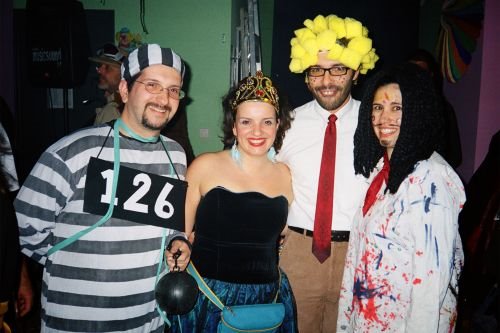
From left to right, we have myself dressed as, well... dressed as different things to different people; my sister, Igor, dressed as a "princess" - she wore trainers, all the better to dance on, but still managed to sprain her ankle badly enough to need a week off work, all within 20 minutes of turning up; Thanassi, square bob spongepants, apparently a hit with the youngsters, and K as a painter, although the rasta wig is a little incongruous with the rest of the outfit.
Such was our attire at the annual carnival fancy dress party at the club. We did have a good time.
About a month ago, we went to the Dali Sculpture exhibition at the BXM - Byzantine and Christian Museum in Athens. Not a bad exhibition but a little smaller than I would have liked. Much sculpture and some prints which were not bad. I don't know - we have seen so much stuff that has pushed the envelope since Dali, that what we were looking at seemed almost normal or tame. We could still marvel at the three dimensionality of twisted christ (I may have a photo somewhere) or the surreality of his Aphrodites (picture above - note the ear-nose and throat), but there was something about the exhibition which I did not like. Maybe it is that the same scultpure was exhibited in two different sizes, next to each other, or like the Aphrodites above, but I think that the problem was that there was very little to look at. I'll get some photos of Dali up later.
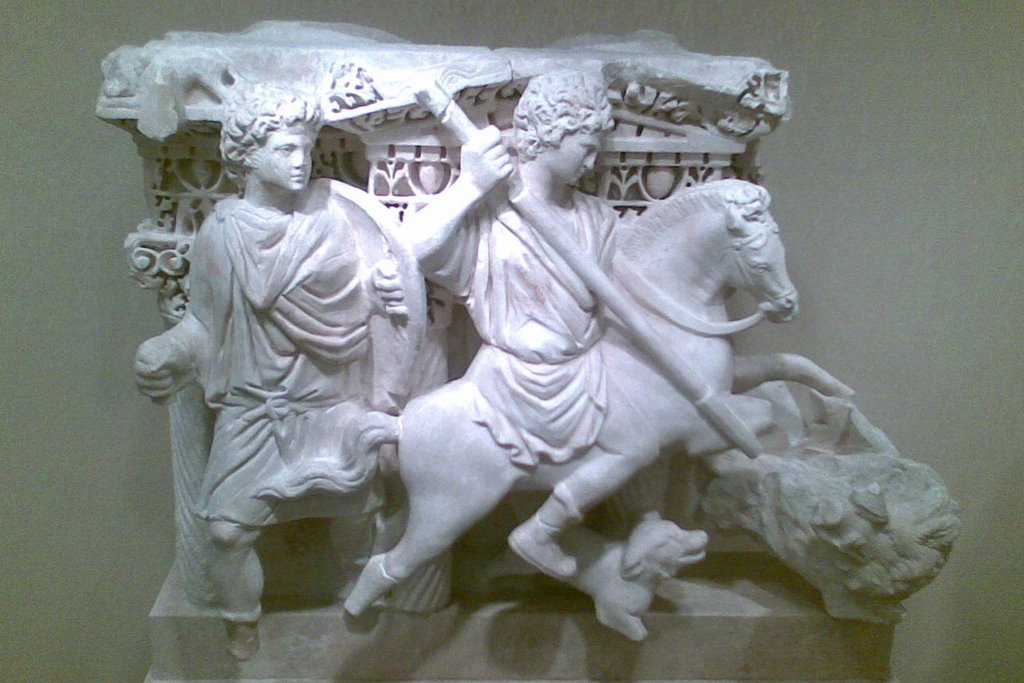
In the meantime, I would like to introduce an occasional feature of the blog which will run until I get bored of it, called ByzMus picture of the day.
It's a tomb monument from very early Christian times - from late antiquity with that characteristic late antique depth to it. It's trying so hard to present a classical face in the subject matter, the poses and the clothing (although clothing would have been classical even then), but at the same time we see elements of what has been called the "stumpy-dumpy style" creeping in - like why is the horseman's hand almost the same size as the horse's head?
I like it because it is approaching the byzantine from late antique, you can almost feel the thresholdiness in the spirally striped columns and over-wrought elaborate designs to the pediment and other architectural bits behind the figures. At the same time, the eyes in the figures are normal - there is no trace of the fourth century's huge bug-eyes.
And that's all I am saying about this one for now.
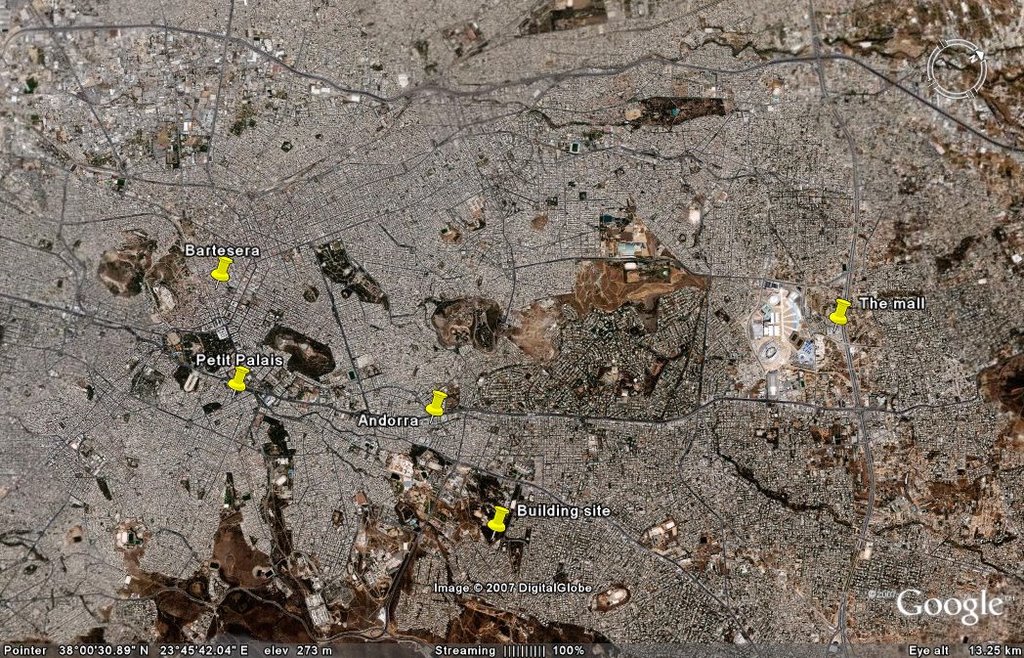
Friday I left jbex earlier than usual but nicely beyond the 8 hours one is expected to stay there. The unrelenting boredom of jbex did not allow me to delay my departure any longer, despite our meeting time with K at "the Mall" being at half seven, meaning I would have to walk the over heated passageways and open spaces of this huge building alone for about one and a half hours before K turned up. The plan was for me to exchange a book I had been given for my bidet last month and then watch a film at one of the fifteen screens that the village cinemas have in the complex. If there was time, I would be going to the cosmote shop to upgrade my mobile phone.
Seeing as I arrived a full 90 minutes before our meeting there was plenty of time and I went on an uncharacteristic spending rampage through the high tech shops renting space within the walls of "the mall".
First off was cosmote, where I renewed my contract with them and was awarded 185 euro for a hardware upgrade. I chose to upgrade my 5410 for a 5500, I think, fucking numbers make it very hard to know which model I have which one I used to have, which one I had last year and so on and so forth. The one I got is the so-called sports model, which is splash proof and slightly shock proof and has a 2 MP camera. I had to pay some extra over the top of the 185 freebie, but I was prepared for that since the chances of such a large amount as a freebie next year are minimal at best.
So - with new phone in hand, I went in search of a bigger memory card. Since when have phones had memory cards? I found one at Plaisio a nice 1 GB card... then off I went in search of those connector thingies that allow me to plug my old fat charger into my new nokia's slim charger hole. I picked that up at a Germanos after being told in a Vodafone shop that I would not find it anywhere in "the mall" but only through club nokia themselves.
Somewhere around this point in the evening I realized that I would never be able to work in retail because I would have to spend at least some of the day dealing with arseholes like myself and having to maintain a straight face and a welcoming smile.
Next up I went to change the book I had been given as a present for the bidet a month earlier and had to charm the till lady and explain that I already had the book and had been travelling and for this reason I was unable to bring it in to be exchanged earlier and please please let me change it. Funny place fnac - French bookshop place. Seems to be doing ok though.
So one hardback Jamie Oliver cookbook later, I found myself browsing through Multirama and buying blank DVDs and things, when K comes and finds me not a moment too soon as I was eyeing up a rather fine looking Canon digital camera, the G7 I think, which has manual focus and all sorts of things not found on your run of the mill digital point and shoot, and I really ought to go to the photovision exhibition at the old airport at hellenikon to see what else is happening in the digital world. Apparently - according to missy behind the counter, Nikon have been left behind in the race, and this upsets me because I am Nikon mad and don't want to have to change my brand, even though I'll have to change absolutely everything else and consign all my lenses and stuff to the big camera bag in the sky.
We went to get the tickets when K turned up, two tickets for Blood Diamond with that blond kid who was in Baz Luhrman's Romeo and Juliet. We got a free coupon for cheap pizza which we cashed in on and killed time before the film by walking around the mall a little and sort of trying not to stare as we walked past what is currently the only Hooters in Athens.
The film was good enough, with blondie putting on a good performance and a convincing accent which dropped only once or twice through the whole film. There were moments when one is forced to do a bit of thinking about how our greed taps into other people's greed and ultimately fuels a whole lot of other people's unhappiness. But, like the heroes of the film said (repeatedly too): T.I.A: This Is Africa...
Apparently blondie's been put up for an Oscar tonight and before I get a chance to post this tomorrow morning we'll know what has happened with that.
Saturday started off badly with the usual arguments and raised voices which precede any shopping trip for things which I consider superfluous and unnecessary. In this case new shirts for me to wear when traveling and wearing a tie. I have two or three and some which though old are not so bedraggled as to be unwearable. In my book. What the fuck do I know though. Oh no, I have to have a bunch of new shorts in all sorts of weird colours which are now fashionable rather than buying a whole bunch in the diachronously fashionable blues I usually go for.
On the plus side I bought some gloves for caving. Crazy thing, gloves, only worn them once in the three years I have been doing this and I can't say that I was aware of their benefits at the time. Anyway - I now have some better gloves and we'll just have to wait and see to what extent they'll be useful. The idea is that they are only for things like Propantes when we'll have like 300m of rope going through my right hand in only a few minutes.
After a fondue at Bartesera off Kolokotroni street we came home and prepared to go to our local cinema - Petit Palais to see the German art-house film "The Lives of Others". Yeah, so we thought blondie and the African were good the night before, this one blew us away and had us in tears at the end. Characters were well rounded and deep, the whole was claustrophobic enough to make you feel you could taste the atmosphere of the mid eighties Eastern Germany. The film was amazing, I think it is proposed for an award tonight as foreign film, though I cannot be sure if it is this one or the one we'll be seeing on Tuesday (did I mention our orgy of cinema going is continuing?). The end was beautiful, the last line of the film being both moving and funny at the same time but natural, too. There was no other way to end the film.
Early to bed as we had our first introduction to rescue techniques this morning and we had to be up early for it.
For ease of access, many of the field meetings of the cave rescue team happen in an abandoned half finished building in Papagou. The building has had anchors put in, in a whole lot of places and it is perfect for teaching. There were not that many of us apart from the new kids, and this was a good thing as it gave us a chance to see things and do them for real rather than see others from a distance doing them too quickly to follow. It weren't half cold though... My only regret is that by going to the rescue training, I miss Komni's dive in the sump in our new sinkhole on Parnitha, but like I said to myself to persuade myself to go, the sinkhole will be there next time, the stuff you will learn at the building site will not be taught again.
Back home for a nap and then back to the cinema... this time to Andorra which was to have been the scene of our first date with K, only she came very late and the film had started so we went to eat something instead, and that gave us an opportunity to talk and one thing led to another and here we are almost four years later.
Anyway - Andorra was still playing Little Miss Sunshine (it has been playing all the Oscar nominees over the weekend) and since we didn't see it when it was out last month, we went. The film was a good road movie with plenty to laugh out loud at and quite a bit of stuff to think about. It gets my thumbs-up on many levels. But I am running out of steam now and so will not be doing it justice... pity.
Next up: got to charge my new phone and see what it is like, no?
So here we go with the description of the second day of the weekend in the Argolid, during which we set off to look for the Triassic fossil beds of Epidaurus on the old route from Mycenae to the coast.
We set off on the road out of Nafplio a little after breakfast ceased being served at the Marianna Rooms under the castle and after a short drive around the fortifications of the "Its Kale", or more altaicly Uç Kale we set off east for the Epidaurus area.
A quick word on the Uç Kale whatsit - the words mean three forts or three castles in Turkish and are a reference to the triple fortifications of the hill above Nafpio on which the Xenia and Nafplia Palace now stand.
The video below opens with a view from the hotel, shows some of the Its Kale fortifications including the winged lions which the venetians saw fit to carve into flat surfaces everywhere. It's a little jerky in places, but you get the idea.
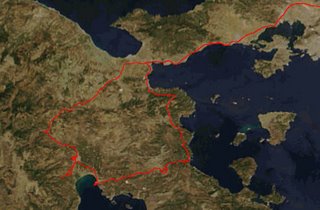
The plan was to go out towards Ligourio, have a look around in the Natural History Museum in the town and then to go fossil hunting for ourselves in the area before the theater. If there was time, we would look for the old medieval church which is covered in classical spolia which is meant to be in Ligourio.
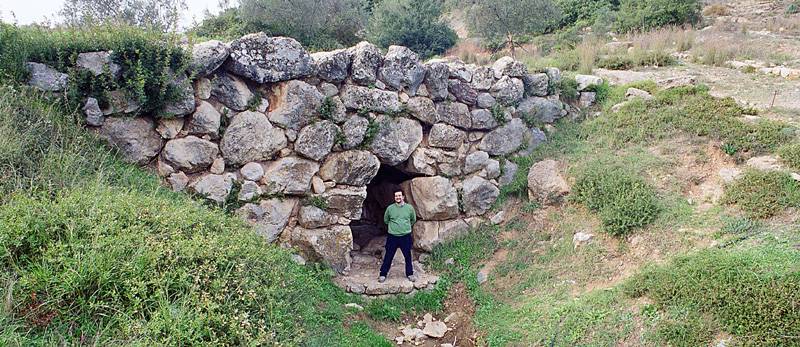
On the way, with K driving, we passed a MiniCult sign, in the standard 1:5 side ratio and the brown cultural sign colour. Mycenaean bridges, it said. This was quite a few km from the Mycenaean bridge I know about on the route, although I have often read about there being more thna one bridge no the way to Epidaurus. Well, we did what every self-respecting bronze-age loving sort of guy does and we stopped the car and set off along the foot path for the bridges marked by the signpost.
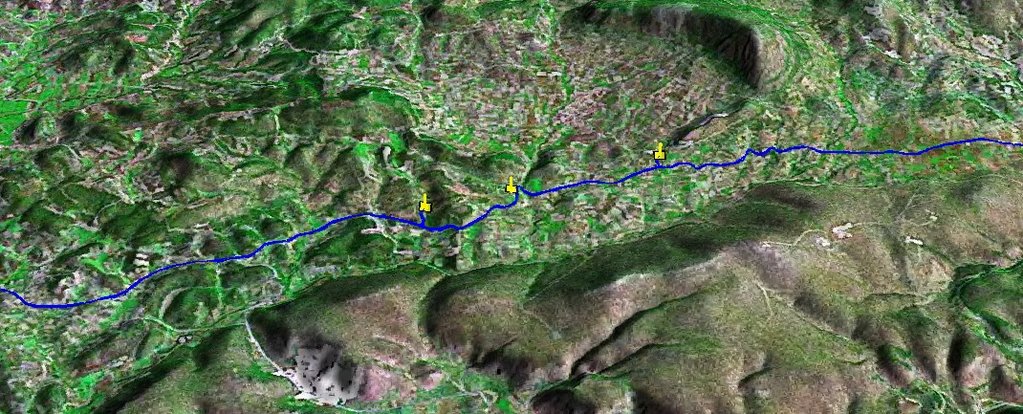
After a brief walk of about 300m on a footpath worn away in places by recent strong rains we reached a signpost indicating that there are two bridges, one very close, the other an unknown distance away down a continuation of the good footpath. I would not suggest doing the walk between the two bridges during normal daytime hours in the summer, leave it for late afternoon or early morning. I would love to walk the whole route some day linking Epidaurus on the coast to Mycenae via Midea.
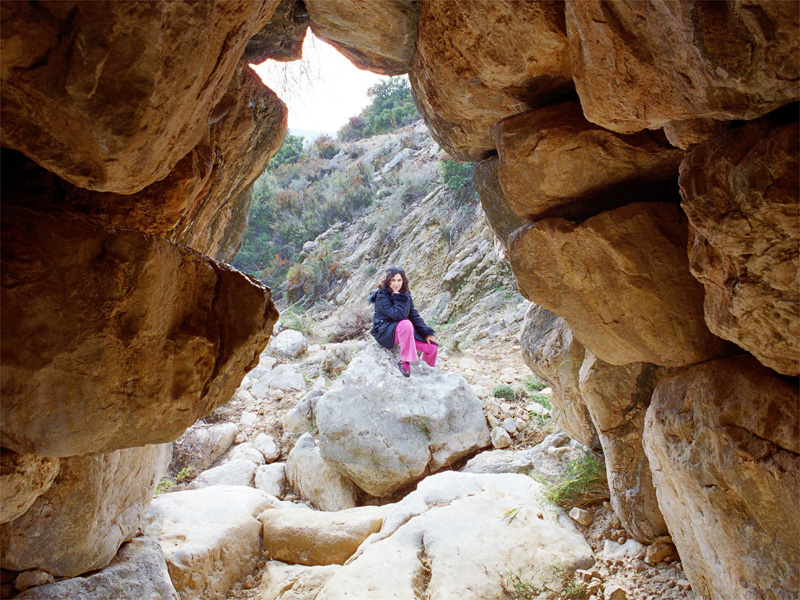
Here is K with the bridge's corbelled arch framing her. Corbelling is a vaulting technique whereby a space can be vaulted not by making use of the arch (first discovered and widely implemented in the Hellenistic times) but by positioning each successive block in such a way that although it overhangs the previous, the forces produced do not cause instability as they are sent downwards to the base of the structure. Something like the cantilever effect, I am told. The system was used extensively for the so-called galleries at Tiryns and, of course, in the construtcion of tholos / beehive tombs.
The Three yellow squares represent the three bridges visited.
The photo in the trailer post was taken in front of the well known and very photographed mycenaean bridge at Kazarma. I have photos of myself with this bridge from maybe even ten years ago, maybe more. We found the other end of the nice new footpath here, confirming that the second bridge referred to at the first was the one at Kazarma.
I hope some day to be able to get organised enough to put up a photo from every one of my visits to the bridge.
Next up, and really rather happy with our successes in seeing new things in an old neighbourhood, we took a left turning to go find the third of the three bridges which are currently signposted. The signposts lead you up a narrow road which stops abruptly next to a local resident's house. Fortunately this local resident keeps her yard gate open, otherwise there would be no space to do the 3 point turn required if one is to avoid reversing back to the main road. The bridge is close enough to the main road to walk easily rather than to go through the whole three point turn and reversing thing.
The rubbish around the third bridge we visited.
We were rather disappointed with K to finally reach the final bridge. The recent heavy rains had brought a whole lot of crap down the hill and what we ended up seeing was less an archaeological site than a tip - complete with what seems to be the mandatory child's bicycle. I am not sure whether this is visible in the photo, but it should be clear in the video.
The video opens with the walk from the car to the first bridge, some looks at the first bridge, the road on the way to the Kazarma bridge, some walking around and into the bridge of Kazarma, complete with some close-up views of the masonry and some little numbered dots that the archaeologists have put on the bridge. From there, we have a drive-by shot of the Kazarma Tholos Tomb - pretty much contemporary with the bridges, or possibly slightly earlier (to judge by the size of the blocks in the masonry). We then have the drive up to the local lady's house and the walk to the third bridge. I know I could have made the editing tighter, but when one is rushed, and has no real natural flair, one sacrifices quality for time - that's what I say to myself to allow me to sleep at night.
Putting the bridges firmly behind us and a little disappointed by the third bridge, we continued on to Ligourio. I had mixed feelings about the Natural History of Ligourio ever since I heard about its opening and especially given the quality of other road-side private museums I have visited.
Collection of shells spelling out the museum's name
Entering, I was pleased to see the number of posters on geologic or ecologic themes, many of which were obviously brought from abroad and translated specifically for the museum. The museum is laid out on one floor, in a number of rooms with most emphasis being placed on marine fossils from the Paleozoic and Mesozoic periods, although some more recent finds from the Pikermi bone beds and from the Rafina area were also present. There was obvious emphasis placed not only on the local fossils (from the Epidaurus area) but also on Moroccan fossils which had been purchased specially for the museum.
The lady told me that photography was allowed and here is a selection of my favourite shots from in the museum:
Crinoids - these frond shaped critters are animals which anchor themselves to the sea floor and filter nutrients and plankton and stuff out of the seawater in order to eat.
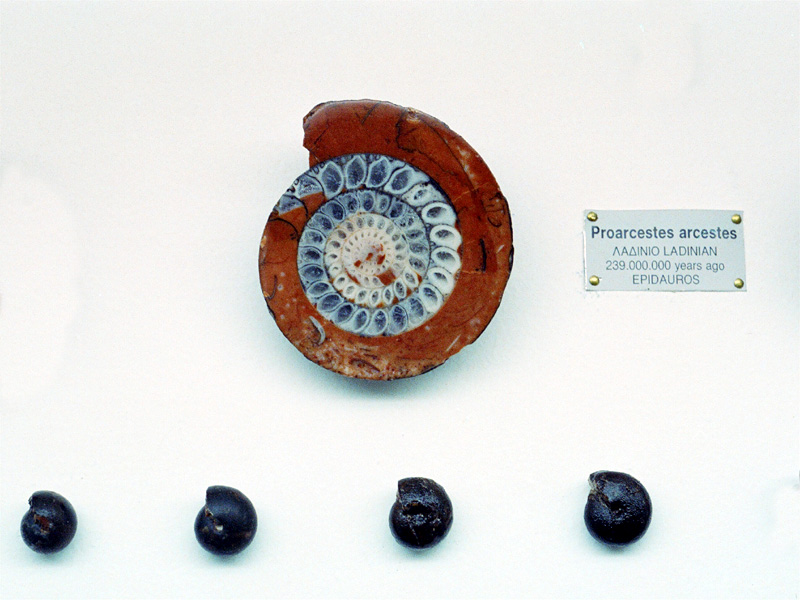
An Epidaurian ammonite sawn in half and polished to display the internal structures preserved.
Death assemblages of ammonites, again from the Epidaurus region
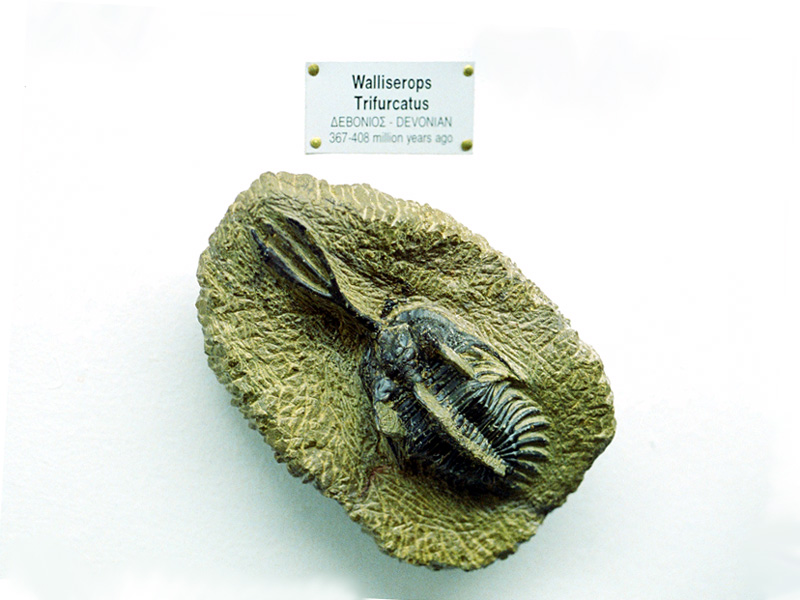
A trident-faced trilobite of the Walliserops Trifurcatus species.
The video shows a walk-around of the main parts of the museum. One take, a little rushed.
I bought my very first trilobite from the museum shop for the sum of 10 Euro - not a bad deal I think although I have no idea how much trilobites cost elsewhere.
We had managed to gather no information about the whereabouts of the Epidaurus fossil beds, but we had a pretty good idea of what we were looking for - essentially black round things sticking out of the pinky-red matrix.
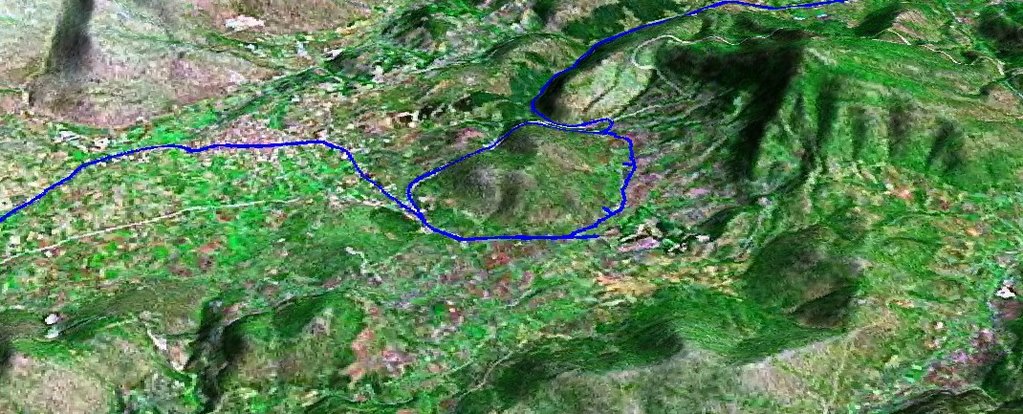
We set off from the museum and following a lead found on the net, we circled the nearby hill which we supposed must be the location of the fossil beds. We found nothing. I am not used to not finding what I am looking for, so we went round and round this hill, and we walked into it off the dirt track, but generally had no joy.
I need to have a look at a geological map of the area, slap it onto the computer, then onto the GPS and go back.
The hill we circled may not be the right place to look - but it had a dirt-road so we looked there.
From there we went to Epidaurus on the coast and back to Athens.
So let me tell you a little bit more about the weekend in the Argolid. The Argolid is close enough to Athens to be the sort of place one thinks of visiting and far enough away for it to be the sort of place one thinks of visiting.
Our last trip out to the Peloponnese of the exploratory sort was on Palm Sunday 2006, and we climbed Acrocorinth and visited Corinth proper and then went to the cemetery at Aidonia and generally we had a totally diachronic time looking at remains of the three great civilizations which have made Greece characteristically theirs. Hell, it's not me blowing this hot air out of my hat, it's Toynbee himself, who in writing "The Greeks and their Heritages" about the Mycenaean era, the Classical era and the Byzantine era basically said a lot of stuff that struck a chord with me.
So we saw in one day, the Mycenaean cemetery at Aidonia, the Classical civic centre of old Corinth and the fortified Byzantine settlement of Acrocorinth, and then we found time for Frankish gothic architecture and weird mountain lakes before we went on to dodge about dirt roads at altitudes where the snow had not yet melted, but this is all another story.
This time we spread the history and culture with its tripartite nature over the whole of the weekend, and probably skimped a bit on the Classical, though not a lot.
As usual, we left Athens very late and stopped at almost every opportunity for snacks while managing to arrive at our medieval site with only about an hour until sunset. We had spent some time at one of the classical stops on our weekend, so I guess this is not totally unjustified.
My suggested route to the sites requires the driver to take a right immediately after crossing the Inakhos on the way into Argos.
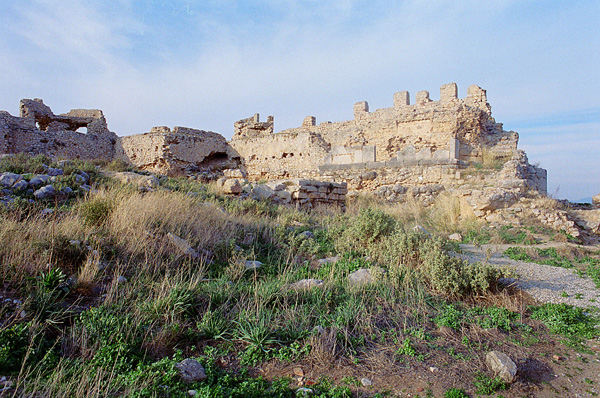
The fortified hill of Deiras sits slightly before the fortified hill of Argos proper, known since antiquity as Larissa - a reference to the seagulls which no doubt frequented the spot. We walked around the sanctuaries of Athena and Apollo, slightly underwhelmed by what we were looking at, in the same way that a visitor to Sparta may be disappointed.
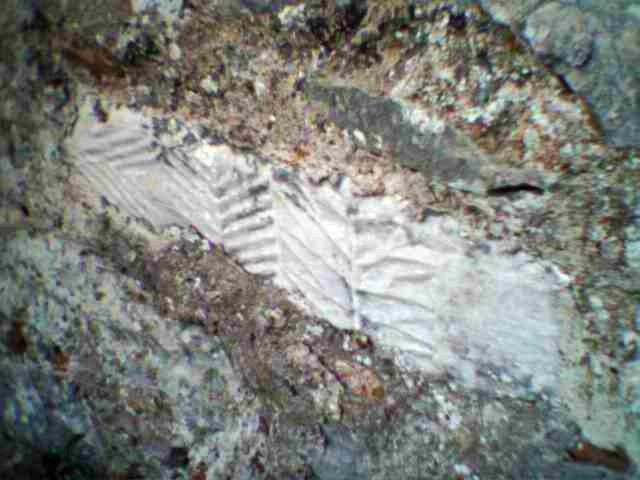
Layers at Deiras
Still there was opportunity to do a bit of archaeo-sleuthing and mental reconstruction and all the other mindgames which offer themselves at sites having more than one building phases or periods of usage. We then drove the circuit of the Aspis hill, stopping at some of the polygonal masonry bastions and remarking at the large number of used prophylactics littering the one lane, but asphalted ring road, before setting off up the windy road to the summit of the hill.
Polygonal masonry on Aspis Hill
The asphalt road takes the visitor right up to what must be the old main entrance, facing sort of south and a little west and commanding a view over the modern town of Argos right through to Palamidi to the south, and beyond. The books mention that three different building phases are clearly visible and we were determined to tell them all apart, although we were upset that there would be no Mycenaean fortification to look at in addition to all the others.
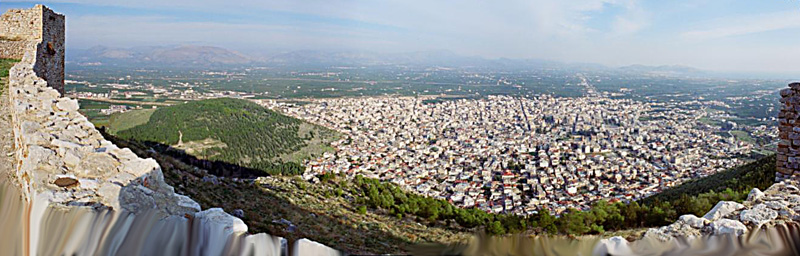
The view to Nafplio
We took in the view, which stretches easily out to the Palamidi to the south and on down the curving coast towards the lowlands of Arcadian Parnon and then entered the castle by what looks like it ought to be the main entrance after a small diversion playing with plants. Not any old plants - but some plant the name of which I must look up in a proper book because google is not returning anything useful. They have a bulbous head about 7-15 cm above the ground hiding the seeds. If you touch it ever so slightly, it will burst, showering the area with seeds. Very good fun for city kids like yours truly and K.
We took what seemed to be the most logical route around the castle - anticlockwise at ground level then walking back to enter the "keep" and after thoroughly exploring the keep, exiting from the ramp to the south.
Spolion in Northernmost bastion
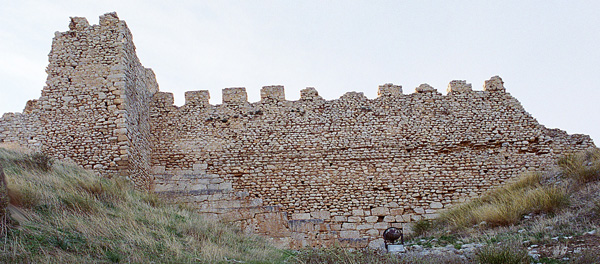
There was a nice spolion in the northernmost bastion which I recorded on the video. Spolia are pieces of older masonry re-used as building blocks with no regard for their original purpose or position - all that is of interest is that it is a sometimes ready squared piece of building block. It is often the case that spolia incorporate carved members and inscriptions. It is on the walls of the citadel / keep that the many different periods of construction are visible - in this stretch of wall there are clearly visible ashlar, polygonal and medieval masonry courses.
To the left of the stretch of wall in the image is an improper entrance into the citadel which has some spray paint graffiti creating a rather bad image for the visitor. Talking of bad images for the visitor, the flag is in a very badly ripped state.
Entering the citadel from here (flagpole to your back and graffiti to your right), there is a walk around circuit which takes you to the opposite side and back to the car, while the rest of the citadel stretches out to your right. Do not go straight for the exit as you will miss most of the fun of having come up here.
Graffiti near the flagpole
Its is probably best to walk a little around towards the exit before turning round to face the entrance you have come in from. The upright wall with the window at the spot where you entered should now make sense architecturally. Maybe it won't, but for me it did. The window is the window in the apse of a medieval church, which runs parallel with the wall (with the ashlar and polygonal masonry described above) on the other side of it. The church is set at a level slightly higher than ground level and I am not sure from where access would have been originally. The church has a very simple plan (one aisle basilica with apse) and it was impossible for me to tell whether it was built by the defenders or the subsequent conquerors.
Looking back towards the church with cisterns in left foreground
We are currently standing about two thirds of the way to the other exit, OK - we did not go clamber about the church because I wrote that you should just look over your shoulder at it not go and clamber about. If you have clambered about, you may want to go back to where you were before going to clamber. It is not my fault you won't follow instructions.
With your back to the church, turn right and being careful of the cisterns, walk to the north encircling wall with the walkway that leads to the church again. Hang on - that means the church is set up N-S rather than E-W. The cisterns are fairly interesting in and of themselves. It is so easy to forget how important a reliable and clean supply of water is, no?
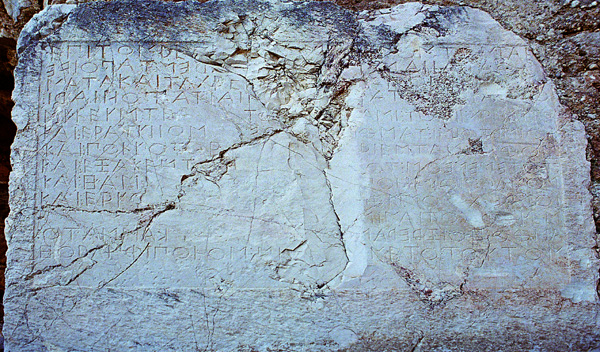
So we are now standing in the corner of the citadel, the church to our right in the distance and the cisterns behind us. We are facing northish and the walkway which goes right to the church is in front of us. There is a nice spolion column to our right, but the highlight of my visit to the citadel was this funky spolion incorporating an original archaic inscription. Absolutely mind blowing. The text does a bit of boustrophedon and has very archaic looking letters to my non specialist eye. It begins EPI TONDE and the top right corner is lost to canon or something. It incorporates the Ksi, Phi and Theta letters but as far as I can see no other late letters. I can't tell what it is about, although there is a few lines of text all beginning with KAI. There seem to be digammas in the script too and the deltas are rounded like roman Ds. I had a go at putting stuff into google but did not have as much success as the slab in the Bulgarian bar.
Archaic inscription slab
We left the citadel and came down into Argos joining the so-called ring road which takes you round the town on one way streets rather than through the central vegetable market when you are trying to get through Argos. You normally join this road by taking the right immediately before the very popular and rather good Pantazis fast food place. We went under the theatre etc. and headed out to Hellenikon to show K the pyramid and hopefully have all sorts of discussions about the loons who believe it to be older than it really is.
Here K outside the Castle of Larissa
We did not have the discussion which is a pity on the one hand as I was looking for K to confirm that what the consensus says is right, on the other hand, it was good. Why good? Well, we could not talk about it because K was totally unfamiliar with what it is the kooks say about the "pyramid". We just agreed that, yes it is pyramid shaped and left it at that.
K in front of the "pyramid" of Hellenikon
We spent the night at the rather nice Pension Marianna in Nafplio, which is on the castle and just underneath the Xenia hotel. Brilliant view and the rooms were not so bad as well.
K on top of the "pyramid" of Hellenikon - in a pose not unlike that of the French dwarf soldier from the 19th Century
The title says a lot really. I went out twice, once with my slightly polarizing dark glasses, but there is really too much haze in the sky to be able to say that I saw anything. I have my 300mm lens in the car with my camera, ready for tomorrow's attempt. I am thinking though, that my 135mm lend with the polariser should blacken the sky enough, but will the 2.5 stop light reduction be so much as to lose the comet itself? I am thinking of shooting at 1/1000 sec at f8 (on 200ASA film), so use of the polariser will mean I have to open up to f4 or more. At least I know where to set the focus distance...
I missed the comet McNaught C2006/P1 in its evening apparition due to bad weather and bad organisation. I now read that it is visible in daylight, and instructions have been posted at astroprof. I went out today to give it a shot, but had no luck. I will come back tomorrow with the long lens and the binos - binos to check where it is, etc. and then the long lens to try to take some photos in daylight.
There was too large a humidity halo around the sun, today. I will try again later in the week and will keep you posted.
My favourite Mycenaean Bridge lies on a rather steep curve on the road between Nafplio and Lygourio. Imagine my surprise in December when we saw another two bridges signposted and heard tell of a third somewhere. Once upon a time I would chase these things all over the country. Then came the MiniCult and it started putting the brown signposts everywhere. This is not so bad in and of itself as it tends to draw one's attention to sites which may have otherwise been overlooked. It does however detract from the joy of the hunt.
The bridge in the photo is my fave because it is the first I consciously spotted. I have many photos of it over the years and may dig them up for you some time. Built at least 3200 years ago on a corbelled design (not vaulted, but corbelled) the bridge is still a monument to a time when public works in Greece were built to last.
The photo is from December 2006 from a groovy road trip K and I made:
Hopefully I will have a chance to write all about it soon. There is a small video over at You Tube: Larissa Castle at 5telios at YouTube. The video shows K exploring Larissa Castle and has some good shots of the different masonry styles and some spolia in two different locations.
A fair number of photos from the weekend, which I just got today exist, and I'll have to include them when the time comes to write about it.
 The dome of the Omorphoklisia church with kite in the background.
 We decided to visit Veikou Park, belonging to the municipality of Galatsi (a suburb of Athens built by refugees from and named for the Romanian Town of Galaţi), not least because the park is close to a 13th Century church which I have read about and want to visit, but have not had the chance to do so. The view from a distance was brightened up by the large number of kites in the sky all with their happily streaming tails. We parked about a mile from the church and walked up to it, then crossed opposite towards the park where there was all sorts of crazy stuff going on, things being bought and sold and people thronging and whatnot.
 We bought our kite from a Roma at the entrance - a fancy schmancy affair in the shape of a bird, with a 3D body. The seller set it up for us leaving me to carry around this huge bird with more than 1m wingspan complete with bits of wooden rod sticking out (I would have had someone's eye out on one of them, but I was being careful).

 Now it is time to start preparing the messenger and the parafauna for next time!