Showing posts with label christian. Show all posts

Tuesday, June 30, 2015

Jus' sayin'...

Once upon a time, there was an issue so important and so burning that you could not go to the baker without getting an earful. Of course, there were no referendums then.
Πάντα γὰρ τὰ κατὰ τὴν πόλιν τῶν τοιούτων πεπλήρωται, οἱ στενωποὶ, αἱ ἀγοραὶ, αἱ πλατεῖαι, τὰ ἄμφοδα· οἱ τῶν ἱματίων κάπηλοι, οἱ ταῖς τραπέζαις ἐφεστηκότες, οἱ τὰ ἐδώδιμα ἡμῖν ἀπεμπολοῦντες. Ἐὰν περὶ τῶν ὀβολῶν ἐρωτήσῃς, ὁ δέ σοι περὶ γεννητοῦ καὶ ἀγεννήτου ἐφιλοσόφησε· κἂν περὶ τιμήματος ἄρτου πύθοιο, Μείζων ὁ Πατὴρ, ἀποκρίνεται, καὶ ὁ καὶ ὁ Υἱὸς ὑποχείριος. Εἰ δὲ, Τὸ λουτρὸν ἐπιτήδειόν ἐστιν, εἴποις, ὁ δὲ ἐξ οὐκ ὄντων τὸν Υἱὸν εἶναι διωρίσατο.

As rendered by Kallistos Ware:
The whole city is full of it, the squares, the market places, the cross-roads, the alleyways; old-clothes men, money changers, food sellers: they are all busy arguing. If you ask someone to give you change, he philosophizes about the Begotten and the Unbegotten; if you inquire about the price of a loaf, you are told by way of reply that the Father is greater and the Son inferior; if you ask “Is my bath ready?” the attendant answers that the Son was made out of nothing.

#GReferendum #Yes #NAI #Ναι #WhatHaveTheRomansDoneForUs 

Saturday, May 18, 2013

Sifting through scanned negatives from 2006, coming soon: Kastoria churches


I’ve spent the best part of today (after drilling holes in the bathroom for a new towel rack) trying to sort out some old photos from Kastoria in 2006... taken on film (obviously, given that I was still 2 years away from the beginning of my transition to digital).

Kastoria was like a middle Byzantine playground! Amazing small-scale religious architecture and the promise of some decent frescoes when doors were not locked – like a mini-Ochrid.

I have spent the morning going through two rolls of film, trying to match church names to images for uploading to Flickr (coming soon). 

Some of the images to be sorted and sent to Flickr
Given that I could only remember two of the churches, and one of these not by name, this was a non-trivial detective task. The main thing in my favour was that I had only the one camera with me, and therefore only one roll of film being exposed at one time. The other thing in my favour was that I was carrying my new Garmin GPS and creating a track of our walk.

Screengrab from Google Earth

So I fire up OziExplorer to re-trace my track and get an idea of the route I took chronologically (and so I could export the .trk file to a kml file Google Earth can understand) and I fire up Google Earth to get an idea of where the track is on the satellite image.
Getting jiggy with it
And lo and behold, I get the route and the little jiggy bits point out where I stopped walking and stood and walked around.

The areas marked “a” (with deliberate flame-bait use of Comic Sans font) are the jiggy-bits showing I wandered around and stopped rather than continued to move (making it likely that a photo was taken there). The area marked “b” with vertical dotted line shows a different effect – the dotted vertical is drawn to bring attention to the impossible path beginning and ending at the entrance to the church. This is where I entered the church and lost signal. The sharp line is where the GPS tries to get a firmer fix on my position. 


Path anomalies
 So – we now know I stopped walking in front of square building and entered the odd pyramid cake building, but we are no closer to an id. I then make a guess on the basis of different materials used to roof these buildings that these two are churches (and specifically the churches of St. George and St. Stephen – taking that from Barber’s map on pages 590 and 591 of the 1981 version of Greece’s Blue-Guide, reprinted 5th Edition of 1990, a gift from Charlie).

Some of these kids are doing their own thing...
 Not all buildings with the duller tiles can be churches, but all churches have the duller tiles.

Armed with this knowledge – that St. George (more about this church when I get it up on Flickr) is that one, and knowing which one St. George is in the images, I can then follow my route backwards and forwards from there to identify all remaining images (if only as ‘unknown church on Ag. Anargyron street).

The last piece in the chain of this detective story is the identification of the other buildings – and here at the last moment, I remembered Wikimapia. Firing up a new browser window, I got names for all but one of the buildings I had shot and got the final one from the Blue Guide (although I am curious why wikimapia does not tag it. 

Extract from Wikimapia 
So there we have it – actual photos coming soon.

Tuesday, August 07, 2012

Isthmia museum, July 2011

The museum at Isthmia is really very much off the beaten track and this is a pity as it houses some amazing finds in materials not normally encountered when making any sort of must-see tour of the Peloponnese or indeed mainland Greece. It is modern, well laid out and with plenty of well-written texts.

Isthmia museum, main hall, July 2011
A view of the main hall of the Isthmia museum

The religious site at Isthmia was of course dedicated to Posidon, the god of the sea and not without some reason. The site straddles and controls the paths from the south to the isthmus and along with Corinth itself two and a half hours to the west it effectively controls all access to the Peloponnese. The southern edge of the isthmus is just 15 minutes’ walk away while the harbour of Kenchreae is one hour to the south.

Excavations were conducted from 1952 onwards. It is one of the locations of the four great Panhellenic Games (Delphi, excavated by the French and Olympia by the Germans were both excavated before the end of the 19th Century, Nemea and Isthmia were both excavated in the last half of the 20th Century by the American School). The finds of the excavations from the fifties and subsequent re-examinations form the main part of the museum’s exhibition, although the finds from sites such as Kenchreae and Almyrae are no less interesting and the finds from Kenchreae are what give the museum its unique nature in terms of the materials on show.

Terracotta fragments from a well at Isthmia, July 2011
Terracotta finds originally from the archaic temple of Poseidon, dated to the 7th CBC and found in the Large Circular Pit which lies to the west of the Palaimonion and south of the Temple precinct.

This Large Circular Pit contained many other finds. The pit was used to bury fragmentary and broken terracotta and stone artefacts and serves as a sort of Perserschutt pit for Isthmia. One of the larger finds is the Poros Kouros, below.

The Poros Kouros' bum, Isthmia, July 2011
Fragmentary statue in the shape of a Kouros, youth

The kouros part was found at Isthmia in October 1959 by members of the University of Chicago digging at the site under the auspices of the American School of Classical Studies. The piece was found at a depth of 18.70 m. in the Large Circular Pit.

The fragmentary nature of the find and the fact that the pit contained all sorts of finds spanning many centuries has allowed classical scholars free reign to try to date the statue on stylistic grounds alone. This, coupled with the relative paucity of Kouros finds in the Peloponnese, the soft material used (and the constraints this imposes on diagnostic indicators) makes it an interesting case.

Next up, back to the Bronze Age:

Psi-figurines from the Almyre cemetery, Isthmia museum, July 2011
Mycenaean Psi-figurines

The ubiquity of the Psi and Phi figurines in Late Helladic contexts is one of those reassuring things. We are so used to them that that if there were none, you would be curious to know why. Other people do a much better job of discussing and describing these so I will not repeat what better researchers have already said. The specific figurines are part of the exhibition focusing on the chamber-tomb Cemetery of Almyri, near Isthmia. More precisely, Kato Almyri, Rachi Bechri. There are twenty odd tombs excavated at this site, yielding some pretty standard looking ceramics and the psi and phi figurines. The floor plans of the tombs look interesting enough and maybe I’ll make a trip sometime in the future – although given how long it has been since I first tried to get into this museum and how many years passed until I made it there when it was open to the public, I doubt such a visit would be any time soon.

Moving on to Kenchreae, the star of the show…

Kenchreae is one of the harbours around the Isthmus of Corinth. For some it is famous for the haircut of St. Paul (dude, srsly?), for others it is known for the amazing underwater excavations of the American school in the sixties. The reason for underwater excavations is the earthquake which struck in 375 and caused the land to sink a few feet, thereby burying buildings in the water of the harbour. How’s that for a funky
terminus ante quem? Underwater excavations usually means that we get a whole bunch of stuff turning up which would normally have rotted away. When it sits underwater, there is a great chance that a site’s perishable materials will be buried in anoxic mud and will not rot, but remain for the archaeologist to find. And so we have it… the so called temple of Isis, looking remarkably like a village church in floorplan, revealed a whole lot of funky finds in materials we don’t normally encounter.

Ancient wood from the Temple of Isis, Kenchreae, Isthmia Museum, July 2011
Wooden furniture find from the so-called Temple of Isis

The furniture is a great discovery as not only will it allow the interested visitor to have a good look at ancient joinery, but also to see the ivory inlays and sculpted decorations which would have adorned the furniture itself. The piece above shows some very finely wrought, presumably burned decoration in the wood itself.

Ivory plaques from the Temple of Isis at Kenchreae, Isthmia Museum, Jult 2011
Ivory plaques for decoration of wooden furniture

Speaking of inlays and decorative bits, the ivories above depict cupids doing everyday tasks. To me the worksmanship and subject look very much like later medieval ivories with almost identical theme. This is the sort of thing that if I had seen it without the context, I would have dated totally wrong... as such it is very much good fun.

One final but uber-funky wooden find from the so-called Temple of Isis is these wooden doors:

Wooden Doors off the "Temple of Isis", Kenchreae, Isthmia Museum, July 2011
Wooden Doors off the so called Temple of Isis, Kenchreae

These are by far the largest of the wooden finds currently on show at the Isthmia museum. To me, they look not very much different to provincial or naïve doormaking of far more recent times. We don’t often get a lot of wood surviving in Greece so this is all good stuff.


Another great find from the so-called Temple of Isis were the packing crates with the glass panels depicting scenes from a seaside city... These were stacked in groups around the walls of the main area of the temple, presumably either for installation or for transhipment elsewhere and most likely originated from an Alexandrian workshop. They date to the period immediately before the earthquake that led to their burial and subsequent preservation.

Decorative glass paste from Kenchreae, Isthmia Museum, July 2011
Corner of one of the plates

There were originally about 120 glass plates which would have covered an area of about 150sq.m. The plates were either completely decorative, depicted life-sized figures of priests or philosophers or were part of a cityscape panorama showing a seaside town. The whole work is an amazing look at an art form for which we have very little (if any) other information and an impressive decorative programme spanning many meters of wall space.

Glass paste decorative plaques (squid detail), Isthmia museum, July 2011

Fisherman from the harbour panel, Isthmia, July 2011
Scenes from the seaside town panoramas

The panels were stacked face to face, and the faces were the parts most susceptible to the corrosion of the sea, frequently resulting in the fusing of the two panels face to face. Most of the finds on display are actually the back side, rather than the front side which would have been on show, and this should be kept in mind. Because of the difficulties of desalination and the fragile nature of the finds, they are now stored in climate controlled rooms in the museum basement.


To sum up – if you have not been to the Isthmia museum – definitely make a point of taking a three minute detour and go!

Tuesday, December 27, 2011

Merbakas: A byzantine jewel in the Argolid

Byzantine church in Aghia Triada, Argolid, April 2011

The church just outside the modern village of Aghia Triada is dedicated to the dormition of the theotokos. It was built some time in the period between about a century before and after the fourth crusade. The actual dating is one of the great mysteries of the building as it rests to some extent on written evidence (which may or may not be flawed) for the building of a nearby stylistically similar church and to some extent on the immured ceramics. Τhe dating of these are also much debated by scholars, not least because the dating of the immured ceramics had been 'fixed' by a possibly inaccurate date for this church itself.

The village of Aghia Triada used to be known as Merbakas. The old name is largely forgotten outside Byzantist circles apart from its pejorative use in the phrase: "Καλά ρε φίλε, απ΄τον Μέρμπακα είσαι;" as used even into the 1990s by Nafplio kids to indicate a school friend is particularly stupid.

I first heard of the village in 1988 when touring the Peloponnese with JHWM (and PAGS) although there was no time to visit the church, and again in 1990 when SFM replaced PAGS. I don't think I actually saw the church itself until 1995 or even as late as 1998, when it was still serving as the cemetery church and the village cemetery itself still surrounded the church.

I have tried to drive past the church every time I have visited the area since then. Every time I visit, I see more and every time I leave I read more about it and around it and come back with more to look at. There is so much to look at in this one small Byzantine building and while something is urging me to insert the word intertextuality in here somewhere, I fear that so many years away from mildewey libraries may have blunted my ability to pull off that sort of writing...

Merbakas is unknown as a toponym elsewhere in the Balkans or even in Turkey. The word is not encountered in any of the languages of the peoples who have at some time established themselves in the Peloponnese. However, the Dutch village of Moerbeke happens to be the place of origin of William of Moerbeke, Latin bishop of Corinth, a Dominican and a pretty shit-hot classical scholar of his time. So while many chose to deny any link with Moerbeke for whatever reasons, if we do so, another William (almost contemporary with ours, but Franciscan and an Englishman from Ockham in Surrey) would have been rightly upset.

I cannot write about the similarities and differences with the churches at Areia and Chonikas, nor do I know enough about the ceramics to make some sort of judgment on the date of the church and therefore the likelihood of the patron being William of Moerbeke. Guy Sanders has a paper up on academia.edu in which he argues for the late date and the patronage of William. Although every time I read the paper I end up on different sides of the fence as to whether he convinces, the questions being asked are definitely going in the right direction.

The late date is supported by the ceramic evidence. The church has a whole lot of ceramic bowls immured in the walls. The mortar used has been shown to be one with the mortar used in the building of the walls: hence the bowls are contemporary with the original building, and dating the bowls will allow dating the church.

Immured ceramics, south wall, Byzantine church in Aghia Triada, Argolid, April 2011


The bowls in this images are called Grid Iron Protomaiolica bowls. Similar bowls are immured in the walls of the Dormition at Gastouni which has been recently dated to the last quarter of the 13th Century. The bowls are the product of a Western (Italian) workshop. Other immured ceramics have an eastern provenance, such as the Zeuxippus ware from Constantinople. The choice of ceramics from both edges of the Greek world, east and west is used by Sanders to support his position.

View form the East, Byzantine church in Aghia Triada, Argolid, April 2011

This view from the apses gives an opportunity to see a number of features of the church. From the ground up, we have the three steps reminiscent of an ancient stylobate. Christianity standing on ancient foundations, or triumphing over the old religion? The lower courses actually use building blocks taken from the Argive Heraion a few kilometers distant, while the blocks in the higher courses were brought from Corinth, presumably quarried fresh from local stone.

Apses of the Byzantine church in Aghia Triada, Argolid, April 2011

The higher courses are in cloisonné style with decorative brick-work at the top made to look like a Greek key (meander).

Central apse of the Byzantine church in Aghia Triada, Argolid, April 2011

The central apse, with its Gothic engaged columns in the trilobed sanctuary window, and more Greek key decorative brickwork. A meander is also visible running horizontally in the marble under the windows.

So, going back to the spolia... apart from the otherwise non-descript blocks from the Argive Heraion (which I still have yet to visit), there are two blocks of spolia with figured representations still on the church (a third is in Copenhagen, for some reason), in addition to a classical sundial reincorporated into the wall of the church and two blocks bearing inscriptions.

Immured spolia and gothic capitals on the drum of the Byzantine church in Aghia Triada, Argolid, April 2011

The sundial is on the south wall towards the SW corner.

Immured spolia on the Byzantine church in Aghia Triada, Argolid, April 2011

One of the two, figured spolia. The low relief sculpture is a classical grave marker with three figures on it. There is an inscription which reads something along the lines of "[Ε]ΥΠΟΡΟΣ ΕΥΠΡΑΞΙΣ [Ζ]ΗΑΝΤΕΡΩ[Σ]" which is probably three proper names. The Inscriptiones Graecae online gives the text as: Εὔπορος Ἀντέρωτος. Εὔπραξις ζῇ. Ἀντέρως and if I had not looked it up in the concordance, I would not have noticed the lower line of text underneath the text Εὔπορος. Have I mentioned how much I love the internet? The inscription is known as IG IV 539. Given the probably correct reading in the IG catalogue, it is probably a marker for Euporos (on the left) who was the son of Anteros on the right and is survived by his mother Eupraxis (centre).

It is said that the village ultimately gets its modern name from this grave marker, by way of the village church, which was dedicated to the holy trinity because of this very prominent spolion on the corner of the village's cemetery church.

Immured sculpted spolion in the north wall of the Immured spolia on the Byzantine church in Aghia Triada, Argolid, April 2011

The second stele on the north wall of the church, shows two more classical figures, with no discernable inscription. The placing of the two grave stelai and the subject matter are used to argue for the involvement of a Latin churchman in the foundation and building of the church at a time when the argument over the filioque was ongoing. The north stele shows two figures (argued to represent the father and the son from whom the unseen spirit is presumably processing in a western way) and the south stele shows the holy trinity in all its orthodox oriental glory. I don't buy into this in a wholehearted way, although as circumstantial evidence, I feel it ought to be mentioned.

Next up, the two spolia with inscriptions, one placed near the north door, the other near the east door. The one near the east door I did not know about and as a result, I have not got a photograph of it (and it is not immediately obvious when looking for it, else I would have noticed).

Immured inscribed spolion in the North wall of the Immured spolia on the Byzantine church in Aghia Triada, Argolid, April 2011

This is the first inscription, reading: Q(UINTO) CAECILIO C(AII) F(ILIO) METELO | IMPERATORI ITALICI | QVEI ARGEIS NEGOTIA(NTUR). Now the Metelus in question was the chappy who conquered Crete for Rome, thereby clearing the Aegean and this part of the Mediterranean of piracy. To me the echoes with the council of Lyons which amongst other things (such as the union of the churches) sought to suppress piracy are a little faint, but it has been argued that the founder of the church was aware of the historical Metellus and wished to make such a link. In any case, it is strange that a text in latin script which would not have been understood at all by the local population was immured with the inscription visible.

The final spolion bears a Greek dedicatory inscription and is immured close to the east door. As I have already mentioned, I have not seen it.

Elaborate decorative brickwork and bell tower at the Byzantine church in Aghia Triada, Argolid, April 2011

The bell tower above the east door, where the spolion bearing a Greek inscription is to be found.

Gothic capital on drum of the Byzantine church in Aghia Triada, Argolid, April 2011

The dome colonettes, showing gothic architectural influences. The crocket capitals are a decorative element common in Gothic architecture. This element is also used as an ornament on furniture and metalwork in the Gothic style. The name derives from the diminutive of the French croc, meaning "hook", due to the resemblance of crockets to a bishop's crosier.

South door of the Byzantine church in Aghia Triada, Argolid, April 2011

And final photo – the south door, which is built in the Byzantine rather than the western style (all other doors on the building are built in the western style). In Byzantine architecture, the jambs are separate from the matrix of the walls, as they are here. In western doors, the jambs bond with the walls.

Next time I have to go back, with all this in mind, to take photographs which illustrate the points in question better. As it is, the information on the church I got from the internet fit reasonably nicely with the photos I took, but not perfectly. Next time, it would be nice to get inside too to see the frescoes of St. Leo of Catania and to see how truly western some of the non-figured frescoes are.

Thursday, December 02, 2010

Monastery at Daphne / Dafni

So we took A to the monastery at Daphni. I had not been since 1991, almost twenty years ago. I remember walls and fortifications and a blurry photograph I have of the pantokrator (which I may be confusing with a pantokrator in Mystra). I did not remember the Ionic columns from the temple of Apollo and I would not then have been able to spot any trace of Gothicness on the narthex, let alone remember it. Given how much we did learn and retain while making this study tour with the school, there is no fault to be ascribed to Jimmy and the gang if we missed some of the Mediterranean Gothic...

Walking into the site today, the visitor is confronted by the massive block of the Daphni church, orange and pink in limestone and brick with its impressive drum and dome on top, all covered in scaffolding and dotted with stickers labeled ΕΜΠ and NTUA. The south door which was in front of us was locked. We headed to the west colonnaded section of the monastic complex's southern courtyard. The buildings there housed classical sculptures from the Daphnephoros sanctuary and late antique, Byzantine and medieval architectural fragments. Across the court, on the top floor, there is an exhibition on the restoration and the work being done. After wandering about a bit more, we found the phylax and much of what follows we were either told or I figured it out for myself as the phylax took us up the scaffolding.

Photos and videos are not allowed inside (rofl). No, really, they are not, so I was all fidgety and annoyed both because of the brevity of the preparation time available to take some photos while no one was looking but also by the need to keep my (now handheld) helmet-cam hidden.

On the way up, we first see two Gregories, amazingly large when at eye-level, amazingly pink-skinned and white haired in their restored splendour. Each mosaic we saw was an invitation to spend a whole afternoon there, wondering in awe at the work of the mosaicist. Opposite these was Zacharias in an arch, with his funny cuboid hat and then onwards and upwards - the guide rushing us upwards, but telling us to take our time... At conch level, we were face to face with (from NE-NW clockwise): Annunciation (amazingly tranquil and inspiring), Birth, Baptism (no willy), and Metamorphosis (badly damaged). And like the Narnian Mouse - "Further up and further in!", cried the phylax and we found ourselves face to face with sixteen prophets around the drum, again splendidly pink and white, like the Gregories or Zacharias, all of course with their golden backgrounds and with calligraphic names but also with conspicuous tubes and plastic pipes sticking out of them for the strengthening of the mosaics and eventually for the cement enemas which will serve to strengthen the walls and finally allow the walls to again take the weight of the building for themselves.

Then, finally, on the top floor of the scaffolding, we stood face to face with the pantokrator in awe, and were able to distinguish the tesserae and notice that each one is quite a large stone. Amazing indeed, but I had to let K see it too. I came down with appetite for close-up mosaic unsated and told her to go up while we played with A in the garden to the West. The narthex contains one of the four original Ionic columns from the Daphnephoros sanctuary. I am not sure where the other three are, various sources give various stories about what indeed Elgin took from here. The asymmetric gothic exonarthex is rather fun as well, with its arches not quite lining up on each side.

The need for restoration came with the famous quake of 1999, where, apparently the mosaic decoration all came to the ground. On commencement of restoration, they only replaced whatever pieces had a definite provenance, meaning that there are great chunks which will never be replaced. The opportunity to get this close to such exquisite mosaic work was amazing and I totally recommend a visit. The feeling it inspires reminds me of the feeling I had when facing some fresco work in Ochrid or facing the frescoes of the Protaton in Karyes, both pretty much contemporary with these mosaics. I want to go again...


View towards the exonarthex from the North West

View towards the exonarthex from the North West in clunky HDR


Base of the Ionic column from the exo narthex colonnade, complete with seismic sensors


Capital of the Ionic column from the exo narthex colonnade


Ionic column from the exo narthex colonnade

Saturday, October 17, 2009

A visit to Naxos Archaeological museum (2009)

The Archaeological Museum of Naxos is located pretty centrally on the castle of the old town. It houses a rather fine collection of Cycladic figurines and mycenaean grave goods from the numerous LH cemeteries on the island. We went last year with K and A (seven years old at the time).
On the way up to the museum we spotted this rather nice spolion in a yard wall...


The museum is in the old town which is essentially the medieval castle of Naxos. There are many "Frankish" arches in evidence such as the one on the left and many heraldic designs of the various dukes and counts and lords who were installed after the fourth crusade (don't get me started).

The museum is housed in a Francescan building which shares this side of the square with the Ursuline building, all very tangible signs of the Catholic church's attempt to convert fellow Christians to caesaropapism on the one hand and the heresies of Rome on the other.

Strictly no photography is allowed in the museum (in clear contravention of Law 3028/2002) despite the potential for outreach. Inside, the museum houses a nice cycladic collection with good Late Helladic (second millennium BC) gravegoods and some kitsch looking Roman sculpture. In the open air part, there is assorted sculpture from all ages which is presumably not considered special enough to warrant a guard or protection from the elements. Most of the photos which follow are from the outside part of the exhibition as the lack of a guard allows some photographs to be taken.


The open air section has a large mosaic in the middle, showing the bull carrying Europa off in its centre and animal forms around the edges. In style it is not very different to mosaics from the late antique period all over the Roman empire. The outside section is really quite chaotic and without labelling. On the right, we have classical and gothic capitals rubbing shoulders without seeming to mind the millennium which separates them.

Amongst the many loose sculptural finds from all ages in the open air section, there was also this rather exciting archangel in the "stumpy dumpy" style of the late and post-Byzantine era.


On the left, above, we have various bits of sculpture with an unfinished kouros and on the right, an unfinished Kouros amongst more sculpture of various periods.


On the left, capitals from various periods and in various "styles" - note the very vernacular low relief moustachioed cubes. On the right, a rather nice capital with a medieval / late byzantine figure between two animals, reminiscent of the mistress / master of the animals motifs from many centuries before.


This is the only shot inside the museum I managed to shoot before being told that it was forbidden. It shows a rather nice seated Cycladic figurine from the end of the third millennium BC.


Korinna and Cousin A with the spolia... a walk up to the museum is an opportunity to walk through the town of Naxos and talk about the processes which lead to the incorporation of spolia in newer structures (which themselves become old).

A final few words on the museum: don't miss it. It is old-style with old style labelling and the sleepy-eyed guard will tell you (the ticket lady doesn't talk) that the reason you are not allowed to take photos is that the artefacts are unpublished (this is the case for some, not all the items).

The problem with this logic, of course, is that the excavations were in the late forties and early fifties, and the excavator is dead. This is compounded by the fact that no one in the ephor's seat since has the good sense to get up off their arses and make even a preliminary publication of the important bronze age cemeteries the grave goods of which are in the museum.

If they have enough money to waste on fancy-schmancy touch screens with exceedingly little information stored on them, all but one of which were inoperable (through either faults of design or omissions in the training of the local staff) only months after installation, then why is there no money to make a publication of the old digs? Perhaps because the kick-back off purchasing fancy schmancy touch screens sits better in the baggy pockets of ministry officials such as "bounce" Zachopoulos than the ghostly thanks of the original archaeologist...

Another (totally) final thing: don't be scared by the way the exhibits rattle and move about in their wooden cases as you walk over the creaking wooden boards of the museum. The ministry is informed. That's why they spent money on touch-screen machines that don't work.

Monday, April 23, 2007

St. George at the Byzantine Museum

The 23rd of April is not always St. George's day. Oh no. The feast is such a big one, probably the biggest of those not immediately connected with Christ or the BVM. For this reason, if the 23rd of April falls in lent (and it does so more often than not), then the feast of St. George is celebrated on Easter Monday. This is because Lent is a time of solemnity and whatnot and we can't go feasting and celebrating in the middle of lent.

So, this year, St. George's day falls on the 23rd as it should. St. George is called the tropaiophoros, the bringer of triumph and is one of the earliest saints to be revered by the church. The whole story with the dragon comes from the levant (lebanon alone has a handful of locations with claims to be the spot where the dragon had been killed. The English crusaders (more about them some other day) saw the cult of the warrior saints (George and the many other literal soldiers of christ) and took his cult back to the British Isles with them. Together with the cult, they took back the red on white cross, known as St. George's cross. It is currently also displayed on the flag of Georgia.

Anyway, back to our picture of the day: the picture shows a piece of cloth with woven design measuring about 20 by 20cm (about 8x8 in inches). The design depicts a mounted saint dispatching a dragon - the chances are that it is St. George, although St. Demetrios is infrequently depicted in a very similar way. It's not clear whether there would have been space in the top right corner for St. George's little helper and the princess who gets saved. Both are iconographically late and are probably not there.

Last for today - the cloth is from the Egyptian collection at the BXM, hence we have it at all. The BXM's egyptian collection has a great number of both everyday items and ceremonial items of normally perishable material which has been saved thanks to the arid climate of the egyptian desert. That is why we have this cloth and quite a few other things, some of which may be featured in future pics of the day.

Thursday, April 19, 2007

Byzantine and Christian Museum - pic of the day 2

Today's picture is from the Byzantine and Christian museum in Athens, from the section of the museum dealing with late antiquity when there were many changes being made to old temples to convert them to christian use. I am not sure if the specific capital is from the parthenon, the acropolis in general or what, but it is in that corner of the museum (good, this, ennit?)

What have we got here? well, it is a marble capital with what seem to be crowned lambs sticking out at the corners. Things to look out for are the deep drilled holes in the lower half of the capital, which are trying to go for the so called marble lace effect (as employed to good effect in the 6th century basilicas of Constantinople and Ravenna and also in Egypt of the same time).

This is one of the more florid and over-worked capitals I am familiar with, hence its notability and inclusion here. The lamb theme is very popular in both mosaic work and plastic work for a few centuries, appearing both in the old (Theodosian) hagia sofia friezes from the 5th century and in the mosaics at St. Apollonaris in Classe from the sixth century.

Do I need to go into the why the lamb is significant in early christian art? What about the problems over the depiction of christ in human form to the extent that this goes against the graven images commandment? Maybe some other time.

Tuesday, April 10, 2007

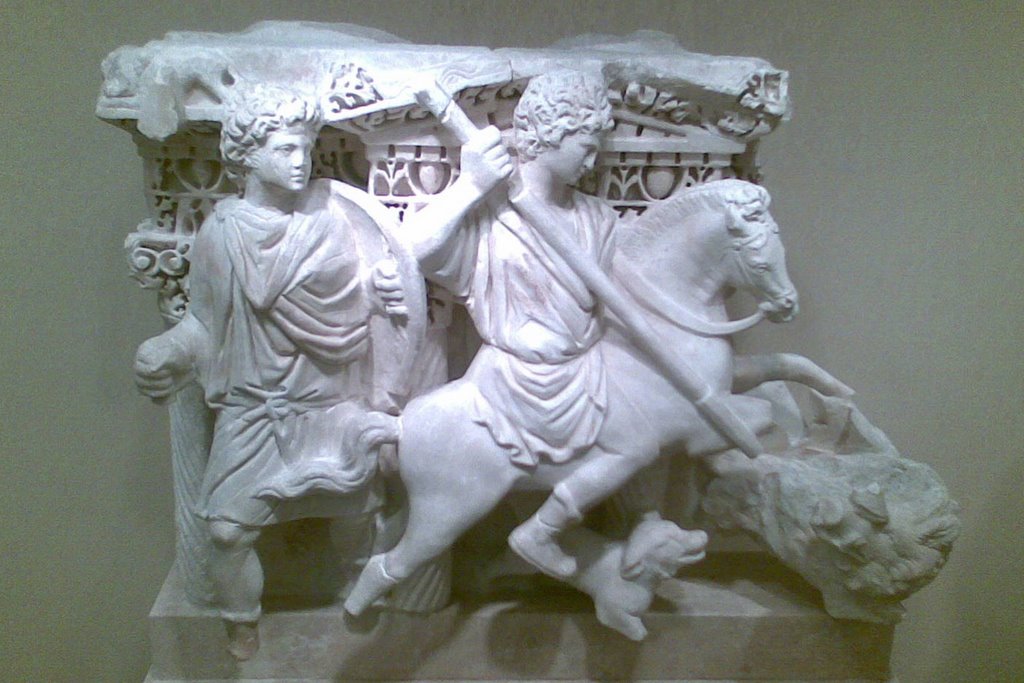
Byzantine and Christian Museum


About a month ago, we went to the Dali Sculpture exhibition at the BXM - Byzantine and Christian Museum in Athens. Not a bad exhibition but a little smaller than I would have liked. Much sculpture and some prints which were not bad. I don't know - we have seen so much stuff that has pushed the envelope since Dali, that what we were looking at seemed almost normal or tame. We could still marvel at the three dimensionality of twisted christ (I may have a photo somewhere) or the surreality of his Aphrodites (picture above - note the ear-nose and throat), but there was something about the exhibition which I did not like. Maybe it is that the same scultpure was exhibited in two different sizes, next to each other, or like the Aphrodites above, but I think that the problem was that there was very little to look at. I'll get some photos of Dali up later.

In the meantime, I would like to introduce an occasional feature of the blog which will run until I get bored of it, called ByzMus picture of the day.


It's a tomb monument from very early Christian times - from late antiquity with that characteristic late antique depth to it. It's trying so hard to present a classical face in the subject matter, the poses and the clothing (although clothing would have been classical even then), but at the same time we see elements of what has been called the "stumpy-dumpy style" creeping in - like why is the horseman's hand almost the same size as the horse's head?

I like it because it is approaching the byzantine from late antique, you can almost feel the thresholdiness in the spirally striped columns and over-wrought elaborate designs to the pediment and other architectural bits behind the figures. At the same time, the eyes in the figures are normal - there is no trace of the fourth century's huge bug-eyes.

And that's all I am saying about this one for now.