Showing posts with label archaeology. Show all posts

Tuesday, August 27, 2013

Back to Kato Zakros...

Cast your minds back to 1994 – here’s what I was doing in mid to late August – I was doing a slow and leisurely road trip by KTEL (with JWH) round Crete. It was then that I first heard of the “Gorge of the Dead” above Zakros – 19 years ago, just less than half my life ago. I have been back to Zakros, but with less KTEL timetabling hilarity in 2000, again that “Gorge of the Dead” whispering to me to explore it. Of course in 2000, I also saw the Ha gorge entrance, but this is a whole new chapter, one of the precursor stories to how I ended up becoming a caver.

On the one hand, it’s a pity that it isn't an exact 20 years since I first went to Kato Zakros, on the other, it is a pity that it took me so fucking long to get to the position where I could consider walking the gorge…

Saturday, May 18, 2013

Sifting through scanned negatives from 2006, coming soon: Kastoria churches


I’ve spent the best part of today (after drilling holes in the bathroom for a new towel rack) trying to sort out some old photos from Kastoria in 2006... taken on film (obviously, given that I was still 2 years away from the beginning of my transition to digital).

Kastoria was like a middle Byzantine playground! Amazing small-scale religious architecture and the promise of some decent frescoes when doors were not locked – like a mini-Ochrid.

I have spent the morning going through two rolls of film, trying to match church names to images for uploading to Flickr (coming soon). 

Some of the images to be sorted and sent to Flickr
Given that I could only remember two of the churches, and one of these not by name, this was a non-trivial detective task. The main thing in my favour was that I had only the one camera with me, and therefore only one roll of film being exposed at one time. The other thing in my favour was that I was carrying my new Garmin GPS and creating a track of our walk.

Screengrab from Google Earth

So I fire up OziExplorer to re-trace my track and get an idea of the route I took chronologically (and so I could export the .trk file to a kml file Google Earth can understand) and I fire up Google Earth to get an idea of where the track is on the satellite image.
Getting jiggy with it
And lo and behold, I get the route and the little jiggy bits point out where I stopped walking and stood and walked around.

The areas marked “a” (with deliberate flame-bait use of Comic Sans font) are the jiggy-bits showing I wandered around and stopped rather than continued to move (making it likely that a photo was taken there). The area marked “b” with vertical dotted line shows a different effect – the dotted vertical is drawn to bring attention to the impossible path beginning and ending at the entrance to the church. This is where I entered the church and lost signal. The sharp line is where the GPS tries to get a firmer fix on my position. 


Path anomalies
 So – we now know I stopped walking in front of square building and entered the odd pyramid cake building, but we are no closer to an id. I then make a guess on the basis of different materials used to roof these buildings that these two are churches (and specifically the churches of St. George and St. Stephen – taking that from Barber’s map on pages 590 and 591 of the 1981 version of Greece’s Blue-Guide, reprinted 5th Edition of 1990, a gift from Charlie).

Some of these kids are doing their own thing...
 Not all buildings with the duller tiles can be churches, but all churches have the duller tiles.

Armed with this knowledge – that St. George (more about this church when I get it up on Flickr) is that one, and knowing which one St. George is in the images, I can then follow my route backwards and forwards from there to identify all remaining images (if only as ‘unknown church on Ag. Anargyron street).

The last piece in the chain of this detective story is the identification of the other buildings – and here at the last moment, I remembered Wikimapia. Firing up a new browser window, I got names for all but one of the buildings I had shot and got the final one from the Blue Guide (although I am curious why wikimapia does not tag it. 

Extract from Wikimapia 
So there we have it – actual photos coming soon.

Saturday, January 05, 2013

Athena Alea at Tegea, in Arcadia, September 2011

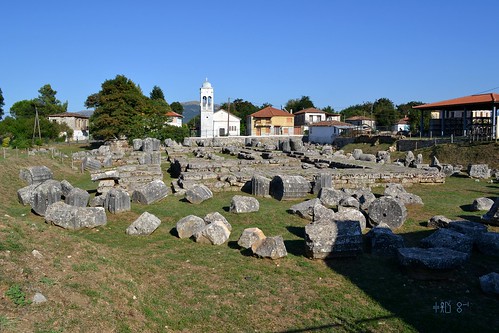
The final stop on the September 2011 Peloponnesian Road Trip was at the Temple of Athena Alea at Tegea, in Arcadia.
Temple of Alean Athena, Tegea (Arcadia), September 2011
The remains of Skopas' doric temple to Athena Alea
Much of the temple has been incorporated into the village church and other buildings and there is nothing that would have been visible above ground were it not for the excavation. What is visible is actually the Hellenistic era Doric-order temple undertaken by Skopas (of “Dancing Maenad” fame) after the classical temple had burned down.

For the rest of the road trip, click:

2011 peloponnesian road trip
2011 Peloponnesian road trip

Pellana, LH Chamber Tomb cemetery, September 2011

Off the road to Arcadia, north of Sparta lies the village of Pellana. A dot on today’s map, but for the excavations which have brought to light heavy bronze-age occupation and a rather fine set of chamber tombs built into a hill. These chamber tombs somewhere at some time by someone were called Tholos Tombs and most of the references to the cemetery on the internet refer to Tholos Tombs of Pellana, (so that must be right, yeah?)

Unfortunately, no.

The Tholos Tomb form, θολωτός τάφος, is a very specific funerary structure with a built chamber.

Entrance signpost to the Pellana Mycenaean Chamber tomb cemetery
Entrance signpost
Just because the shape of the burial chamber mimics the Tholos form, it does not make the tombs in this cemetery Tholos Tombs, regardless of what the excavators and local ephorate would have you believe or what the expatriate community in the states would have you believe. This link directs to one such expatriate site which is scarily wrong in almost everything it presents as fact – perhaps interesting for those modern day analysts of urban folklore (or even the texts of Pausanias and Herodotus), in that it tells the story the writer has believed and which readers will find plausible in the absence of conflicting, more authoritative information but which is based on second and third hand “facts” from local people who are more concerned with impressing the visitor with their superlatives than proving factual information.

So, setting aside all the crazy where was ancient Lakedaimon and this was Menelaos’ palace stuff, let’s get on to discuss the cemetery itself.

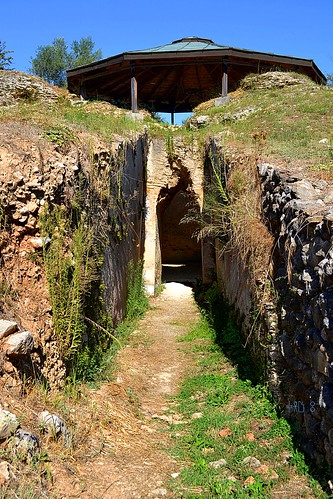
As you can see from the image above, the cemetery is signposted and fenced in standard fashion, with the cheeky hole (πονηρή τρυπούλα) to the right of the main entrance (if I am not mistaken). Following the ridge to the right takes the visitor above the main tombs, the largest one of which has been covered with a rather funny octagonal pagoda structure.

Octagonal pagoda, over the Large, so called Royal Tomb, at the Pellana LH chamber tomb cemetery
The tombs were excavated in the period from 1926 to the late eighties. All had been plundered in antiquity and many had fallen in subsequent to this. The standard practice, as shown in the image below, seems to have been the interment in unlined pits in the floor of the chamber.

Chamber tomb of thr Pellana LH cemetery, from above, showing burial pits
One of the tombs, from above, showing burial pits
The large grave, image below also had pits in the chamber floor. It has a diameter of about 10m, making it one of the largest known LH chamber tombs.

The large Pellana Chamber Tomb, September 2011
The large, so called Royal Tomb, at Pellana 
I rather like the way the bedrock from which the tomb was excavated shows the geological bedding in this photo:
Bedrock stripes, Pellana, Mycenaean chamber tomb
Bedrock stripes on the dromos of the large Chamber Tomb
We did not follow-through with a visit to the Palace, mainly due to time constraints. Ariadne was sleeping and we decided to press on to Alea... It should be noted that at the time of our visit, no doubt because of the preparations for the new Tripolis/Sparta road the road system in the area was very difficult to navigate with roads stopping without warning and much doubling back on ourselves.

For the rest of the road trip, click:

2011 peloponnesian road trip
2011 Peloponnesian road trip

Thursday, January 03, 2013

Amyclae, from the fence, September 2011

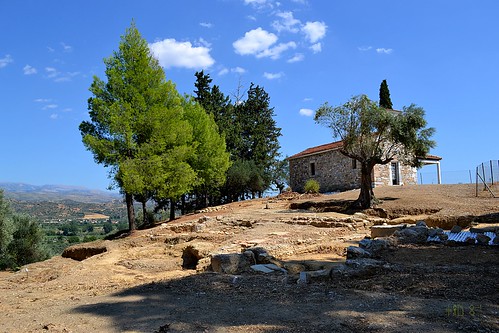
A little further on from Vapheio is the sanctuary of Amyclae. On the same trip, we visited the site and drove round the fencing which is in a much better condition, no doubt because of the small church in the site itself.

Just another day in Amyclae, September 2011
Amyclae, on Flickr
The tiny church was built with and on top of the ruins of the temple of Apollo at Amyclae, which was built on and quite possibly with the ruins of the tumulus of Hyakinthos, a pre-Greek deity (yeah, whatever, tell it to the hand) celebrated on-site before the city was subjugated by Sparta, only a few Km away. The old cult of Hyakinthos was swallowed into the cult of Apollo (now Apollo-Hyakinthos).

For the rest of the road trip, click:

2011 peloponnesian road trip
2011 Peloponnesian road trip

Tuesday, January 01, 2013

Armenoi, Minoan Chamber tomb site, September 2011

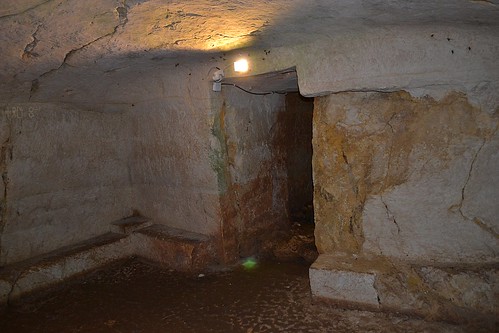
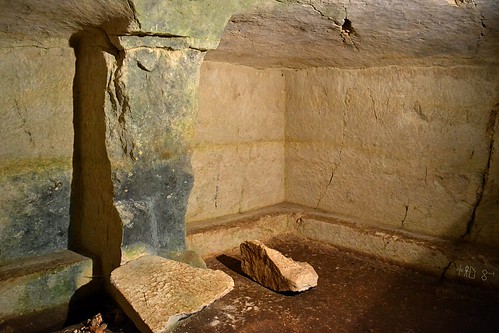
Outside the village of Armenoi in the Rethymnon prefecture of Crete there is a huge cemetery of LMIII chamber tombs. The site today is well shaded and there are more than 100 tombs which have been excavated and are open to the public. A nice spot for a wander.

All together in the shade at Armenoi
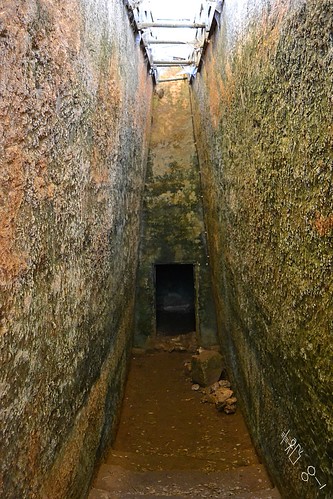
The highlight of the site is the large chamber tomb, probably royal:
Late Minoan Cemetery outside Armenoi, looking down the dromos of the large tomb, September 2011
The dromos of the large tomb
Late Minoan Cemetery outside Armenoi, interior of large tomb, September 2011
Inside the large tomb
Late Minoan Cemetery outside Armenoi, interior of large tomb, September 2011
Inside the large chamber tomb
I first heard of the site during the Minoans and Mycenaeans Flavours of their Time exhibition in the late 1990’s, because the skeletal remains were analysed for Nitrogen isotopes to see if the researchers could tell the source of the protein in the diet of the interred. If I remember correctly, there was a difference in the male and female skeletons, with men eating meat and women receiving most of their protein from the sea. 

 Well worth a visit. 

Friday, December 28, 2012

Chania Archaeological Museum, Crete, September 2011

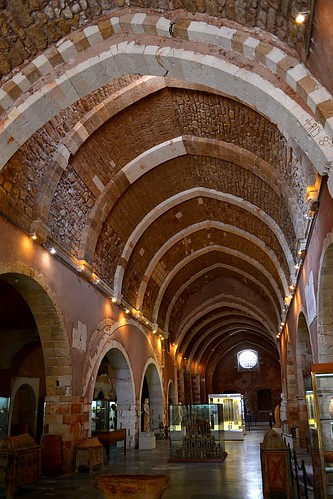
The Archaeological Museum in Chania was founded in 1962, after the building it is in had served as a store house, a cinema and a mosque (dedicated to Yussuf Pasha) during various times in the island's history. The building was originally built as the church of St. Francis of the Franciscan monastery most likely established in the C13th and displays rare Mediterranean Gothic features.

We visited in September 2011, on the back of the 14th National Speleological Meeting… excerpts from my diary follow:

After so many years, I get to go to the Chania Museum. The visit was made in far from ideal conditions – not enough time and both girls with us. The museum itself is built / housed in the old Franciscan church a the centre of an old Franciscan monastery dating to the 13th Century, if I am not mistaken.

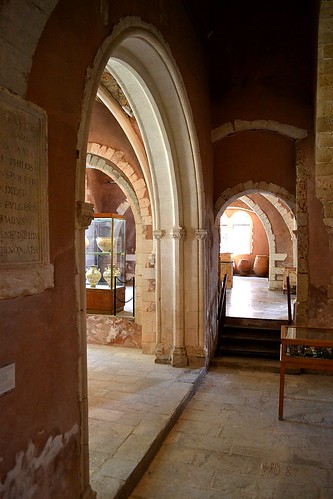
Unfortunately, the guards were not so well informed as to what is original and what is restoration, which is a pity as I am not sure I have seen better gothic ribbed vaulting in Greece.

Archaeological Museum of Chania, Crete, September 2011
General view of the nave / main hall
Cretan gothic at the Archaeological Museum of Chania, September 2011
Gothic arches in the museum
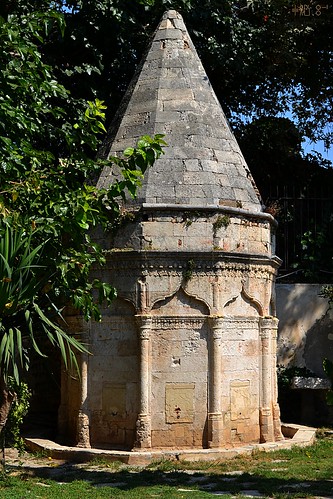
Garden of the Chania Archaeological Museum, Ottoman ablution fountain, September 2011
Ablution fountain in the garden
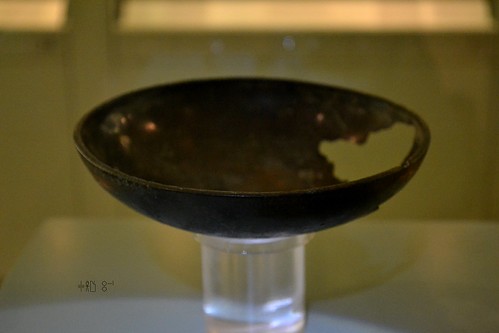
The tourists from Northern Europe have no idea of the rarity or peculiarity of this and indeed of all gothic features. The museum itself has finds from all over western Crete, famously from the palace at Kydonia itself and from various other locations. It also houses the Mitsotakis collection, which is basically huge and spans all eras of Greek history. Especially notable is a bronze bowl, bearing an inscription in Linear A – apparently the only surviving bronze object to have been thus inscribed. The LED lights positioned to highlight the inscription were not working, so I did not actually see it well enough to photograph.

Bronze bowl with Linear A inscription, Chania, September 2011
The bronze bowl, suffering from the LED malfunction
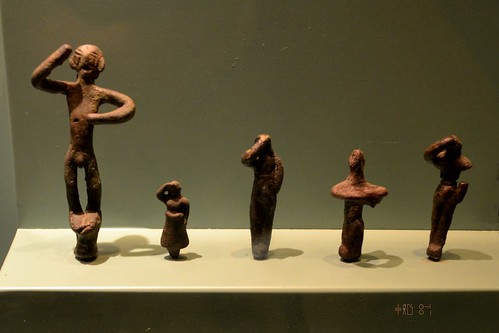
Adorants from the Mitsotakis Collection, Chania Archaeological Museum, September 2011
Bronze adorants from the Mitsotakis collection
Unfortunately, beyond the Mitsotakis collection, very little else is published and therefore very little else is permitted to be photographed. The bull offerings from a rural sanctuary in the Chania prefecture are actually unpublished and not allowed to be photographed, and yet it is in such small letters that unless the guard is actually next to you it is very difficult to know that you have gone astray. 

An image of K and the girls in front of an exhibit in the Chania Archaeological Museum with many bulls from a rural sanctuary
oops!
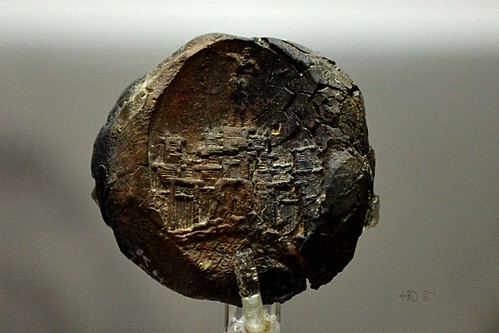
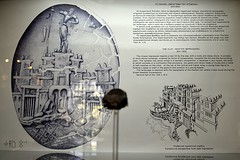
For me, and no doubt for many Minoan fans, the highlight of the museum is on the left about a third of the way in – a sealing impression, in clay, showing the so called Lord of Kydonia – an amazingly crafted scene, which may indeed represent the town of Chania, some three and a half thousand years ago…

The Chania sealing (Master Impression), Chania Archaeological Museum, September 2011
The Lord of Kydonia

All about the the Chania sealing (Master Impression), Chania Archaeological Museum, September 2011 and explanation:

Thursday, December 27, 2012

Back to the Acropolis Museum, December 2012

So last week I went back to the museum... and it’s time for something positive, this being the season of goodwill and all.

I remember my three major complaints being the photography ban, the lack of printed and explanatory information and the lack of children oriented materials.
Image of sign outside New Acropolis Museum showing that photography is forbidden
No photography sign, outside the New Acropolis Museum
Image of the New Acropolis Museum entrance, with pottery left and right, the Archaic room ahead and the Caryatids above and a very prominent no photography sign
Main entrance hall of the New Acropolis Museum, with prominent no photography reminder
Well, having gone on Saturday 15 December (a normal, pay to enter day) with the girls, we had the museum essentially to ourselves – up in the Parthenon gallery we walked round the whole thing twice, only seeing other people towards the end of our tour. An experience both satisfying and slightly worrying at the same time.
My girls alone in the Hellenistic/Roman hall of the New Acropolis Museum - In the distance Praxiteles' huge head of Artemis
All the Hellenistic and Roman era to ourselves...
The major changes I noticed from the summer of 2009:

1. The Kritios Boy seems to have been raised on his pedestal to a much higher level. Can’t imagine why, but, there you have it. Blonde Boy also seems to have a new perch...

Archaic room, from behind the Blonde Boy and the Kritios Boy
Kritios boy, on a new perch (2012) - compare with the image below (2009)

Image of the back of the Blonde Boy's head and the back of the Kritios boy

2. There is now material for kids to read or have read to them, in big letters, bright colours and targeted at them. So – yes, the museum is currently better for kids than it was three years ago. Can it be better yet? I think so, but this is a good first step.

3. (I took about 50 photos and hardly anyone minded, shhh…)

4. In 2009, I had a very specific complaint about the lack of “how” – well, in the archaic sculpture room, there is now a very nice display of marble-working tools along with an example of how each one left its mark on the marble. There was a similar display about the various minerals used to colour the marble, where they came from and how they were prepared to be applied.
A display of tools of the marble worker in the new acropolis museum
Tools of marbleworking and the marks they make

So – the museum is getting better. I am more enthusiastic, and I can’t wait to go back. Oh, and as a coda: Ariadne, at 45 months old told me the next day that the sixth Caryatid should come back from London to be with her sisters. It’s not right that she’s far away from them. I had explained that the pedestal is empty because one of the girls has gone to London to another museum, in a totally non-judgmental and neutral way.


Tuesday, August 14, 2012

Tripolis Archaeological Museum, September 2011

The archaeological museum of Tripolis is housed in a wonderful neo-classical building with a wonderfully damp and drippy basement, which is a pity as the wall-mounted exhibits have suffered as a result.

Probably in an effort to avoid photographs of exploding drippy basement wall plaster, or else because some researcher has not been properly arsed to publish his or her material, photography in the museum is banned and as a result the guards, two older ladies not so well informed about what they are watching over but certainly well enough informed of the ban will follow and hound any prospective photographer ensuring that this ban of dubious legality is not circumvented. I mention dubious legality as according to law it should be possible to photograph the exhibits free of charge for personal use in the museums of Greece. See my posts on Naxos and the New Acropolis Museum...

Anyway – so there we were in September last year on a great Peloponnesian north/south roadtrip with an overnight in Tripolis. The museum was just across the street from the hotel, and I took Ariadne and went.

Tripolis Archaeological Museum gardens, September 2011
Ariadne enjoys the garden of the Tripolis museum…

Once you get over the bad state of the museum itself and the museological side of things, there are a few gems housed within. On the left on the ground floor, the finds from the LHIIIC Palaiochora chamber cemetery, pretty much exclusively ceramic but certainly worth a visit. In the basement, the sculptures from the villa of Heroides Atticus are also very much worth a visit, despite whatever feelings one may have about Roman-era 'art'. Most of the rest of the museum actually reinforces whatever feelings you may have of Roman-era 'art'. Well, it did for me…

For the rest of the road trip, click:

2011 peloponnesian road trip
2011 Peloponnesian road trip

Tuesday, August 07, 2012

Isthmia museum, July 2011

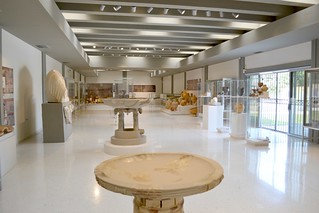
The museum at Isthmia is really very much off the beaten track and this is a pity as it houses some amazing finds in materials not normally encountered when making any sort of must-see tour of the Peloponnese or indeed mainland Greece. It is modern, well laid out and with plenty of well-written texts.

Isthmia museum, main hall, July 2011
A view of the main hall of the Isthmia museum

The religious site at Isthmia was of course dedicated to Posidon, the god of the sea and not without some reason. The site straddles and controls the paths from the south to the isthmus and along with Corinth itself two and a half hours to the west it effectively controls all access to the Peloponnese. The southern edge of the isthmus is just 15 minutes’ walk away while the harbour of Kenchreae is one hour to the south.

Excavations were conducted from 1952 onwards. It is one of the locations of the four great Panhellenic Games (Delphi, excavated by the French and Olympia by the Germans were both excavated before the end of the 19th Century, Nemea and Isthmia were both excavated in the last half of the 20th Century by the American School). The finds of the excavations from the fifties and subsequent re-examinations form the main part of the museum’s exhibition, although the finds from sites such as Kenchreae and Almyrae are no less interesting and the finds from Kenchreae are what give the museum its unique nature in terms of the materials on show.

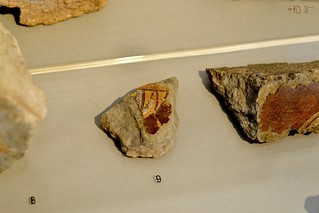
Terracotta fragments from a well at Isthmia, July 2011
Terracotta finds originally from the archaic temple of Poseidon, dated to the 7th CBC and found in the Large Circular Pit which lies to the west of the Palaimonion and south of the Temple precinct.

This Large Circular Pit contained many other finds. The pit was used to bury fragmentary and broken terracotta and stone artefacts and serves as a sort of Perserschutt pit for Isthmia. One of the larger finds is the Poros Kouros, below.

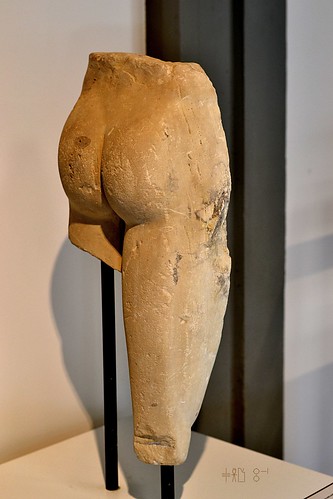
The Poros Kouros' bum, Isthmia, July 2011
Fragmentary statue in the shape of a Kouros, youth

The kouros part was found at Isthmia in October 1959 by members of the University of Chicago digging at the site under the auspices of the American School of Classical Studies. The piece was found at a depth of 18.70 m. in the Large Circular Pit.

The fragmentary nature of the find and the fact that the pit contained all sorts of finds spanning many centuries has allowed classical scholars free reign to try to date the statue on stylistic grounds alone. This, coupled with the relative paucity of Kouros finds in the Peloponnese, the soft material used (and the constraints this imposes on diagnostic indicators) makes it an interesting case.

Next up, back to the Bronze Age:

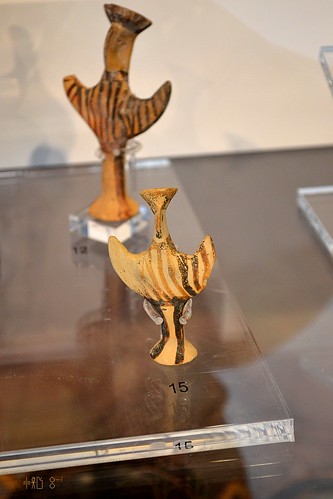
Psi-figurines from the Almyre cemetery, Isthmia museum, July 2011
Mycenaean Psi-figurines

The ubiquity of the Psi and Phi figurines in Late Helladic contexts is one of those reassuring things. We are so used to them that that if there were none, you would be curious to know why. Other people do a much better job of discussing and describing these so I will not repeat what better researchers have already said. The specific figurines are part of the exhibition focusing on the chamber-tomb Cemetery of Almyri, near Isthmia. More precisely, Kato Almyri, Rachi Bechri. There are twenty odd tombs excavated at this site, yielding some pretty standard looking ceramics and the psi and phi figurines. The floor plans of the tombs look interesting enough and maybe I’ll make a trip sometime in the future – although given how long it has been since I first tried to get into this museum and how many years passed until I made it there when it was open to the public, I doubt such a visit would be any time soon.

Moving on to Kenchreae, the star of the show…

Kenchreae is one of the harbours around the Isthmus of Corinth. For some it is famous for the haircut of St. Paul (dude, srsly?), for others it is known for the amazing underwater excavations of the American school in the sixties. The reason for underwater excavations is the earthquake which struck in 375 and caused the land to sink a few feet, thereby burying buildings in the water of the harbour. How’s that for a funky
terminus ante quem? Underwater excavations usually means that we get a whole bunch of stuff turning up which would normally have rotted away. When it sits underwater, there is a great chance that a site’s perishable materials will be buried in anoxic mud and will not rot, but remain for the archaeologist to find. And so we have it… the so called temple of Isis, looking remarkably like a village church in floorplan, revealed a whole lot of funky finds in materials we don’t normally encounter.

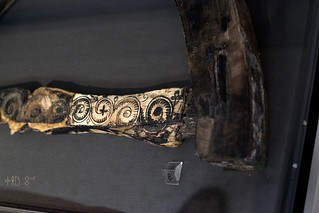
Ancient wood from the Temple of Isis, Kenchreae, Isthmia Museum, July 2011
Wooden furniture find from the so-called Temple of Isis

The furniture is a great discovery as not only will it allow the interested visitor to have a good look at ancient joinery, but also to see the ivory inlays and sculpted decorations which would have adorned the furniture itself. The piece above shows some very finely wrought, presumably burned decoration in the wood itself.

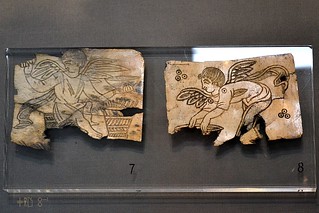
Ivory plaques from the Temple of Isis at Kenchreae, Isthmia Museum, Jult 2011
Ivory plaques for decoration of wooden furniture

Speaking of inlays and decorative bits, the ivories above depict cupids doing everyday tasks. To me the worksmanship and subject look very much like later medieval ivories with almost identical theme. This is the sort of thing that if I had seen it without the context, I would have dated totally wrong... as such it is very much good fun.

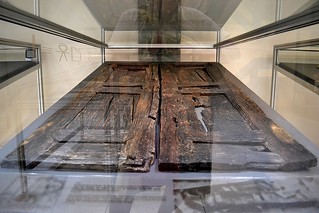
One final but uber-funky wooden find from the so-called Temple of Isis is these wooden doors:

Wooden Doors off the "Temple of Isis", Kenchreae, Isthmia Museum, July 2011
Wooden Doors off the so called Temple of Isis, Kenchreae

These are by far the largest of the wooden finds currently on show at the Isthmia museum. To me, they look not very much different to provincial or naïve doormaking of far more recent times. We don’t often get a lot of wood surviving in Greece so this is all good stuff.


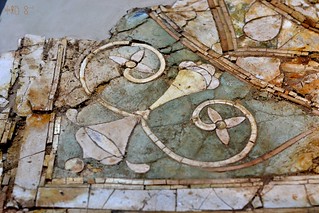
Another great find from the so-called Temple of Isis were the packing crates with the glass panels depicting scenes from a seaside city... These were stacked in groups around the walls of the main area of the temple, presumably either for installation or for transhipment elsewhere and most likely originated from an Alexandrian workshop. They date to the period immediately before the earthquake that led to their burial and subsequent preservation.

Decorative glass paste from Kenchreae, Isthmia Museum, July 2011
Corner of one of the plates

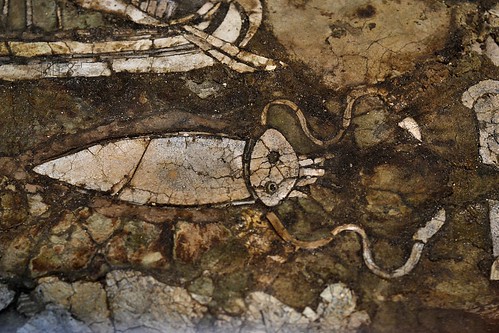
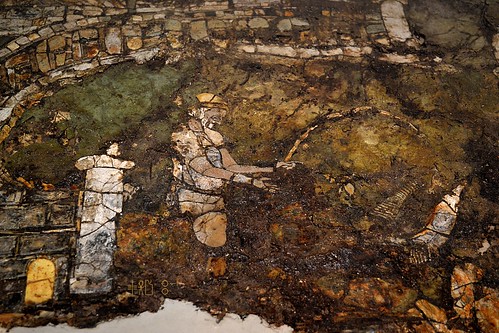
There were originally about 120 glass plates which would have covered an area of about 150sq.m. The plates were either completely decorative, depicted life-sized figures of priests or philosophers or were part of a cityscape panorama showing a seaside town. The whole work is an amazing look at an art form for which we have very little (if any) other information and an impressive decorative programme spanning many meters of wall space.

Glass paste decorative plaques (squid detail), Isthmia museum, July 2011

Fisherman from the harbour panel, Isthmia, July 2011
Scenes from the seaside town panoramas

The panels were stacked face to face, and the faces were the parts most susceptible to the corrosion of the sea, frequently resulting in the fusing of the two panels face to face. Most of the finds on display are actually the back side, rather than the front side which would have been on show, and this should be kept in mind. Because of the difficulties of desalination and the fragile nature of the finds, they are now stored in climate controlled rooms in the museum basement.


To sum up – if you have not been to the Isthmia museum – definitely make a point of taking a three minute detour and go!

Saturday, August 04, 2012

Palamari, an Early Bronze Age site on Skyros

I chanced to have had the opportunity to visit Palamari whle chasing bats with Dr. G in June 2011 – more about which I hope to write soon. Of my impressions at the time, my diary records only the following:

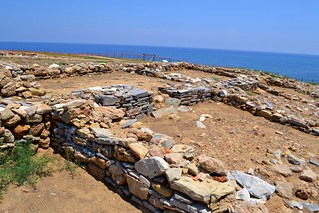
"The site of Palamari is well worth visiting. It’s like a Kastri on Syros only on a lower hill with less clambering. Brilliant EBA fortification, way more impressive than Lerna in its size and scope. Glad to have made the detour."

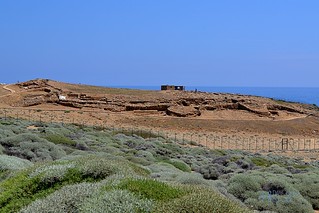
Palamari, Skyros, June 2011

View over the excavations

Verbose, this description is not. And I will not be any more verbose now, fourteen months on.

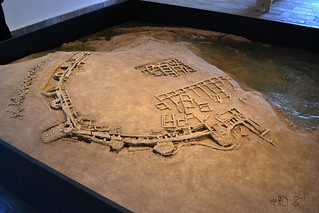
There is an onsite “museum” with a pretty funky model of the excavated site and plenty of text with images on boards covering stuff like the changing environment from the EBII through the MBA as evidenced by faunal remains and the links with other civilisations as evidenced in the ceramic types found on site.

Model of Palamari excavations, Skyros, June 2011

Model of the excavations

The ceramic types cover Trojan depas amphikupella through to Cycladic beaked jugs and Mainland Minyan kantharoi. Not surprising really, given the location of the island and the site, but reassuring to see it.

I stand by my “worth a visit” conclusion of 14 months ago, even for the uninitiated for whom this sort of thing isn’t their bag:

Palamari looking east over the central structures, Skyros, June 2011

Friday, February 03, 2012

Open e-mail to the New Acropolis Museum

" Is the museum still implementing its no-photography policy? If so, how is it justified, given that the archaeological law (Ν. 3028/2003) in conjunction with the joint decision of the Ministers of the Economy and Culture of 28 December 2011 (126463, Article 1.1) permits free photography in museums when carried out with non-professional equipment?

What is the procedure for an interested amateur photographer to be granted permission to take photographs inside the museum for personal / educational purposes? Many thanks for your time. "

So - let's see what they reply.

Tuesday, December 27, 2011

Merbakas: A byzantine jewel in the Argolid

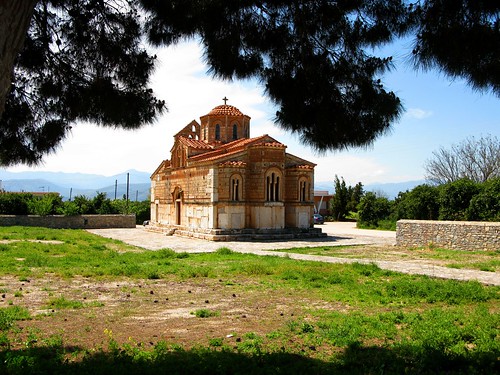
Byzantine church in Aghia Triada, Argolid, April 2011

The church just outside the modern village of Aghia Triada is dedicated to the dormition of the theotokos. It was built some time in the period between about a century before and after the fourth crusade. The actual dating is one of the great mysteries of the building as it rests to some extent on written evidence (which may or may not be flawed) for the building of a nearby stylistically similar church and to some extent on the immured ceramics. Τhe dating of these are also much debated by scholars, not least because the dating of the immured ceramics had been 'fixed' by a possibly inaccurate date for this church itself.

The village of Aghia Triada used to be known as Merbakas. The old name is largely forgotten outside Byzantist circles apart from its pejorative use in the phrase: "Καλά ρε φίλε, απ΄τον Μέρμπακα είσαι;" as used even into the 1990s by Nafplio kids to indicate a school friend is particularly stupid.

I first heard of the village in 1988 when touring the Peloponnese with JHWM (and PAGS) although there was no time to visit the church, and again in 1990 when SFM replaced PAGS. I don't think I actually saw the church itself until 1995 or even as late as 1998, when it was still serving as the cemetery church and the village cemetery itself still surrounded the church.

I have tried to drive past the church every time I have visited the area since then. Every time I visit, I see more and every time I leave I read more about it and around it and come back with more to look at. There is so much to look at in this one small Byzantine building and while something is urging me to insert the word intertextuality in here somewhere, I fear that so many years away from mildewey libraries may have blunted my ability to pull off that sort of writing...

Merbakas is unknown as a toponym elsewhere in the Balkans or even in Turkey. The word is not encountered in any of the languages of the peoples who have at some time established themselves in the Peloponnese. However, the Dutch village of Moerbeke happens to be the place of origin of William of Moerbeke, Latin bishop of Corinth, a Dominican and a pretty shit-hot classical scholar of his time. So while many chose to deny any link with Moerbeke for whatever reasons, if we do so, another William (almost contemporary with ours, but Franciscan and an Englishman from Ockham in Surrey) would have been rightly upset.

I cannot write about the similarities and differences with the churches at Areia and Chonikas, nor do I know enough about the ceramics to make some sort of judgment on the date of the church and therefore the likelihood of the patron being William of Moerbeke. Guy Sanders has a paper up on academia.edu in which he argues for the late date and the patronage of William. Although every time I read the paper I end up on different sides of the fence as to whether he convinces, the questions being asked are definitely going in the right direction.

The late date is supported by the ceramic evidence. The church has a whole lot of ceramic bowls immured in the walls. The mortar used has been shown to be one with the mortar used in the building of the walls: hence the bowls are contemporary with the original building, and dating the bowls will allow dating the church.
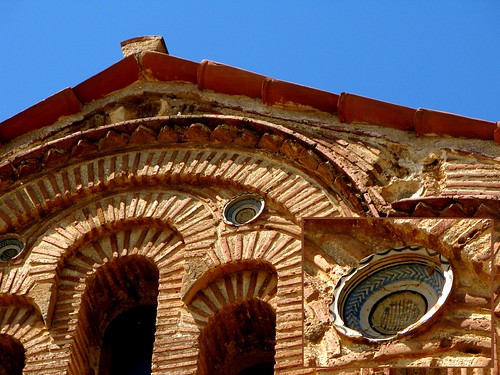
Immured ceramics, south wall, Byzantine church in Aghia Triada, Argolid, April 2011


The bowls in this images are called Grid Iron Protomaiolica bowls. Similar bowls are immured in the walls of the Dormition at Gastouni which has been recently dated to the last quarter of the 13th Century. The bowls are the product of a Western (Italian) workshop. Other immured ceramics have an eastern provenance, such as the Zeuxippus ware from Constantinople. The choice of ceramics from both edges of the Greek world, east and west is used by Sanders to support his position.
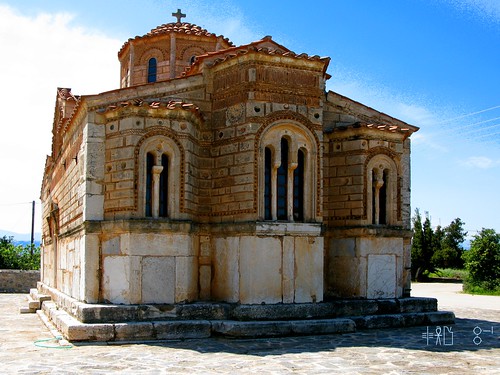
View form the East, Byzantine church in Aghia Triada, Argolid, April 2011

This view from the apses gives an opportunity to see a number of features of the church. From the ground up, we have the three steps reminiscent of an ancient stylobate. Christianity standing on ancient foundations, or triumphing over the old religion? The lower courses actually use building blocks taken from the Argive Heraion a few kilometers distant, while the blocks in the higher courses were brought from Corinth, presumably quarried fresh from local stone.
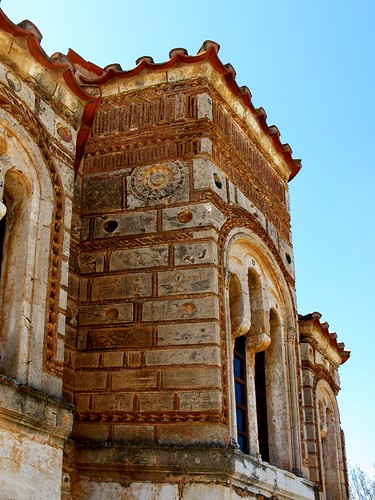
Apses of the Byzantine church in Aghia Triada, Argolid, April 2011

The higher courses are in cloisonné style with decorative brick-work at the top made to look like a Greek key (meander).

Central apse of the Byzantine church in Aghia Triada, Argolid, April 2011

The central apse, with its Gothic engaged columns in the trilobed sanctuary window, and more Greek key decorative brickwork. A meander is also visible running horizontally in the marble under the windows.

So, going back to the spolia... apart from the otherwise non-descript blocks from the Argive Heraion (which I still have yet to visit), there are two blocks of spolia with figured representations still on the church (a third is in Copenhagen, for some reason), in addition to a classical sundial reincorporated into the wall of the church and two blocks bearing inscriptions.

Immured spolia and gothic capitals on the drum of the Byzantine church in Aghia Triada, Argolid, April 2011

The sundial is on the south wall towards the SW corner.
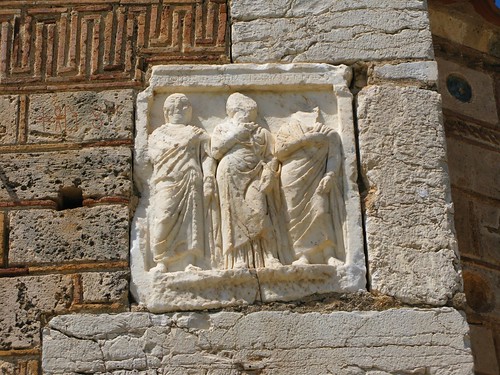
Immured spolia on the Byzantine church in Aghia Triada, Argolid, April 2011

One of the two, figured spolia. The low relief sculpture is a classical grave marker with three figures on it. There is an inscription which reads something along the lines of "[Ε]ΥΠΟΡΟΣ ΕΥΠΡΑΞΙΣ [Ζ]ΗΑΝΤΕΡΩ[Σ]" which is probably three proper names. The Inscriptiones Graecae online gives the text as: Εὔπορος Ἀντέρωτος. Εὔπραξις ζῇ. Ἀντέρως and if I had not looked it up in the concordance, I would not have noticed the lower line of text underneath the text Εὔπορος. Have I mentioned how much I love the internet? The inscription is known as IG IV 539. Given the probably correct reading in the IG catalogue, it is probably a marker for Euporos (on the left) who was the son of Anteros on the right and is survived by his mother Eupraxis (centre).

It is said that the village ultimately gets its modern name from this grave marker, by way of the village church, which was dedicated to the holy trinity because of this very prominent spolion on the corner of the village's cemetery church.
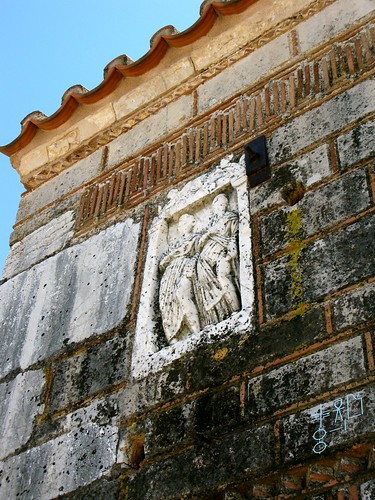
Immured sculpted spolion in the north wall of the Immured spolia on the Byzantine church in Aghia Triada, Argolid, April 2011

The second stele on the north wall of the church, shows two more classical figures, with no discernable inscription. The placing of the two grave stelai and the subject matter are used to argue for the involvement of a Latin churchman in the foundation and building of the church at a time when the argument over the filioque was ongoing. The north stele shows two figures (argued to represent the father and the son from whom the unseen spirit is presumably processing in a western way) and the south stele shows the holy trinity in all its orthodox oriental glory. I don't buy into this in a wholehearted way, although as circumstantial evidence, I feel it ought to be mentioned.

Next up, the two spolia with inscriptions, one placed near the north door, the other near the east door. The one near the east door I did not know about and as a result, I have not got a photograph of it (and it is not immediately obvious when looking for it, else I would have noticed).
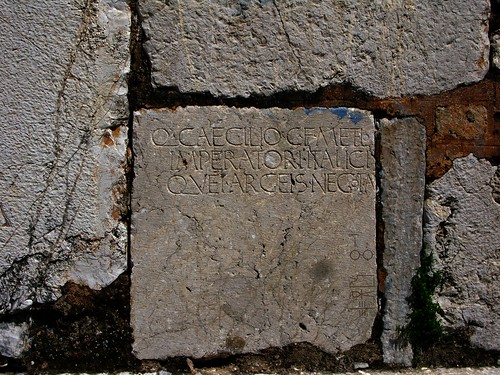
Immured inscribed spolion in the North wall of the Immured spolia on the Byzantine church in Aghia Triada, Argolid, April 2011

This is the first inscription, reading: Q(UINTO) CAECILIO C(AII) F(ILIO) METELO | IMPERATORI ITALICI | QVEI ARGEIS NEGOTIA(NTUR). Now the Metelus in question was the chappy who conquered Crete for Rome, thereby clearing the Aegean and this part of the Mediterranean of piracy. To me the echoes with the council of Lyons which amongst other things (such as the union of the churches) sought to suppress piracy are a little faint, but it has been argued that the founder of the church was aware of the historical Metellus and wished to make such a link. In any case, it is strange that a text in latin script which would not have been understood at all by the local population was immured with the inscription visible.

The final spolion bears a Greek dedicatory inscription and is immured close to the east door. As I have already mentioned, I have not seen it.
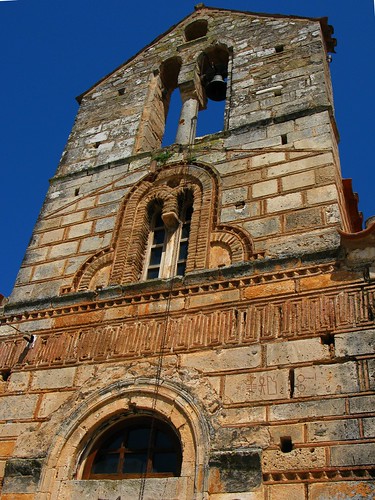
Elaborate decorative brickwork and bell tower at the Byzantine church in Aghia Triada, Argolid, April 2011

The bell tower above the east door, where the spolion bearing a Greek inscription is to be found.

Gothic capital on drum of the Byzantine church in Aghia Triada, Argolid, April 2011

The dome colonettes, showing gothic architectural influences. The crocket capitals are a decorative element common in Gothic architecture. This element is also used as an ornament on furniture and metalwork in the Gothic style. The name derives from the diminutive of the French croc, meaning "hook", due to the resemblance of crockets to a bishop's crosier.
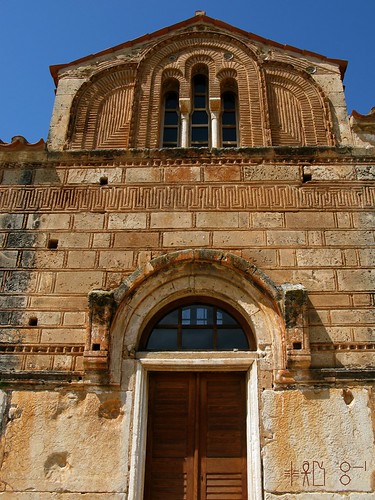
South door of the Byzantine church in Aghia Triada, Argolid, April 2011

And final photo – the south door, which is built in the Byzantine rather than the western style (all other doors on the building are built in the western style). In Byzantine architecture, the jambs are separate from the matrix of the walls, as they are here. In western doors, the jambs bond with the walls.

Next time I have to go back, with all this in mind, to take photographs which illustrate the points in question better. As it is, the information on the church I got from the internet fit reasonably nicely with the photos I took, but not perfectly. Next time, it would be nice to get inside too to see the frescoes of St. Leo of Catania and to see how truly western some of the non-figured frescoes are.