Showing posts with label peloponnesian road trip 2011. Show all posts

Saturday, January 05, 2013

Athena Alea at Tegea, in Arcadia, September 2011

The final stop on the September 2011 Peloponnesian Road Trip was at the Temple of Athena Alea at Tegea, in Arcadia.
Temple of Alean Athena, Tegea (Arcadia), September 2011
The remains of Skopas' doric temple to Athena Alea
Much of the temple has been incorporated into the village church and other buildings and there is nothing that would have been visible above ground were it not for the excavation. What is visible is actually the Hellenistic era Doric-order temple undertaken by Skopas (of “Dancing Maenad” fame) after the classical temple had burned down.

For the rest of the road trip, click:

2011 peloponnesian road trip
2011 Peloponnesian road trip

Pellana, LH Chamber Tomb cemetery, September 2011

Off the road to Arcadia, north of Sparta lies the village of Pellana. A dot on today’s map, but for the excavations which have brought to light heavy bronze-age occupation and a rather fine set of chamber tombs built into a hill. These chamber tombs somewhere at some time by someone were called Tholos Tombs and most of the references to the cemetery on the internet refer to Tholos Tombs of Pellana, (so that must be right, yeah?)

Unfortunately, no.

The Tholos Tomb form, θολωτός τάφος, is a very specific funerary structure with a built chamber.

Entrance signpost to the Pellana Mycenaean Chamber tomb cemetery
Entrance signpost
Just because the shape of the burial chamber mimics the Tholos form, it does not make the tombs in this cemetery Tholos Tombs, regardless of what the excavators and local ephorate would have you believe or what the expatriate community in the states would have you believe. This link directs to one such expatriate site which is scarily wrong in almost everything it presents as fact – perhaps interesting for those modern day analysts of urban folklore (or even the texts of Pausanias and Herodotus), in that it tells the story the writer has believed and which readers will find plausible in the absence of conflicting, more authoritative information but which is based on second and third hand “facts” from local people who are more concerned with impressing the visitor with their superlatives than proving factual information.

So, setting aside all the crazy where was ancient Lakedaimon and this was Menelaos’ palace stuff, let’s get on to discuss the cemetery itself.

As you can see from the image above, the cemetery is signposted and fenced in standard fashion, with the cheeky hole (πονηρή τρυπούλα) to the right of the main entrance (if I am not mistaken). Following the ridge to the right takes the visitor above the main tombs, the largest one of which has been covered with a rather funny octagonal pagoda structure.

Octagonal pagoda, over the Large, so called Royal Tomb, at the Pellana LH chamber tomb cemetery
The tombs were excavated in the period from 1926 to the late eighties. All had been plundered in antiquity and many had fallen in subsequent to this. The standard practice, as shown in the image below, seems to have been the interment in unlined pits in the floor of the chamber.

Chamber tomb of thr Pellana LH cemetery, from above, showing burial pits
One of the tombs, from above, showing burial pits
The large grave, image below also had pits in the chamber floor. It has a diameter of about 10m, making it one of the largest known LH chamber tombs.

The large Pellana Chamber Tomb, September 2011
The large, so called Royal Tomb, at Pellana 
I rather like the way the bedrock from which the tomb was excavated shows the geological bedding in this photo:
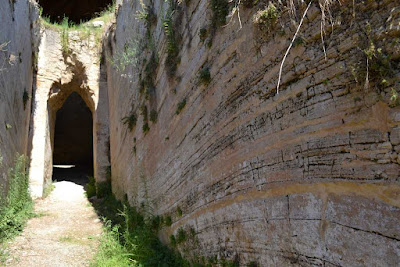
Bedrock stripes, Pellana, Mycenaean chamber tomb
Bedrock stripes on the dromos of the large Chamber Tomb
We did not follow-through with a visit to the Palace, mainly due to time constraints. Ariadne was sleeping and we decided to press on to Alea... It should be noted that at the time of our visit, no doubt because of the preparations for the new Tripolis/Sparta road the road system in the area was very difficult to navigate with roads stopping without warning and much doubling back on ourselves.

For the rest of the road trip, click:

2011 peloponnesian road trip
2011 Peloponnesian road trip

Thursday, January 03, 2013

Amyclae, from the fence, September 2011

A little further on from Vapheio is the sanctuary of Amyclae. On the same trip, we visited the site and drove round the fencing which is in a much better condition, no doubt because of the small church in the site itself.

Just another day in Amyclae, September 2011
Amyclae, on Flickr
The tiny church was built with and on top of the ruins of the temple of Apollo at Amyclae, which was built on and quite possibly with the ruins of the tumulus of Hyakinthos, a pre-Greek deity (yeah, whatever, tell it to the hand) celebrated on-site before the city was subjugated by Sparta, only a few Km away. The old cult of Hyakinthos was swallowed into the cult of Apollo (now Apollo-Hyakinthos).

For the rest of the road trip, click:

2011 peloponnesian road trip
2011 Peloponnesian road trip

Wednesday, January 02, 2013

Vapheio Tholos Tomb, September 2011


The tholos tomb at Vapheio in Laconia was famously excavated in 1889 by Christos Tsountas, pioneer Greek archaeologist of prehistory. The tomb is huge, only slightly smaller than the so-called Treasuries of Atreus and Minyas. Even at the time of excavation, it was in far worse shape than most tombs of this type, but still gave up two glorious gold cups with beautiful carved scenes depicting bulls in relief. Cups of this shape are now called Vapheio Cups. 

I first visited the tomb in the mid-nineties although I don’t think I walked down to the entrance then. We visited again on the way back from Mani in September 2011 and while Corinna fed Nausika, I took Ariadne to her first Tholos Tomb...

Vapheio Tholos Tomb
The tomb, from above and the south
The site is in pretty rough shape, despite a nicely paved walkway going most of the distance from the road to the tomb. The fence is in the standard Greek archaeological site fencing condition – or perhaps slightly worse, with the “cheeky little hole” (by which I mean to render «πονηρή τρυπούλα») being large and just next to the padlocked fence.

Shambolic fencing
Shambolic fencing that even a two year old can circumvent...

The fence closes off the tomb at the end of the dromos, which is more than 30m long, leading up towards the stomion.

Dromos of the Vapheio Tholos, September 2011
Dromos
The stomion is in a pretty bad shape as well – it is thought that the blocks from the tomb have been incorporated into structures in the nearby sanctuary of Apollo Hyakinthos at Kleonae, so it is no surprise that very little remains above the third or fourth course.

Stomion of the vapheio tholos tomb
Stomion in bad shape...
The wooden planks put up, I don’t know when, are not surviving too well and it all looks like the tomb is going to have to fight to make it to the 125th anniversary of the excavation in any shape worth writing home about.


For the rest of the road trip, click:

2011 peloponnesian road trip
2011 Peloponnesian road trip

Tuesday, August 14, 2012

Tripolis Archaeological Museum, September 2011

The archaeological museum of Tripolis is housed in a wonderful neo-classical building with a wonderfully damp and drippy basement, which is a pity as the wall-mounted exhibits have suffered as a result.

Probably in an effort to avoid photographs of exploding drippy basement wall plaster, or else because some researcher has not been properly arsed to publish his or her material, photography in the museum is banned and as a result the guards, two older ladies not so well informed about what they are watching over but certainly well enough informed of the ban will follow and hound any prospective photographer ensuring that this ban of dubious legality is not circumvented. I mention dubious legality as according to law it should be possible to photograph the exhibits free of charge for personal use in the museums of Greece. See my posts on Naxos and the New Acropolis Museum...

Anyway – so there we were in September last year on a great Peloponnesian north/south roadtrip with an overnight in Tripolis. The museum was just across the street from the hotel, and I took Ariadne and went.

Tripolis Archaeological Museum gardens, September 2011
Ariadne enjoys the garden of the Tripolis museum…

Once you get over the bad state of the museum itself and the museological side of things, there are a few gems housed within. On the left on the ground floor, the finds from the LHIIIC Palaiochora chamber cemetery, pretty much exclusively ceramic but certainly worth a visit. In the basement, the sculptures from the villa of Heroides Atticus are also very much worth a visit, despite whatever feelings one may have about Roman-era 'art'. Most of the rest of the museum actually reinforces whatever feelings you may have of Roman-era 'art'. Well, it did for me…

For the rest of the road trip, click:

2011 peloponnesian road trip
2011 Peloponnesian road trip